Gabbia Daniela, De Martin Sara
Department of Pharmaceutical and Pharmacological Sciences, University of Padova, 351131 Padova, Italy.
Biology (Basel). 2023 Nov 27;12(12):1471. doi: 10.3390/biology12121471.
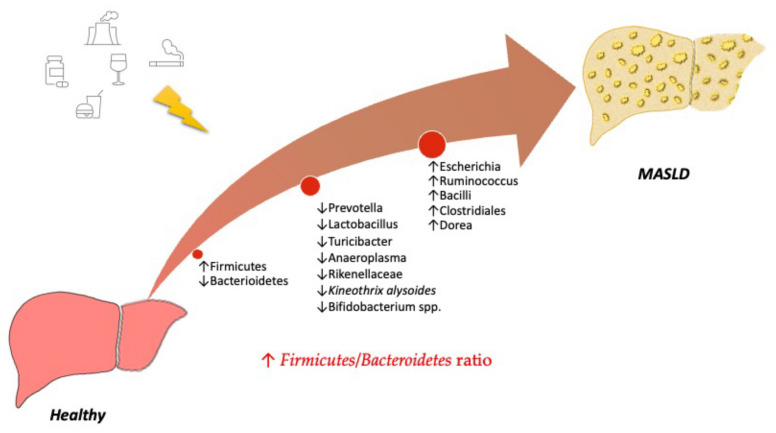
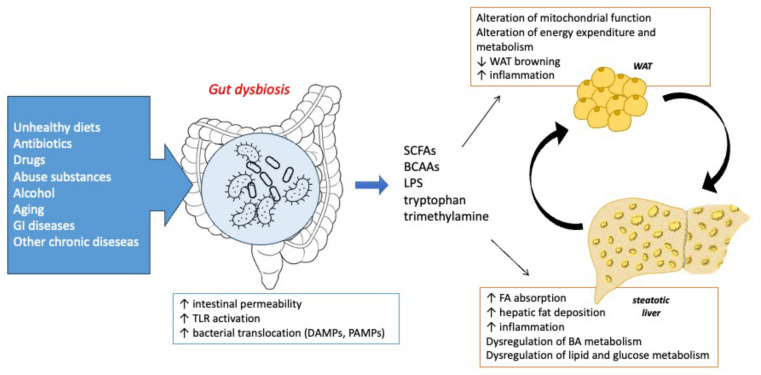
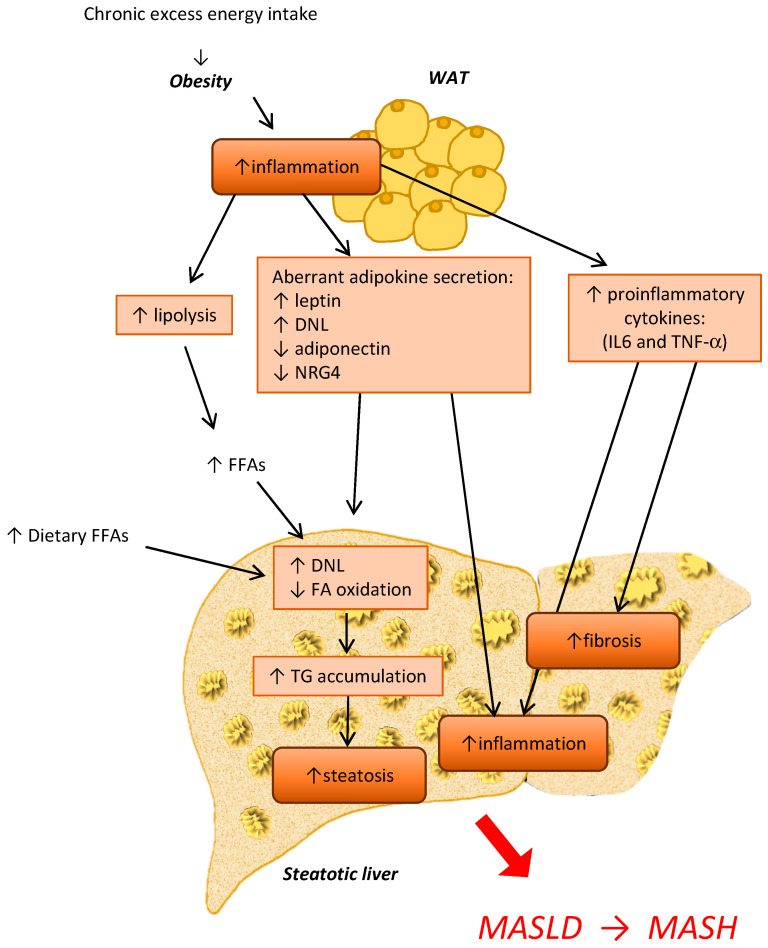
The gut microbiota is a complex system, playing a peculiar role in regulating innate and systemic immunity. Increasing evidence links dysfunctional gut microbiota to metabolic dysfunction-associated steatotic liver disease (MASLD) due to the activation of multiple pathways in the gut and in the liver, including those mediated by Toll-like receptors (TLRs), that sustain hepatic inflammation. Thus, many efforts have been made to unravel the role of microbiota-associated dysfunction in MASLD, with the final aim of finding novel strategies to improve liver steatosis and function. Moreover, recent evidence underlines the role of adipose tissue in sustaining hepatic inflammation during MASLD development. In this review, we focus on the recently discovered strategies proposed to improve the alteration of gut microbiota observed in MASLD patients, with a particular insight into those known to modulate gut microbiota-associated dysfunction and to affect the complex crosstalk between the gut, the adipose tissue, and the liver.
肠道微生物群是一个复杂的系统,在调节先天性免疫和全身免疫方面发挥着独特作用。越来越多的证据表明,功能失调的肠道微生物群与代谢功能障碍相关脂肪性肝病(MASLD)有关,这是由于肠道和肝脏中多种途径的激活,包括由Toll样受体(TLR)介导的那些途径,这些途径会持续引发肝脏炎症。因此,人们已经做出了许多努力来阐明微生物群相关功能障碍在MASLD中的作用,最终目的是找到改善肝脏脂肪变性和功能的新策略。此外,最近的证据强调了脂肪组织在MASLD发展过程中维持肝脏炎症方面的作用。在这篇综述中,我们重点关注最近提出的旨在改善MASLD患者中观察到的肠道微生物群改变的策略,特别深入探讨那些已知可调节肠道微生物群相关功能障碍并影响肠道、脂肪组织和肝脏之间复杂相互作用的策略。