Group of Skeletal, Mineral, and Gonadal Endocrinology, Department of Growth and Reproduction, Rigshospitalet, University of Copenhagen, Copenhagen, Denmark.
Division of Translational Endocrinology, Department of Endocrinology and Internal Medicine, Copenhagen University Hospital - Herlev and Gentofte, Copenhagen, Denmark.
Respir Res. 2024 Jan 4;25(1):11. doi: 10.1186/s12931-023-02642-9.
Vitamin D has been suggested to influence the immune system, and vitamin D metabolites and the vitamin D receptor (VDR) are generated and expressed in white blood cells (WBC). Moreover, vitamin D status has been associated with incidence and prognosis of some respiratory tract infections (RTI). Therefore, we investigated the effect of vitamin D supplementation on WBC, acute phase reactants (APR), and the risk of developing RTIs.
A double-blinded, randomized, placebo-controlled clinical trial of 307 infertile men with multiple secondary immunological endpoints. The vitamin D group (n = 151) initially received 300,000 IU (7,500 µg) cholecalciferol once - followed by 1,400 IU (35 µg) daily for 150 days. The placebo group (n = 156) did not receive active ingredients.
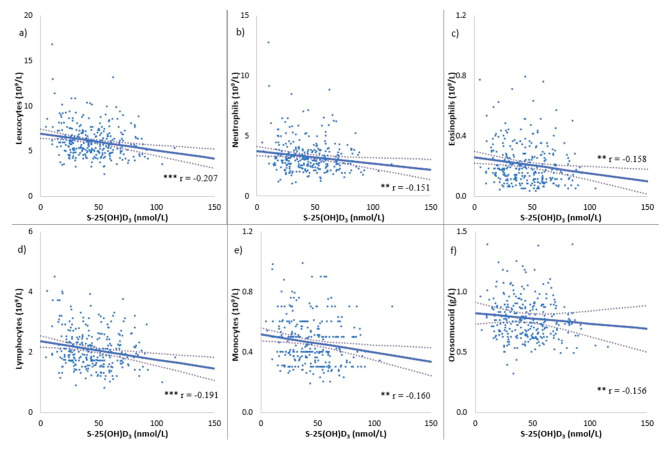
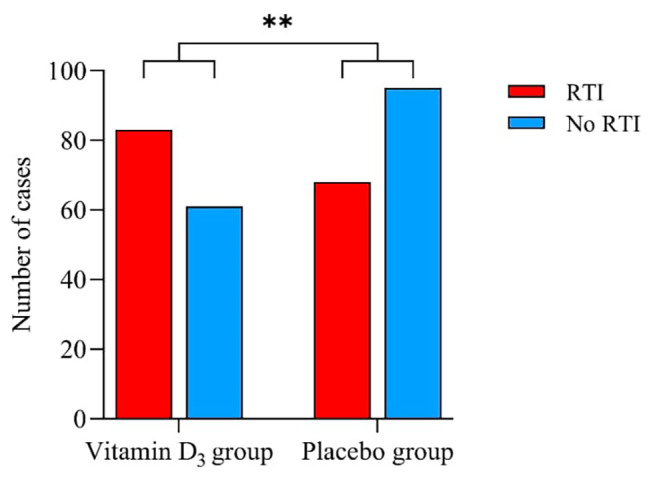
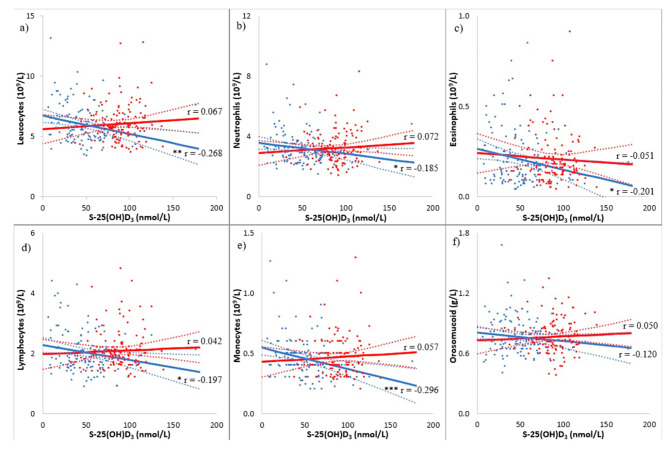
At baseline, stratification into clinically relevant groups of vitamin D status (< 25; 25-50; 50-75; >75 nmol/L), showed an inverse association with total leucocyte concentrations (7.0 vs. 6.0 vs. 6.0 vs. 5.5 (10/L); p = 0.007), lymphocytes (2.4 vs. 2.1 vs. 2.0 vs. 2.0 (10/L); p = 0.048), CRP (2.0 vs. 1.7 vs. 1.2 vs. 1.2 (mg/L); p = 0.037), and orosomucoid (0.82 vs. 0.77 vs. 0.76 vs. 0.70 (g/L); p = 0.015). After 150 days, no differences were detected in WBC counts or APRs between the vitamin D and the placebo group. However, vitamin D treated men had a higher prevalence of self-reported RTIs compared with the placebo group (55% vs. 39%; p = 0.005).
High-dose vitamin D supplementation did not alter WBCs or APRs, but a higher prevalence of respiratory infections was observed in the vitamin D group. Serum 25(OH)D was negatively correlated with most WBCs, indicating that vitamin D status may be linked with inflammation and WBC turnover, but not an important determinant of developing RTIs.
NCT01304927 (ClinicalTrials.gov). Registered February 20, 2011.
维生素 D 被认为会影响免疫系统,维生素 D 代谢物和维生素 D 受体 (VDR) 存在于白细胞 (WBC) 中并表达。此外,维生素 D 状况与一些呼吸道感染 (RTI) 的发病率和预后有关。因此,我们研究了维生素 D 补充对 WBC、急性时相反应物 (APR) 和发生 RTI 的风险的影响。
一项针对 307 名患有多种免疫终点异常的不育男性的双盲、随机、安慰剂对照临床试验。维生素 D 组(n=151)最初接受 300,000 IU(7,500μg)胆钙化醇一次 - 随后 150 天内每天服用 1,400 IU(35μg)。安慰剂组(n=156)未接受活性成分。
在基线时,根据维生素 D 状态(<25;25-50;50-75;>75 nmol/L)将患者分层到临床相关组中,结果显示总白细胞浓度呈负相关(7.0 与 6.0 与 6.0 与 5.5(10/L);p=0.007),淋巴细胞(2.4 与 2.1 与 2.0 与 2.0(10/L);p=0.048),C 反应蛋白(2.0 与 1.7 与 1.2 与 1.2(mg/L);p=0.037)和粘蛋白(0.82 与 0.77 与 0.76 与 0.70(g/L);p=0.015)。150 天后,维生素 D 组和安慰剂组的 WBC 计数或 APR 无差异。然而,与安慰剂组相比,维生素 D 治疗组的自我报告 RTI 发生率更高(55% 与 39%;p=0.005)。
高剂量维生素 D 补充并未改变 WBC 或 APR,但维生素 D 组观察到呼吸道感染的发生率更高。血清 25(OH)D 与大多数 WBC 呈负相关,这表明维生素 D 状态可能与炎症和 WBC 周转率有关,但不是发生 RTI 的重要决定因素。
NCT01304927(ClinicalTrials.gov)。2011 年 2 月 20 日注册。