Key Laboratory of Clinical Laboratory Medicine of Guangxi Department of Education, Department of Clinical Laboratory, The First Affiliated Hospital of Guangxi Medical University, Nanning, Guangxi, China.
Sci Rep. 2024 Jan 7;14(1):746. doi: 10.1038/s41598-024-51459-z.
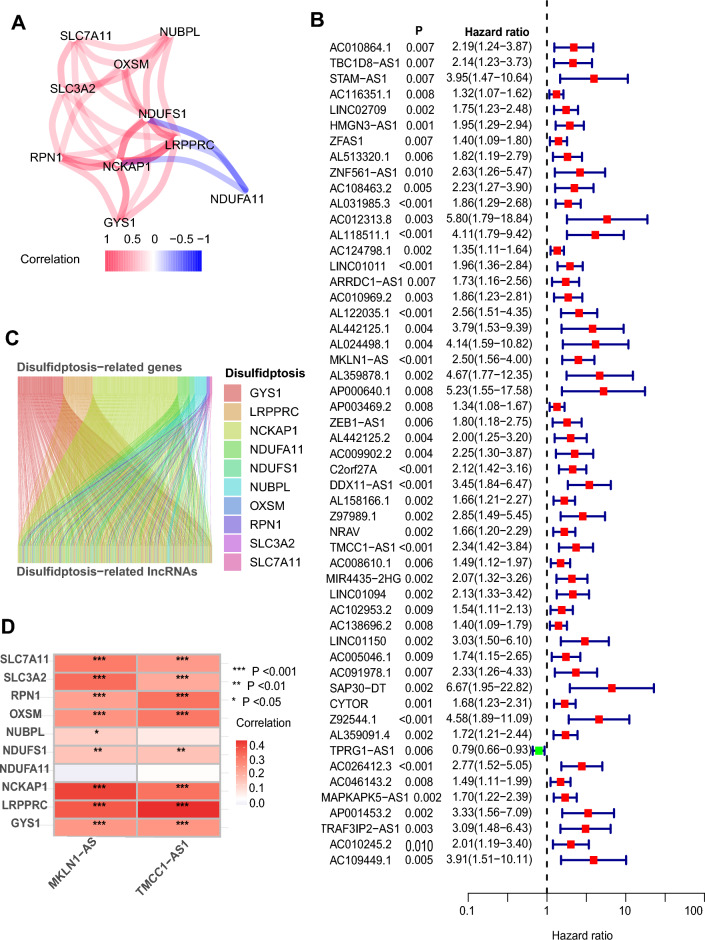
Disulfidptosis, a novel type of programmed cell death, has attracted researchers' attention worldwide. However, the role of disulfidptosis-related lncRNAs (DRLs) in liver hepatocellular carcinoma (LIHC) not yet been studied. We aimed to establish and validate a prognostic signature of DRLs and analyze tumor microenvironment (TME) and drug susceptibility in LIHC patients. RNA sequencing data, mutation data, and clinical data were obtained from the Cancer Genome Atlas Database (TCGA). Lasso algorithm and cox regression analysis were performed to identify a prognostic DRLs signature. Kaplan-Meier curves, principal component analysis (PCA), nomogram and calibration curve, function enrichment, TME, immune dysfunction and exclusion (TIDE), tumor mutation burden (TMB), and drug sensitivity analyses were analyzed. External datasets were used to validate the predictive value of DRLs. qRT-PCR was also used to validate the differential expression of the target lncRNAs in tissue samples and cell lines. We established a prognostic signature for the DRLs (MKLN1-AS and TMCC1-AS1) in LIHC. The signature could divide the LIHC patients into low- and high-risk groups, with the high-risk subgroup associated with a worse prognosis. We observed discrepancies in tumor-infiltrating immune cells, immune function, function enrichment, and TIDE between two risk groups. LIHC patients in the high-risk group were more sensitive to several chemotherapeutic drugs. External datasets, clinical tissue, and cell lines confirmed the expression of MKLN1-AS and TMCC1-AS1 were upregulated in LIHC and associated with a worse prognosis. The novel signature based on the two DRLs provide new insight into LIHC prognostic prediction, TME, and potential therapeutic strategies.
二硫键程序性细胞死亡(Disulfidptosis)是一种新型的程序性细胞死亡方式,已引起全球研究人员的关注。然而,二硫键程序性细胞死亡相关长链非编码 RNA(DRLs)在肝肝细胞癌(LIHC)中的作用尚未得到研究。我们旨在建立和验证 DRLs 的预后特征,并分析 LIHC 患者的肿瘤微环境(TME)和药物敏感性。从癌症基因组图谱数据库(TCGA)中获取 RNA 测序数据、突变数据和临床数据。使用 Lasso 算法和 Cox 回归分析来识别预后 DRLs 特征。通过 Kaplan-Meier 曲线、主成分分析(PCA)、列线图和校准曲线、功能富集、TME、免疫功能障碍和排除(TIDE)、肿瘤突变负荷(TMB)和药物敏感性分析进行分析。使用外部数据集验证 DRLs 的预测价值。qRT-PCR 还用于验证组织样本和细胞系中目标 lncRNAs 的差异表达。我们建立了 LIHC 中 DRLs(MKLN1-AS 和 TMCC1-AS1)的预后特征。该特征可以将 LIHC 患者分为低风险和高风险组,高风险组与预后较差相关。我们观察到两个风险组之间肿瘤浸润免疫细胞、免疫功能、功能富集和 TIDE 存在差异。高风险组的 LIHC 患者对几种化疗药物更敏感。外部数据集、临床组织和细胞系证实,MKLN1-AS 和 TMCC1-AS1 在 LIHC 中表达上调,并与预后较差相关。基于这两个 DRLs 的新型特征为 LIHC 预后预测、TME 和潜在治疗策略提供了新的见解。