Xu Jiyuan, Zhang Ying, Hu Changbao, Yu Bo, Wan Cuixiang, Chen Bin, Lu Lirong, Yuan Liren, Wu Zhihua, Chen Hongbing
State Key Laboratory of Food Science and Resources, Nanchang University, Nanchang 330047, PR China.
College of Food Science and Technology, Nanchang University, Nanchang 330031, PR China.
Food Chem X. 2023 Dec 11;21:101047. doi: 10.1016/j.fochx.2023.101047. eCollection 2024 Mar 30.
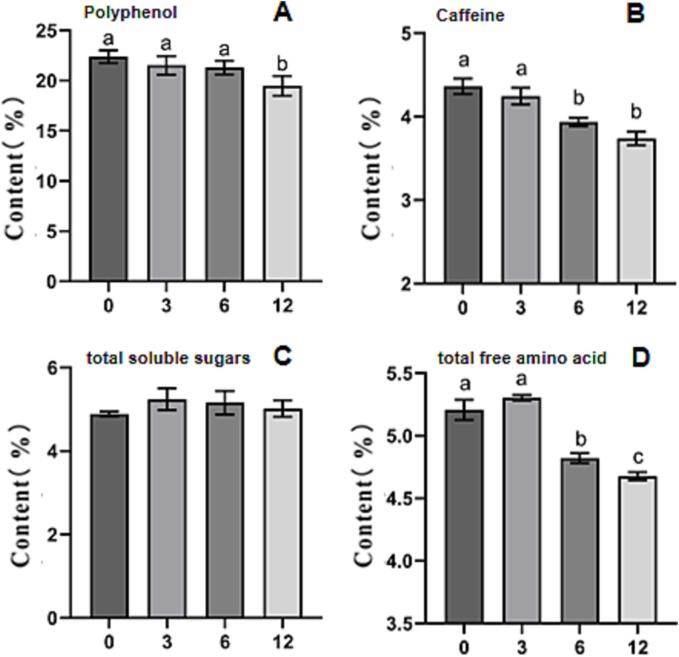
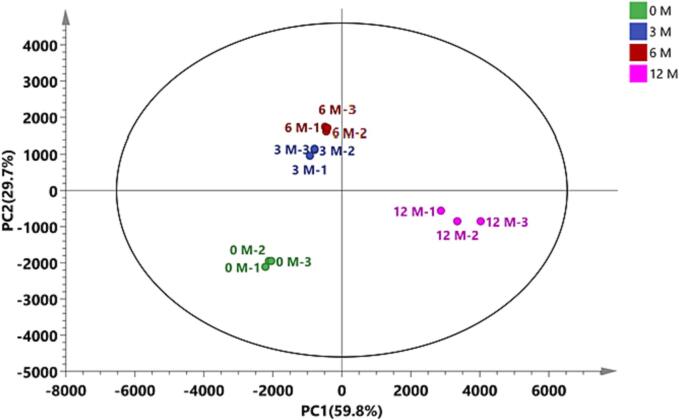
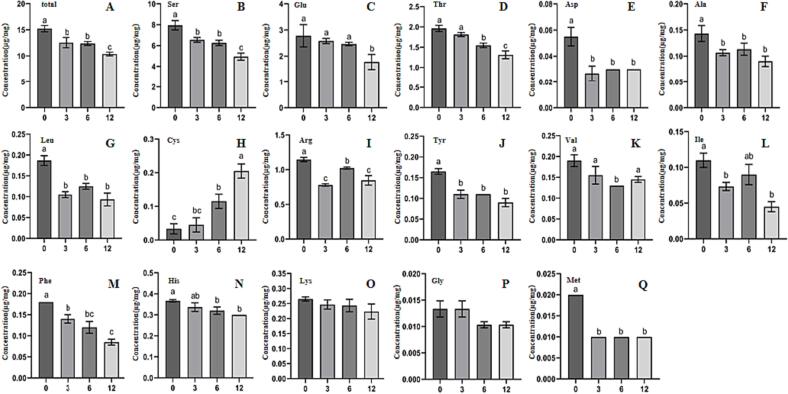
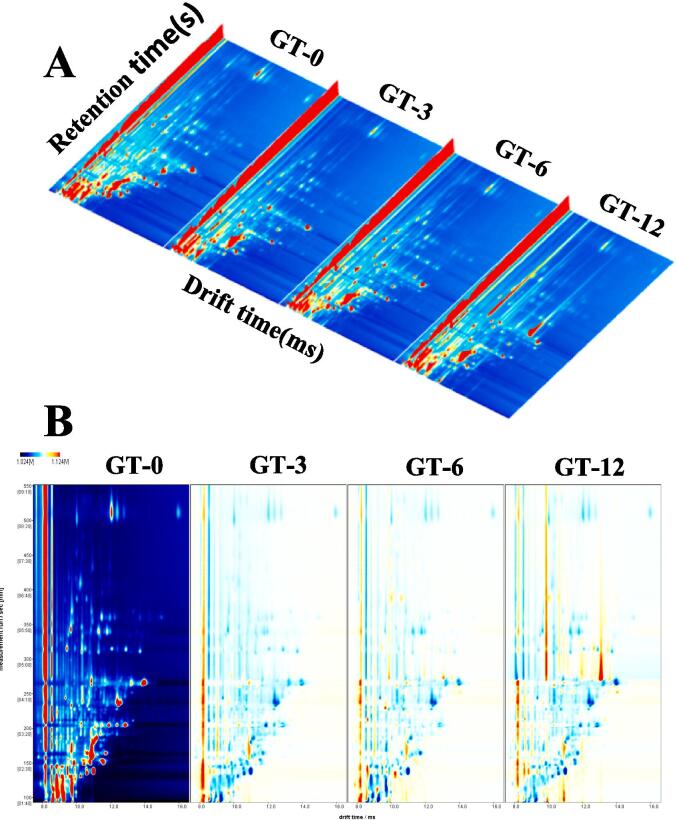
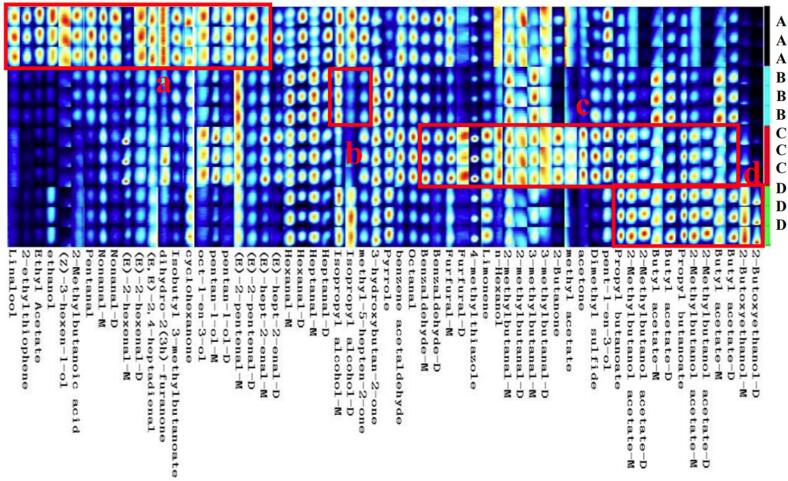
To study the effect of storage (for 0, 3, 6, and 12 months) on the flavor of green tea (GT), we monitored the volatile organic compounds (VOCs) in GT through gas chromatography (GC) combined with ion mobility spectrometry and headspace solid-phase micro extraction, GC-MS (mass spectrometry). Then, relative odor activity value (ROAV) was applied to analyze the aroma contribution of the VOCs. During storage, the polyphenol and caffeine contents gradually decreased from 22.38 % to 18.51 % and from 4.37 % to 3.74 %, respectively, and the total soluble sugar first increased and then decreased (from 4.89 % to 7.16 % and then 5.02 %). Although the total free amino acid contents showed a fluctuating trend, the content of cysteamine increased gradually. The contents of VOCs with positive contribution to GT aroma, including linalool, geraniol, nonanal, and 6-methyl-5-hepten-2-one, decreased. They also contributed less in the ROAV after storage. The ROAVs of nonanal, linalool, and geraniol decreased from 3.37 to 0.79, from 100 to 38.21, and from 2.98 to 1.8, respectively, after 12 months of storage. Principal component analysis can be used to identify the samples with different storage durations based on these data. Given the increase in amount of cysteamine and decrease in that of linalool oxide, oxidation may be not the only factor responsible for tea quality in storage.
为研究储存(0、3、6和12个月)对绿茶风味的影响,我们通过气相色谱(GC)结合离子迁移谱和顶空固相微萃取、GC - 质谱(MS)监测了绿茶中的挥发性有机化合物(VOCs)。然后,应用相对气味活性值(ROAV)分析VOCs的香气贡献。在储存过程中,多酚和咖啡因含量分别从22.38%逐渐降至18.51%和从4.37%降至3.74%,总可溶性糖先增加后减少(从4.89%增至7.16%,然后降至5.02%)。尽管总游离氨基酸含量呈波动趋势,但半胱胺含量逐渐增加。对绿茶香气有积极贡献的VOCs含量,包括芳樟醇、香叶醇、壬醛和6 - 甲基 - 5 - 庚烯 - 2 - 酮,均有所下降。储存后它们在ROAV中的贡献也减少。储存12个月后,壬醛、芳樟醇和香叶醇的ROAV分别从3.37降至0.79、从100降至38.21和从2.98降至1.8。基于这些数据,主成分分析可用于识别不同储存时长的样品。鉴于半胱胺含量增加而氧化芳樟醇含量减少,氧化可能不是储存过程中影响茶叶品质的唯一因素。