Weber Matheus Nunes, da Silva Mariana Soares
Laboratório de Microbiologia Molecular, Universidade FEEVALE, Novo Hamburgo 93525-075, RS, Brazil.
Animals (Basel). 2023 Dec 26;14(1):88. doi: 10.3390/ani14010088.
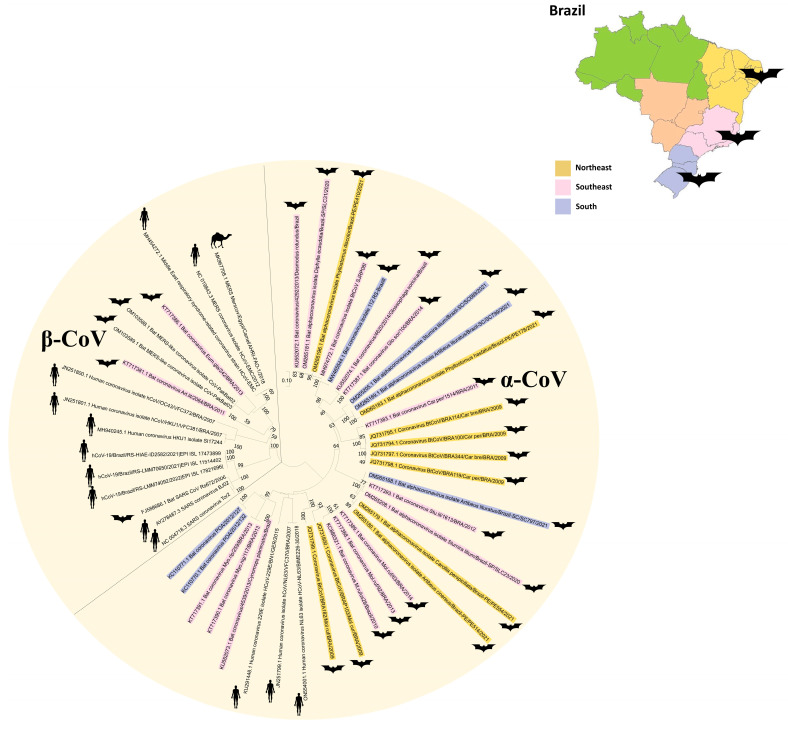
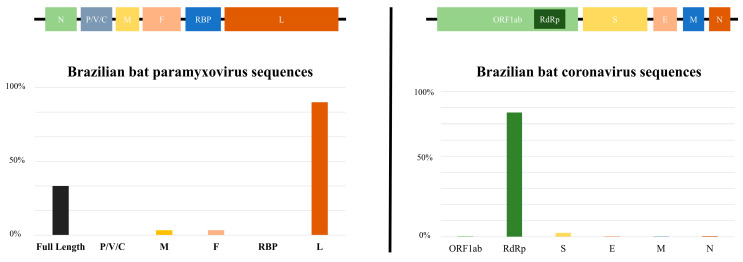
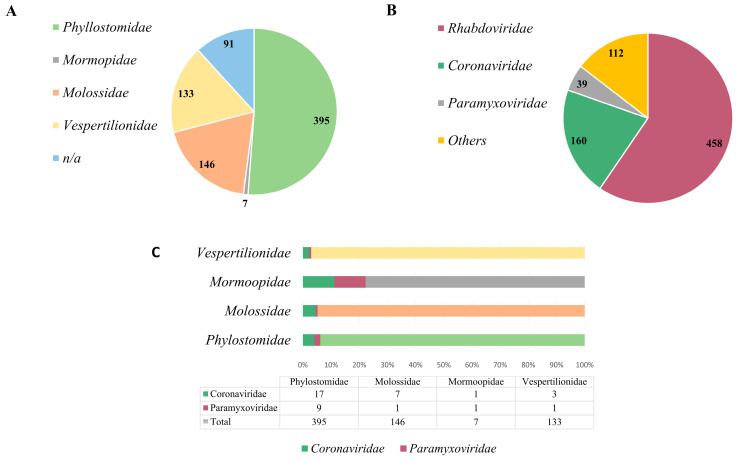
are one of the most diverse mammal orders. They are considered reservoirs of main human pathogens, where coronaviruses (CoVs) and paramyxoviruses (PMVs) may be highlighted. Moreover, the growing number of publications on CoVs and PMVs in wildlife reinforces the scientific community's interest in eco-vigilance, especially because of the emergence of important human pathogens such as the SARS-CoV-2 and Nipha viruses. Considering that Brazil presents continental dimensions, is biologically rich containing one of the most diverse continental biotas and presents a rich biodiversity of animals classified in the order , the mapping of CoV and PMV genetics related to human pathogens is important and the aim of the present work. CoVs can be classified into four genera: , , and . Delta- and gammacoronaviruses infect mainly birds, while alpha- and betacoronaviruses contain important animal and human pathogens. Almost 60% of alpha- and betacoronaviruses are related to bats, which are considered natural hosts of these viral genera members. The studies on CoV presence in bats from Brazil have mainly assayed phyllostomid, molossid and vespertilionid bats in the South, Southeast and North territories. Despite Brazil not hosting rhinophilid or pteropodid bats, which are natural reservoirs of SARS-related CoVs and henipaviruses, respectively, CoVs and PMVs reported in Brazilian bats are genetically closely related to some human pathogens. Most works performed with Brazilian bats reported alpha-CoVs that were closely related to other bat-CoVs, despite a few reports of beta-CoVs grouped in the and subgenera. The family Paramyxoviridae includes four subfamilies (, , and ), and bats are significant drivers of PMV cross-species viral transmission. Additionally, the studies that have evaluated PMV presence in Brazilian bats have mainly found sequences classified in the and genera that belong to the subfamily. Despite the increasing amount of research on Brazilian bats, studies analyzing these samples are still scarce. When surveying the representativeness of the CoVs and PMVs found and the available genomic sequences, it can be perceived that there may be gaps in the knowledge. The continuous monitoring of viral sequences that are closely related to human pathogens may be helpful in mapping and predicting future hotspots in the emergence of zoonotic agents.
是最多样化的哺乳动物目之一。它们被认为是主要人类病原体的宿主,其中冠状病毒(CoV)和副粘病毒(PMV)可能尤为突出。此外,关于野生动物中CoV和PMV的出版物数量不断增加,这增强了科学界对生态警惕的兴趣,特别是由于重要的人类病原体如SARS-CoV-2和尼帕病毒的出现。考虑到巴西幅员辽阔,生物资源丰富,拥有最多样化的大陆生物群之一,并且存在丰富的、分类在该目的动物生物多样性,绘制与人类病原体相关的CoV和PMV基因图谱非常重要,这也是本研究的目的。CoV可分为四个属:、、和。δ冠状病毒和γ冠状病毒主要感染鸟类,而α冠状病毒和β冠状病毒包含重要的动物和人类病原体。近60%的α冠状病毒和β冠状病毒与蝙蝠有关,蝙蝠被认为是这些病毒属成员的天然宿主。对巴西蝙蝠中CoV存在情况的研究主要在南部、东南部和北部地区检测了叶口蝠科、犬吻蝠科和蝙蝠科蝙蝠。尽管巴西没有菊头蝠或狐蝠,它们分别是与SARS相关的CoV和亨尼帕病毒的天然宿主,但在巴西蝙蝠中报告的CoV和PMV在基因上与一些人类病原体密切相关。大多数对巴西蝙蝠进行的研究报告了与其他蝙蝠CoV密切相关的α-CoV,尽管有一些关于β-CoV归类于和亚属的报告。副粘病毒科包括四个亚科(、、和),蝙蝠是PMV跨物种病毒传播的重要驱动因素。此外,评估巴西蝙蝠中PMV存在情况的研究主要发现了归类于属于亚科的和属的序列。尽管对巴西蝙蝠的研究数量不断增加,但分析这些样本的研究仍然很少。在调查所发现的CoV和PMV的代表性以及可用的基因组序列时,可以察觉到知识可能存在空白。持续监测与人类病原体密切相关的病毒序列可能有助于绘制和预测人畜共患病原体出现的未来热点。