Department of Physiological and Medical Sciences, Institute of Healthy Living, The Jerzy Kukuczka Academy of Physical Education, 72A Mikolowska Street, Katowice, Poland.
Department of Physiological and Medical Sciences, The Jerzy Kukuczka Academy of Physical Education, 72A Mikolowska Street, Katowice, Poland.
Sci Rep. 2024 Jan 11;14(1):1113. doi: 10.1038/s41598-024-51758-5.
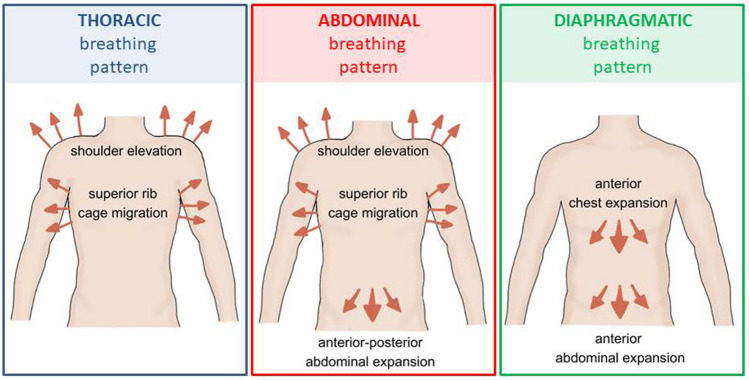
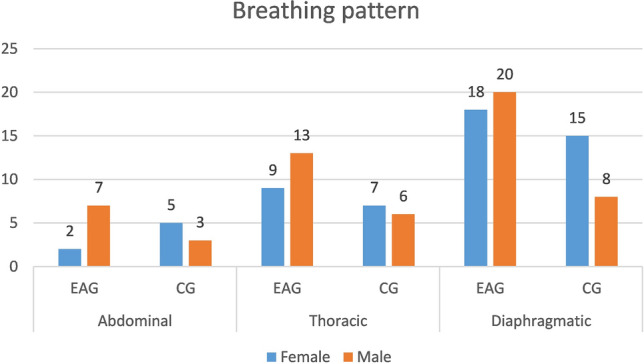
Proper functioning of the respiratory system is one of the most important determinants of human health. According to current knowledge, the diaphragmatic breathing pattern seems to be the most favourable. However, recent reports indicate that athletes often have dysfunctional breathing patterns, which may be associated with an increased risk of musculoskeletal injuries. The influence of the type of breathing pattern on the mechanical airways in athletes has not been investigated. The aim of the present study was to determine the characteristics and relationships between breathing patterns and respiratory function in athletes. This study included 69 Polish elite endurance athletes (♂40, ♀29) in different sports disciplines and 44 (♂17, ♀27) healthy nonathletes as a control group. All participants underwent pulmonary function tests (spirometry, plethysmography, diffusion capacity for carbon monoxide) with assessment of breathing patterns by the Hi-Lo test. Inspiratory and expiratory resistance (R) and reactance (X) of the respiratory system at a given frequency (5 Hz, 11 Hz, and 19 Hz) were measured by a noninvasive forced oscillation technique. In this study, almost half of the athletes (44.92%) had dysfunctional breathing patterns, although at a lower rate than that in the control group. Diaphragmatic breathing patterns were characterized by higher spirometric, plethysmographic and DLCO values compared to thoracic or abdominal breathing patterns. Similarly, lower inspiratory reactance at 5 Hz (X5%pred.) was observed in the diaphragmatic pattern compared to the thoracic pattern. A diaphragmatic breathing pattern is associated with better pulmonary function test results. However, this study revealed a dysfunctional breathing pattern in almost half of the athletes. These results suggest that the assessment of breathing patterns and the implementation of breathing exercises in athletes are essential to promote proper breathing patterns.
呼吸系统的正常功能是人类健康的最重要决定因素之一。根据目前的知识,膈肌呼吸模式似乎是最有利的。然而,最近的报告表明,运动员经常存在呼吸模式障碍,这可能与肌肉骨骼受伤的风险增加有关。呼吸模式类型对运动员机械气道的影响尚未得到研究。本研究的目的是确定呼吸模式与运动员呼吸功能之间的特征和关系。这项研究包括 69 名波兰精英耐力运动员(♂40,♀29)和 44 名(♂17,♀27)健康非运动员作为对照组。所有参与者都接受了肺功能测试(肺活量测定法、体积描记法、一氧化碳扩散能力),并通过 Hi-Lo 测试评估呼吸模式。使用非侵入性强迫振荡技术测量呼吸系统在给定频率(5 Hz、11 Hz 和 19 Hz)下的吸气和呼气阻力(R)和电抗(X)。在这项研究中,几乎一半的运动员(44.92%)存在呼吸模式障碍,尽管其发生率低于对照组。与胸式或腹式呼吸模式相比,膈肌呼吸模式的肺活量、体积描记法和 DLCO 值更高。同样,与胸式呼吸模式相比,膈肌呼吸模式在 5 Hz 时的吸气电抗(X5%pred.)较低。膈肌呼吸模式与更好的肺功能测试结果相关。然而,这项研究表明,近一半的运动员存在呼吸模式障碍。这些结果表明,评估呼吸模式和在运动员中实施呼吸练习对于促进正确的呼吸模式至关重要。