Xin Shangjing, Dai Jing, Gregory Carl A, Han Arum, Alge Daniel L
Department of Biomedical Engineering, Texas A&M University, College Station, TX, 77843 USA.
Department of Electrical and Computer Engineering, Texas A&M University, College Station, TX, 77843 USA.
Adv Funct Mater. 2020 Feb 5;30(6). doi: 10.1002/adfm.201907102. Epub 2019 Dec 4.
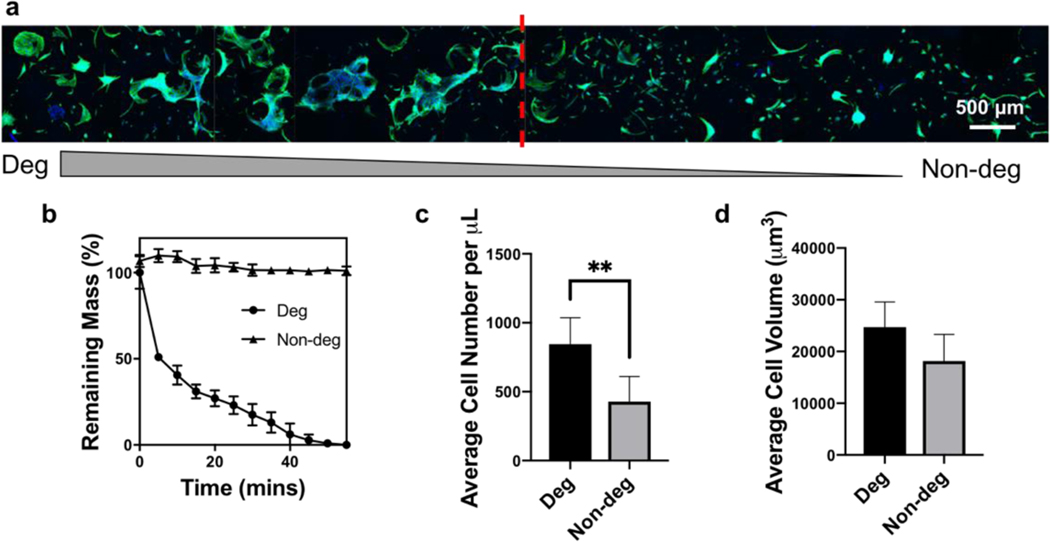
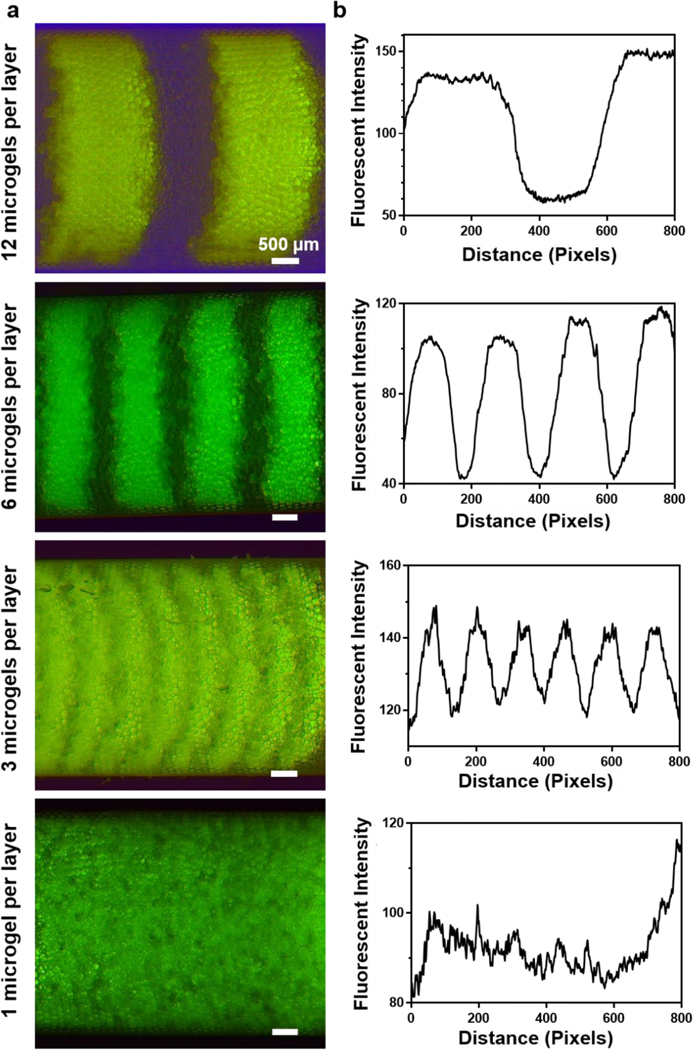
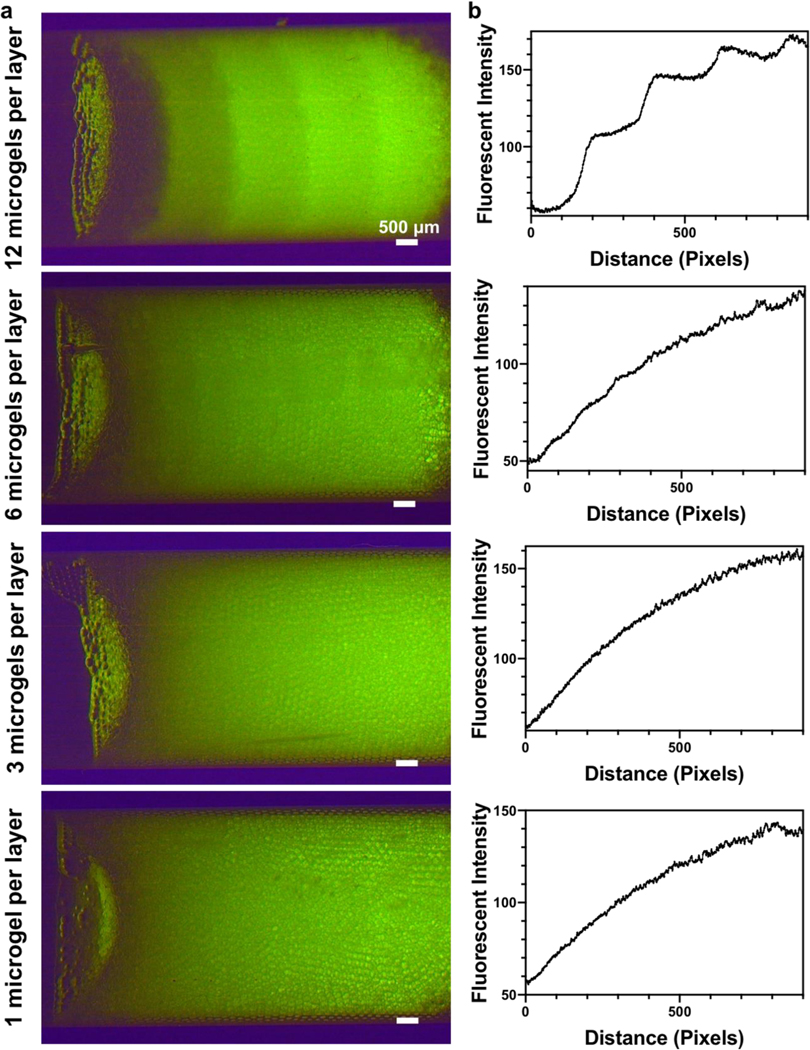
Microporous annealed particle (MAP) hydrogels are an attractive platform for engineering biomaterials with controlled heterogeneity. Here, we introduce a microfluidic method to create physicochemical gradients within poly(ethylene glycol) based MAP hydrogels. By combining microfluidic mixing and droplet generator modules, microgels with varying properties were produced by adjusting the relative flow rates between two precursor solutions and collected layer-by-layer in a syringe. Subsequently, the microgels were injected out of the syringe and then annealed with thiol-ene click chemistry. Fluorescence intensity measurements of constructs annealed and after mock implantation into a tissue defect showed that a continuous gradient profile was achieved and maintained after injection, indicating utility for hydrogel formation. The effects of physicochemical property gradients on human mesenchymal stem cells (hMSCs) were also studied. Microgel stiffness was studied first, and the hMSCs exhibited increased spreading and proliferation as stiffness increased along the gradient. Microgel degradability was also studied, revealing a critical degradability threshold above which the hMSCs spread robustly and below which they were isolated and exhibited reduced spreading. This method of generating spatial gradients in MAP hydrogels could be further used to gain new insights into cell-material interactions, which could be leveraged for tissue engineering applications. A new droplet microfluidic approach to obtain microporous annealed particle hydrogels with physicochemical gradients is presented. Gradient formation is achieved by precisely controlling the mixing of two precursor solutions, and the gradient can be maintained after injection. This approach can be leveraged to produce new materials for tissue repair and to gain unique insights on cell-material interactions.
微孔退火颗粒(MAP)水凝胶是用于构建具有可控异质性的生物材料的有吸引力的平台。在此,我们介绍一种微流控方法,以在基于聚乙二醇的MAP水凝胶内创建物理化学梯度。通过结合微流控混合和液滴生成器模块,通过调节两种前体溶液之间的相对流速来制备具有不同性质的微凝胶,并将其逐层收集在注射器中。随后,将微凝胶从注射器中注射出来,然后通过硫醇-烯点击化学进行退火处理。对退火后的构建体以及模拟植入组织缺损后进行荧光强度测量,结果表明注射后实现并维持了连续的梯度分布,表明其在水凝胶形成方面具有实用性。还研究了物理化学性质梯度对人间充质干细胞(hMSCs)的影响。首先研究了微凝胶的硬度,随着硬度沿梯度增加,hMSCs的铺展和增殖增加。还研究了微凝胶的降解性,发现了一个关键的降解性阈值,高于该阈值hMSCs能强劲铺展,低于该阈值它们则处于分离状态且铺展减少。这种在MAP水凝胶中产生空间梯度的方法可进一步用于深入了解细胞与材料的相互作用,这可用于组织工程应用。本文提出了一种新的液滴微流控方法来获得具有物理化学梯度的微孔退火颗粒水凝胶。通过精确控制两种前体溶液的混合来实现梯度形成,并且注射后梯度可以维持。这种方法可用于生产用于组织修复的新材料,并获得关于细胞与材料相互作用的独特见解。