Department of Biomedical Engineering, Texas A&M University, College Station, TX 77843, USA.
Biomater Sci. 2019 Feb 26;7(3):1179-1187. doi: 10.1039/c8bm01286e.
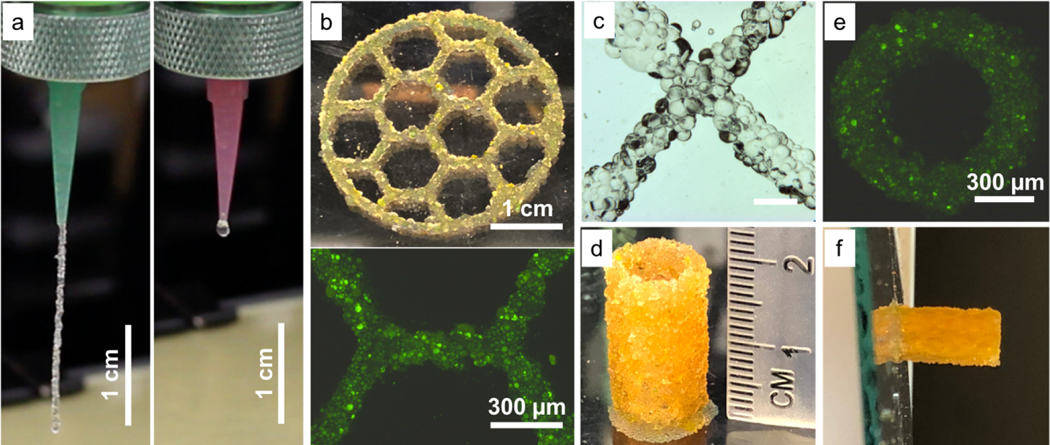
Three-dimensional (3D) bioprinting is important in the development of complex tissue structures for tissue engineering and regenerative medicine. However, the materials used for bioprinting, referred to as bioinks, must have a balance between a high viscosity for rapid solidification after extrusion and low shear force for cytocompatibility, which is difficult to achieve. Here, a novel bioink consisting of poly(ethylene glycol) (PEG) microgels prepared via off-stoichiometry thiol-ene click chemistry is introduced. Importantly, the microgel bioink is easily extruded, exhibits excellent stability after printing due to interparticle adhesion forces, and can be photochemically annealed with a second thiol-ene click reaction to confer long-term stability to printed constructs. The modularity of the bioink is also an advantage, as the PEG microgels have highly tunable physicochemical properties. The low force required for extrusion and cytocompatibility of the thiol-ene annealing reaction also permit cell incorporation during printing with high viability, and cells are able to spread and proliferate in the interstitial spaces between the microgels after the constructs have been annealed. Overall, these results indicate that our microgel bioink is a promising and versatile platform that could be leveraged for bioprinting and regenerative manufacturing.
三维(3D)生物打印在组织工程和再生医学中对于复杂组织结构的发展非常重要。然而,用于生物打印的材料,即所谓的生物墨水,必须在挤出后快速固化所需的高粘度和有利于细胞相容性所需的低剪切力之间取得平衡,这很难实现。在这里,我们介绍了一种由通过偏离化学计量的硫醇-烯点击化学制备的聚乙二醇(PEG)微凝胶组成的新型生物墨水。重要的是,这种微凝胶生物墨水很容易挤出,由于颗粒间的粘附力,在打印后表现出优异的稳定性,并且可以通过第二次硫醇-烯点击反应进行光化学退火,赋予打印结构长期稳定性。生物墨水的模块化也是一个优势,因为 PEG 微凝胶具有高度可调节的物理化学性质。挤出所需的力低,硫醇-烯退火反应的细胞相容性好,也允许在打印过程中高活力地掺入细胞,并且在构建体退火后,细胞能够在微凝胶之间的间隙中扩散和增殖。总的来说,这些结果表明,我们的微凝胶生物墨水是一种有前途和多功能的平台,可以用于生物打印和再生制造。