Intensive Care Unit, University Hospital Basel, University of Basel, Basel, Switzerland.
These authors contributed equally.
Euro Surveill. 2024 Jan;29(2). doi: 10.2807/1560-7917.ES.2024.29.2.2300200.
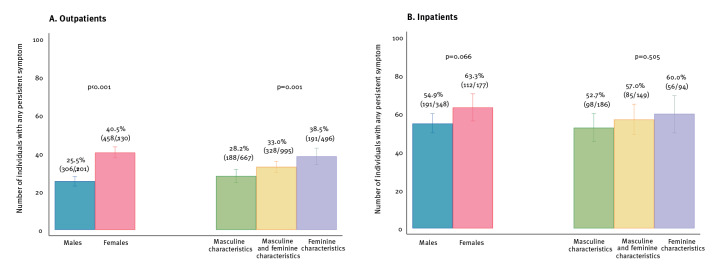
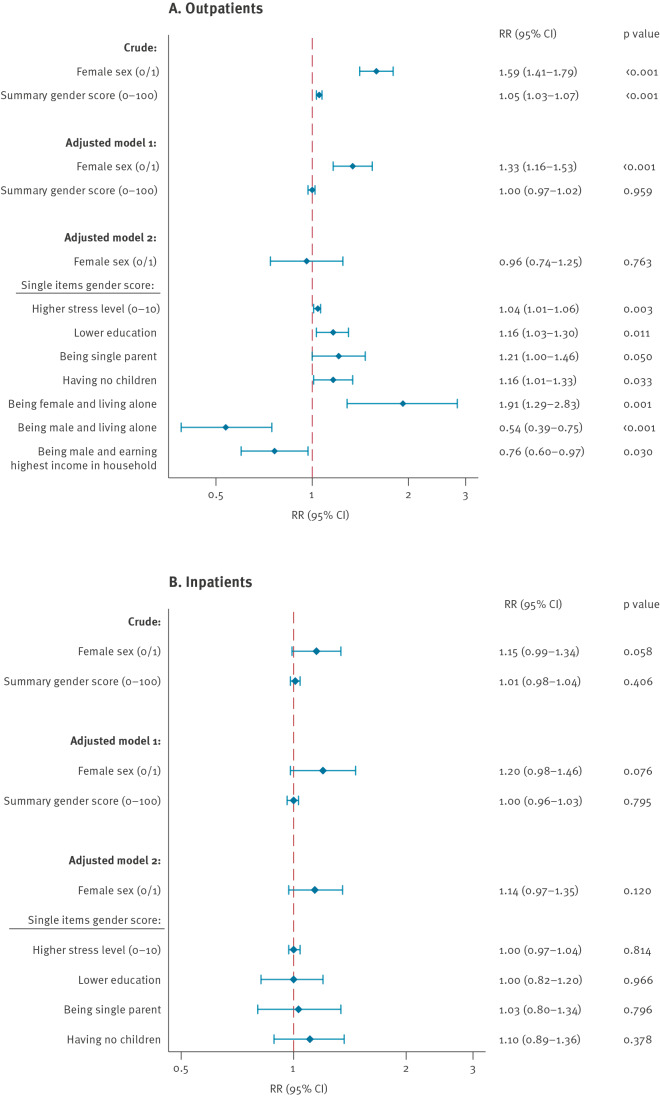
BackgroundWomen are overrepresented among individuals with post-acute sequelae of SARS-CoV-2 infection (PASC). Biological (sex) as well as sociocultural (gender) differences between women and men might account for this imbalance, yet their impact on PASC is unknown.AimWe assessed the impact of sex and gender on PASC in a Swiss population.MethodOur multicentre prospective cohort study included 2,856 (46% women, mean age 44.2 ± 16.8 years) outpatients and hospitalised patients with PCR-confirmed SARS-CoV-2 infection.ResultsAmong those who remained outpatients during their first infection, women reported persisting symptoms more often than men (40.5% vs 25.5% of men; p < 0.001). This sex difference was absent in hospitalised patients. In a crude analysis, both female biological sex (RR = 1.59; 95% CI: 1.41-1.79; p < 0.001) and a score summarising gendered sociocultural variables (RR = 1.05; 95% CI: 1.03-1.07; p < 0.001) were significantly associated with PASC. Following multivariable adjustment, biological female sex (RR = 0.96; 95% CI: 0.74-1.25; p = 0.763) was outperformed by feminine gender-related factors such as a higher stress level (RR = 1.04; 95% CI: 1.01-1.06; p = 0.003), lower education (RR = 1.16; 95% CI: 1.03-1.30; p = 0.011), being female and living alone (RR = 1.91; 95% CI: 1.29-2.83; p = 0.001) or being male and earning the highest income in the household (RR = 0.76; 95% CI: 0.60-0.97; p = 0.030).ConclusionSpecific sociocultural parameters that differ in prevalence between women and men, or imply a unique risk for women, are predictors of PASC and may explain, at least in part, the higher incidence of PASC in women. Once patients are hospitalised during acute infection, sex differences in PASC are no longer evident.
女性在 SARS-CoV-2 感染后后遗症(PASC)患者中人数过多。女性和男性之间的生物学差异(性别)和社会文化差异(性别)可能导致这种不平衡,但它们对 PASC 的影响尚不清楚。目的:我们在瑞士人群中评估了性别和性别对 PASC 的影响。方法:我们的多中心前瞻性队列研究包括 2856 名(46%为女性,平均年龄 44.2±16.8 岁)PCR 确诊的 SARS-CoV-2 感染门诊和住院患者。结果:在首次感染期间仍为门诊患者的人群中,女性报告持续存在症状的比例高于男性(40.5%比男性 25.5%;p<0.001)。这种性别差异在住院患者中不存在。在未调整分析中,女性生物学性别(RR=1.59;95%CI:1.41-1.79;p<0.001)和概括性别社会文化变量的评分(RR=1.05;95%CI:1.03-1.07;p<0.001)均与 PASC 显著相关。多变量调整后,女性生物学性别(RR=0.96;95%CI:0.74-1.25;p=0.763)不如女性相关因素(如压力水平更高[RR=1.04;95%CI:1.01-1.06;p=0.003]、教育程度较低[RR=1.16;95%CI:1.03-1.30;p=0.011]、女性且独居[RR=1.91;95%CI:1.29-2.83;p=0.001]或男性且家庭收入最高[RR=0.76;95%CI:0.60-0.97;p=0.030])显著。结论:在女性和男性之间患病率不同或暗示女性特有风险的特定社会文化参数是 PASC 的预测指标,至少可以部分解释女性 PASC 发生率较高的原因。一旦患者在急性感染期间住院,PASC 中的性别差异就不再明显。