Bensken Wyatt P, McGrath Brenda M, Gold Rachel, Cottrell Erika K
Department of Research, OCHIN, Portland, OR, USA.
Quantitative Sciences Core, OCHIN, Portland, OR, USA.
J Clin Transl Sci. 2023 Nov 10;7(1):e257. doi: 10.1017/cts.2023.680. eCollection 2023.
Area-level social determinants of health (SDoH) and individual-level social risks are different, yet area-level measures are frequently used as proxies for individual-level social risks. This study assessed whether demographic factors were associated with patients being screened for individual-level social risks, the percentage who screened positive for social risks, and the association between SDoH and patient-reported social risks in a nationwide network of community-based health centers.
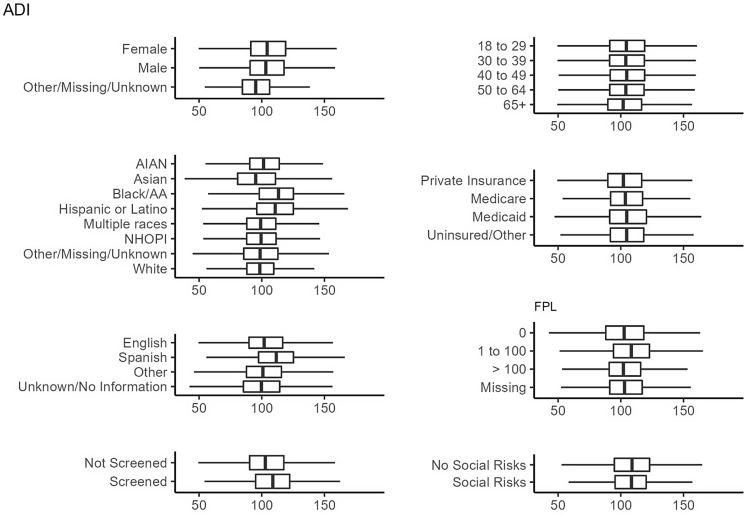
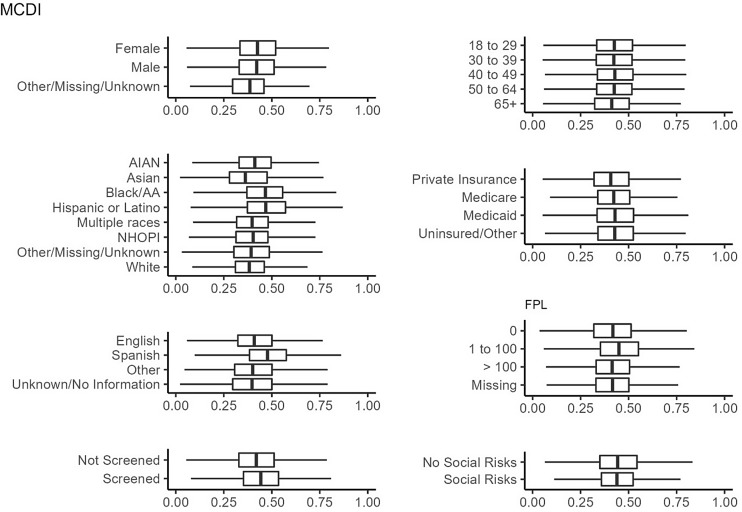
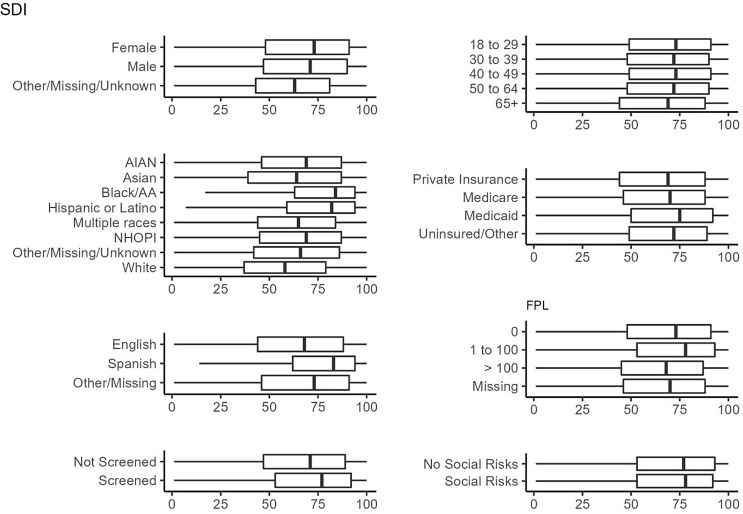
Electronic health record data from 1,330,201 patients with health center visits in 2021 were analyzed using multilevel logistic regression. Associations between patient characteristics, screening receipt, and screening positive for social risks (e.g., food insecurity, housing instability, transportation insecurity) were assessed. The predictive ability of three commonly used SDoH measures (Area Deprivation Index, Social Deprivation Index, Material Community Deprivation Index) in identifying individual-level social risks was also evaluated.
Of 244,155 (18%) patients screened for social risks, 61,414 (25.2%) screened positive. Sex, race/ethnicity, language preference, and payer were associated with both social risk screening and positivity. Significant health system-level variation in both screening and positivity was observed, with an intraclass correlation coefficient of 0.55 for social risk screening and 0.38 for positivity. The three area-level SDoH measures had low accuracy, sensitivity, and area under the curve when used to predict individual social needs.
Area-level SDoH measures may provide valuable information about the communities where patients live. However, policymakers, healthcare administrators, and researchers should exercise caution when using area-level adverse SDoH measures to identify individual-level social risks.
地区层面的健康社会决定因素(SDoH)与个体层面的社会风险不同,但地区层面的指标常被用作个体层面社会风险的替代指标。本研究评估了在全国范围内基于社区的健康中心网络中,人口统计学因素是否与个体层面社会风险筛查的患者、社会风险筛查呈阳性的百分比以及地区层面的健康社会决定因素与患者报告的社会风险之间的关联。
使用多水平逻辑回归分析了2021年在健康中心就诊的1,330,201名患者的电子健康记录数据。评估了患者特征、筛查接受情况与社会风险筛查呈阳性(如粮食不安全、住房不稳定、交通不安全)之间的关联。还评估了三种常用的地区层面健康社会决定因素指标(地区剥夺指数、社会剥夺指数、物质社区剥夺指数)在识别个体层面社会风险方面的预测能力。
在244,155名(18%)接受社会风险筛查的患者中,61,414名(25.2%)筛查呈阳性。性别、种族/民族、语言偏好和付款人都与社会风险筛查及阳性结果相关。在筛查和阳性结果方面均观察到显著的卫生系统层面差异,社会风险筛查的组内相关系数为0.55,阳性结果的组内相关系数为0.38。当用于预测个体社会需求时,这三种地区层面的健康社会决定因素指标的准确性、敏感性和曲线下面积都较低。
地区层面的健康社会决定因素指标可能提供有关患者居住社区的有价值信息。然而,政策制定者、医疗保健管理人员和研究人员在使用地区层面不利的健康社会决定因素指标来识别个体层面的社会风险时应谨慎。