Peléšková Šárka, Polák Jakub, Janovcová Markéta, Chomik Aleksandra, Sedláčková Kristýna, Frynta Daniel, Landová Eva
Department of Zoology, Faculty of Science, Charles University, Prague, Czechia.
Department of Economy and Management, Ambis University, Prague, Czechia.
Front Psychol. 2024 Jan 4;14:1321053. doi: 10.3389/fpsyg.2023.1321053. eCollection 2023.
Animal and human ancestors developed complex physiological and behavioral response systems to cope with two types of threats: immediate physical harm from predators or conspecifics, triggering fear, and the risk of infections from parasites and pathogens leading to the evolution of the behavioral immune system with disgust as the key emotion. Integration of the evolutionary concepts of the fear module and behavioral immune systems has been infrequent, despite the significant survival advantages of disgust in various contexts. Studies comparing attention to ancestral and modern threats accompanied by fear have yielded ambiguous results and what qualifies as salient modern disgusting stimuli remains unclear. We do not know whether disgust or the behavioral immune system, as inherent aspects of human psychology, have adapted to safeguard us from pandemic risks or poisoning by modern toxic substances.
To test these effects, we have developed a survey comprised of 60 short vignettes describing threats evoking fear and disgust belonging to one of the three main categories of threats: (1) ancestral (phylogenetic), (2) modern (ontogenetic), and (3) pandemics of airborne disease. Each vignette was evaluated on a 7-point Likert scale based on fear, disgust, and anger. In total, 660 respondents completed the survey. The data were analysed using a factor analysis and general linear model with the respondent as a random factor.
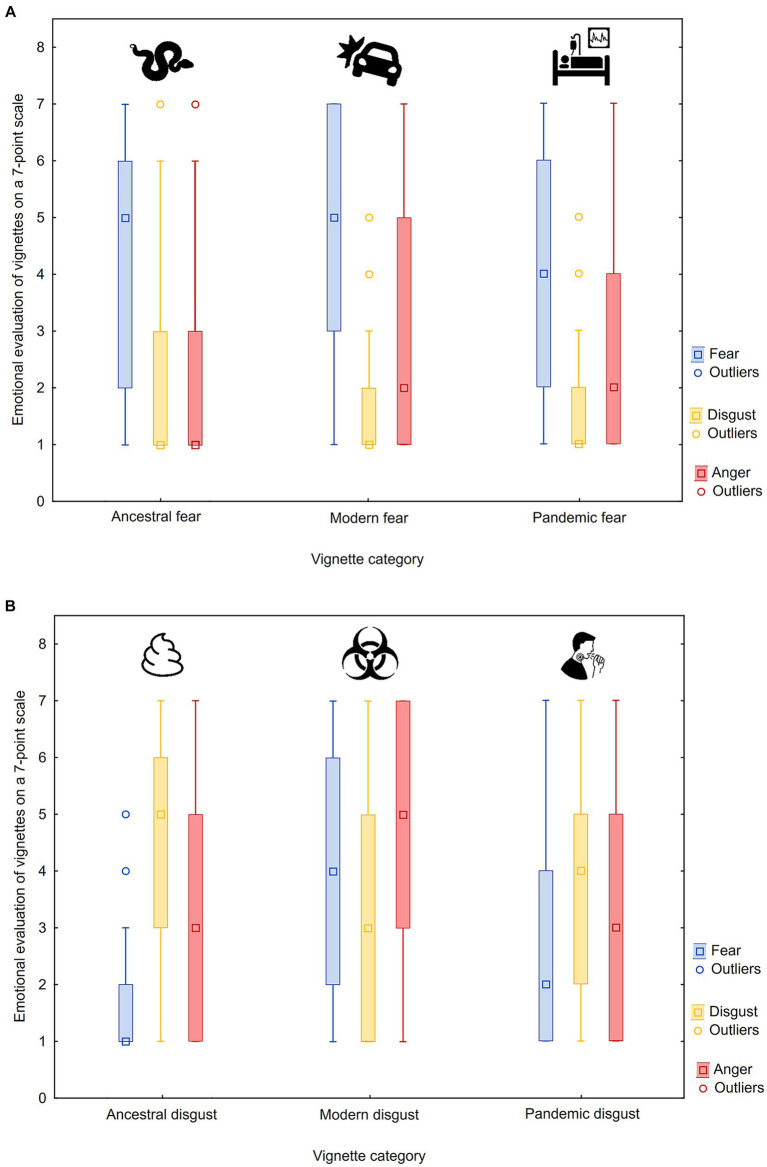
The results show that the strongest fear is triggered by modern threats (electricity, car accidents), while the highest disgust is evoked by ancient threats (body waste products, worms, etc.). Interestingly, disgust does not respond to modern threat stimuli such as toxic substances or radioactivity as these evoke mainly fear and anger. Finally, a distinct response pattern was found for pandemic threats, in which both fear (e.g., of disease and death) and disgust (e.g., of used face masks) are employed.
Our study offers valuable insights into the emotional responses to ancestral and modern threats and their adaptation to pandemic challenges. Ancestral threats are not always more powerful stimuli than adequate threats of the modern type, but they function specifically. Thus, snakes and heights as fear-inducing ancestral threats form separate factors in a multivariate analysis, whereas all ancestral disgust stimuli group together. The threat of a pandemic forms a specific category and people process it emotionally and cognitively. These insights contribute to our understanding of human psychology and behavior in an ever-changing world.
动物和人类祖先发展出了复杂的生理和行为反应系统,以应对两种类型的威胁:来自捕食者或同种个体的直接身体伤害,引发恐惧;以及来自寄生虫和病原体感染的风险,导致行为免疫系统的进化,其中厌恶是关键情绪。尽管厌恶在各种情况下具有显著的生存优势,但恐惧模块和行为免疫系统的进化概念很少被整合。比较对伴随着恐惧的祖先威胁和现代威胁的关注度的研究结果并不明确,而且什么算是突出的现代令人厌恶的刺激仍然不清楚。我们不知道厌恶或行为免疫系统作为人类心理的固有方面,是否已经适应来保护我们免受大流行风险或现代有毒物质中毒的影响。
为了测试这些影响,我们开发了一项调查,其中包括60个简短的 vignette,描述了引发恐惧和厌恶的威胁,这些威胁属于三大类威胁之一:(1)祖先(系统发育),(2)现代(个体发育),以及(3)空气传播疾病的大流行。每个 vignette 根据恐惧程度、厌恶程度和愤怒程度在7点李克特量表上进行评估。总共有660名受访者完成了这项调查。使用因子分析和以受访者为随机因素的一般线性模型对数据进行了分析。
结果表明,最强烈的恐惧是由现代威胁(电、车祸)引发的,而最高程度的厌恶是由古老威胁(身体排泄物、蠕虫等)引起的。有趣的是,厌恶对现代威胁刺激(如有毒物质或放射性)没有反应,因为这些主要引发恐惧和愤怒。最后,发现了针对大流行威胁的独特反应模式,其中恐惧(如对疾病和死亡的恐惧)和厌恶(如对用过的口罩的厌恶)都被调动起来。
我们的研究为对祖先威胁和现代威胁的情绪反应及其对大流行挑战的适应性提供了有价值的见解。祖先威胁并不总是比现代类型的适当威胁更强大的刺激,但它们具有特定的功能。因此,蛇和高处作为引发恐惧的祖先威胁在多变量分析中形成了单独的因素,而所有祖先厌恶刺激则归为一组。大流行的威胁形成了一个特定的类别,人们在情感和认知上对其进行处理。这些见解有助于我们理解在不断变化的世界中的人类心理和行为。