Nagasawa Takae, Sato Katsuyuki, Kasumi Takafumi
1 Asai Germanium Research Institute Co., Ltd.
2 Enzymology and Molecular Biology Laboratory, Department of Chemistry and Life Science, Nihon University.
J Appl Glycosci (1999). 2023 Dec 20;70(4):81-97. doi: 10.5458/jag.jag.JAG-2023_0004. eCollection 2023.
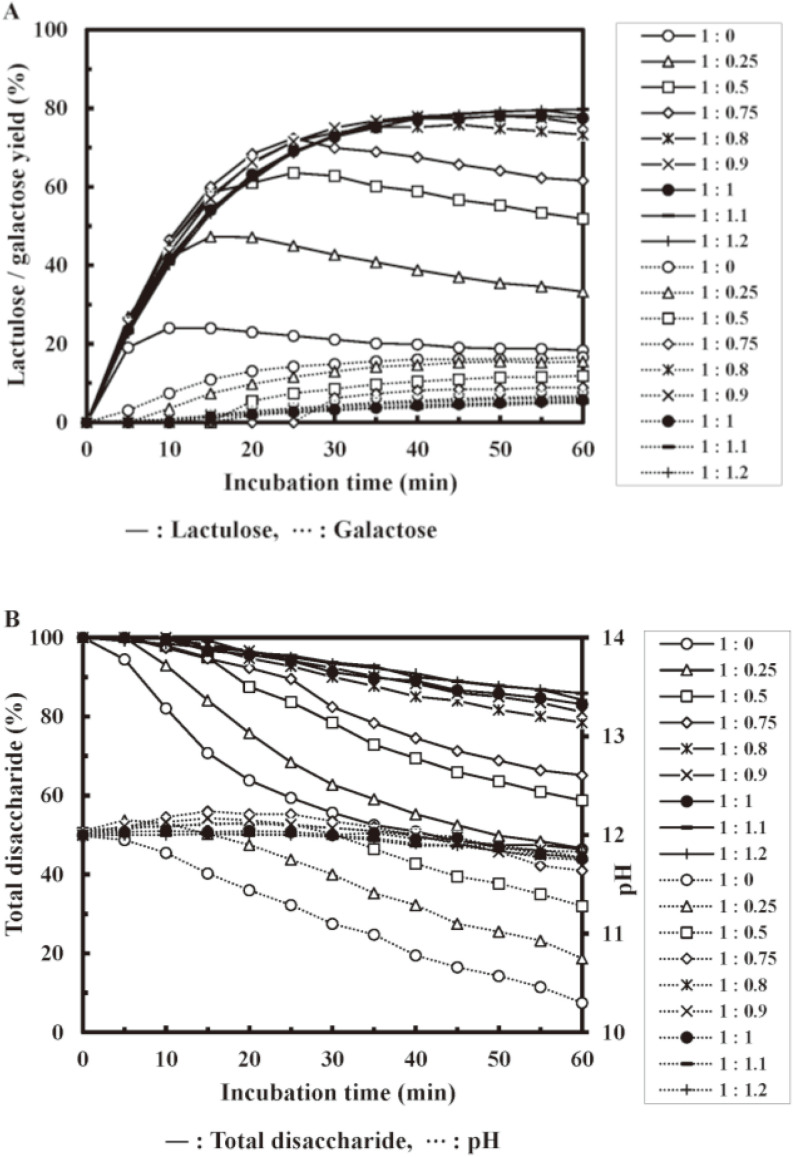
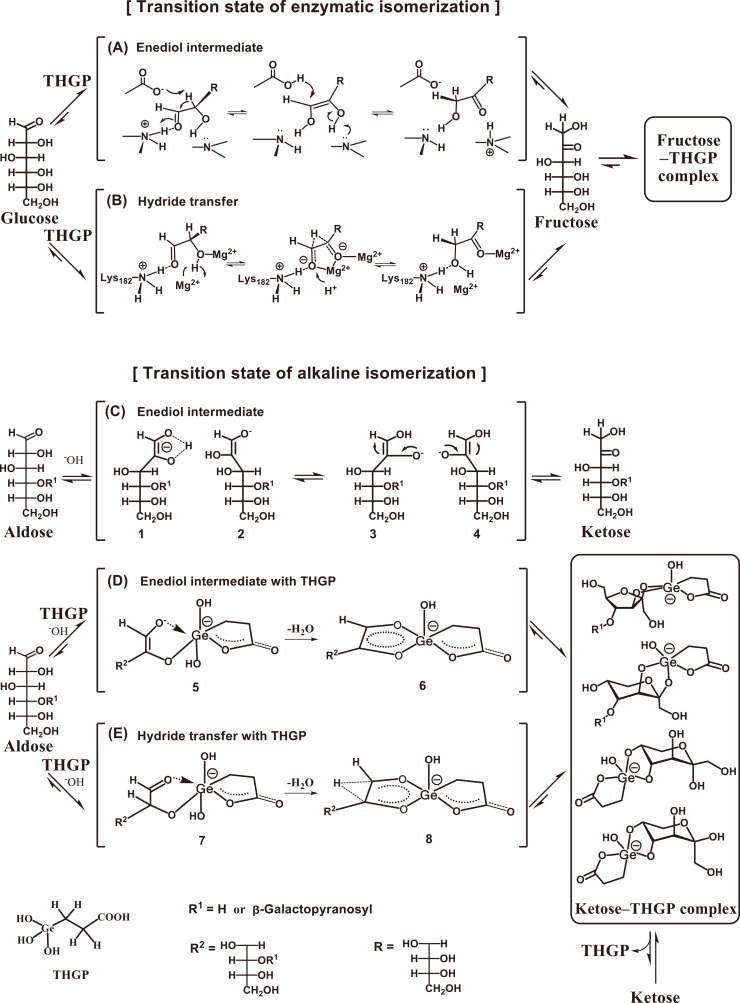
This review discusses sugar isomerization with organogermanium compounds. Organogermanium compounds markedly increase the aldose-ketose (glucose-fructose or lactose-lactulose) isomerization ratio, double the initial reaction rate, and significantly reduce the base-catalyzed degradation of sugars. H-nuclear magnetic resonance analysis reveals that the affinity of organogermanium compounds with a 3-(trihydroxygermyl)propanoic acid (THGP) structure toward ketoses is 20-40 times stronger than that toward aldoses; thus, such organogermanium compounds form complexes more readily with ketoses than with aldoses. Stable ketose complexes, which contain multiple -diol structures and high fractions of furanose structures, suppress the reverse ketose-aldose reaction, thereby shifting the equilibrium toward the ketose side. These complexes also protect sugar molecules from alkaline degradation owing to the repulsion between anionic charges. The increased rate of the initial reaction in the alkaline isomerization process results from stabilizing the transition state by forming a complex between THGP and a -enediol intermediate. The cyclic pentacoordinate or hexacoordinate THGP structures give rise to a conjugated system of germanium orbitals, which is extended through dπ-pπ interactions, thereby improving the stability of the complex. Based on these results, we have developed a bench-scale lactulose syrup manufacturing plant incorporating a system to separate, recover, and reuse organogermanium poly--[(2-carboxyethyl)germasesquioxane]. This manufacturing plant can be used as a model of an alkaline isomerization accelerator for continuous industrial production.
本综述讨论了有机锗化合物参与的糖异构化反应。有机锗化合物能显著提高醛糖-酮糖(葡萄糖-果糖或乳糖-乳果糖)的异构化比率,使初始反应速率翻倍,并显著降低碱催化的糖降解。氢核磁共振分析表明,具有3-(三羟基锗基)丙酸(THGP)结构的有机锗化合物对酮糖的亲和力比对醛糖的亲和力强20-40倍;因此,这类有机锗化合物与酮糖形成复合物的速度比与醛糖形成复合物的速度更快。含有多个二醇结构和高比例呋喃糖结构的稳定酮糖复合物可抑制酮糖-醛糖的逆反应,从而使平衡向酮糖一侧移动。由于阴离子电荷之间的排斥作用,这些复合物还能保护糖分子不被碱性降解。碱性异构化过程中初始反应速率的提高是由于THGP与烯二醇中间体形成复合物,使过渡态得以稳定。环状五配位或六配位的THGP结构产生了锗轨道的共轭体系,该体系通过dπ-pπ相互作用得以扩展,从而提高了复合物的稳定性。基于这些结果,我们开发了一个中试规模的乳果糖糖浆生产装置,该装置包含一个用于分离、回收和再利用聚[(2-羧乙基)锗倍半氧化物]的系统。该生产装置可作为连续工业生产的碱性异构化促进剂的模型。