Okutomi Yuki, Konishi Yasutaka, Kakinuma Akihito, Sawamura Shigehito
Department of Anesthesia and Critical Care, Teikyo University School of Medicine, Tokyo, JPN.
Cureus. 2023 Dec 21;15(12):e50882. doi: 10.7759/cureus.50882. eCollection 2023 Dec.
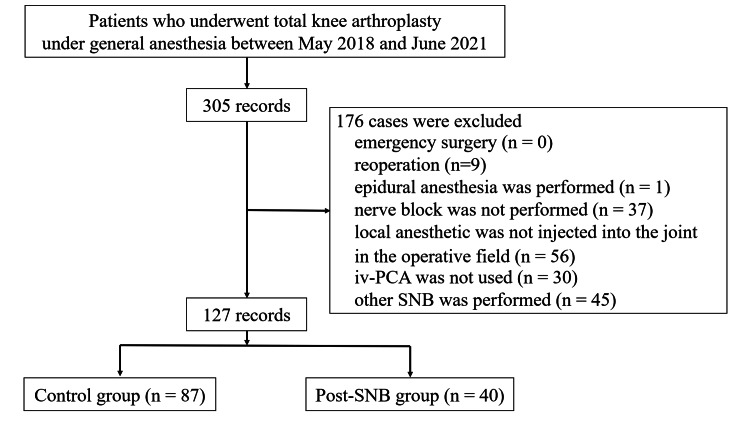
Background A preoperative sciatic nerve block (SNB) before total knee arthroplasty (TKA) frequently causes postoperative drop foot; however, this can also occur as an unintended result of surgical invasion. This study assessed the benefits of a postoperative SNB at the subgluteal space for patients who underwent TKA. Methodology This was a single-center, retrospective cohort study. Patients who underwent TKA under general anesthesia between May 2018 and June 2019 at the Teikyo University School of Medicine were screened for inclusion. They received either a preoperative femoral nerve block alone (control group; n = 87) or a preoperative femoral nerve block and postoperative SNB at the subgluteal space (post-SNB group; n = 40). The primary outcome was the pain-related Numerical Rating Scale (NRS) scores. The secondary outcomes were postoperative nausea and vomiting (PONV), intravenous patient-controlled analgesia (iv-PCA) suspension, and postoperative complications. Results No significant differences were observed in the characteristics, NRS scores, time to first drug use for pain, and iv-PCA suspension between groups. However, the incidence of PONV was significantly lower in the post-SNB group (p = 0.03). Logistic regression analysis revealed that droperidol doses of iv-PCA and the presence of postoperative SNB were independently associated with PONV occurrence [A1] {(p = 0.008, 95% confidence intervals (CI) [0.46, 0.89] and (p = 0.02, 95% CI [0.25, 0.88])}. Conclusions A postoperative SNB at the subgluteal space following TKA does not improve postoperative pain control; however, it may have contributed to reduced PONV.
全膝关节置换术(TKA)前进行术前坐骨神经阻滞(SNB)常导致术后足下垂;然而,这也可能是手术侵袭的意外结果。本研究评估了TKA术后在臀下间隙进行SNB对患者的益处。
这是一项单中心回顾性队列研究。筛选2018年5月至2019年6月在帝京大学医学院接受全身麻醉下TKA的患者纳入研究。他们要么仅接受术前股神经阻滞(对照组;n = 87),要么接受术前股神经阻滞和术后臀下间隙SNB(SNB后组;n = 40)。主要结局是疼痛相关数字评定量表(NRS)评分。次要结局是术后恶心呕吐(PONV)、静脉自控镇痛(iv-PCA)停用情况和术后并发症。
两组在特征、NRS评分、首次使用镇痛药物时间和iv-PCA停用情况方面未观察到显著差异。然而,SNB后组的PONV发生率显著更低(p = 0.03)。逻辑回归分析显示,iv-PCA中氟哌利多剂量和术后SNB的存在与PONV发生独立相关[{(p = 0.008, 95%置信区间(CI)[0.46, 0.89])和(p = 0.02, 95% CI [0.25, 0.88])}]。
TKA术后在臀下间隙进行SNB并不能改善术后疼痛控制;然而,它可能有助于减少PONV。