Guo Wang, Bu Wenlang, Mao Yufeng, Wang Enyu, Yang Yanjuan, Liu Chao, Guo Feng, Mai Huaming, You Hui, Long Yu
State Key Laboratory of Featured Metal Materials and Life-Cycle Safety for Composite Structures, Guangxi University, Nanning 530004, China.
Guangxi Key Laboratory of Manufacturing System and Advanced Manufacturing Technology, School of Mechanical Engineering, Guangxi University, Nanning 530004, China.
Polymers (Basel). 2024 Jan 9;16(2):198. doi: 10.3390/polym16020198.
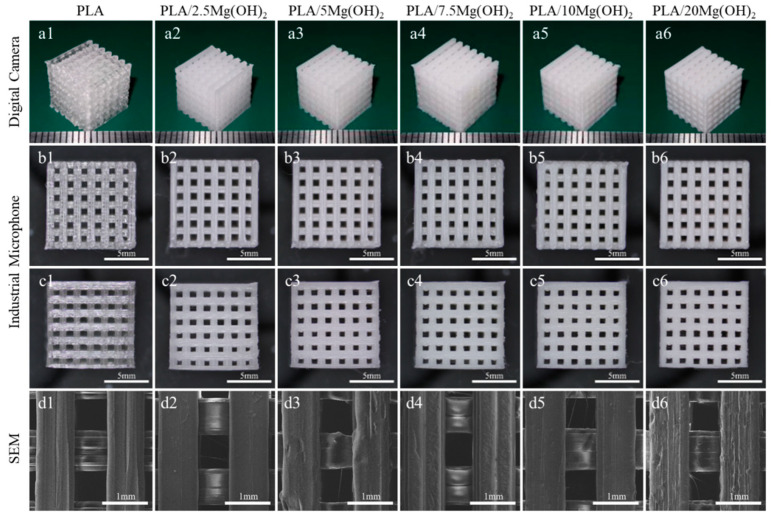
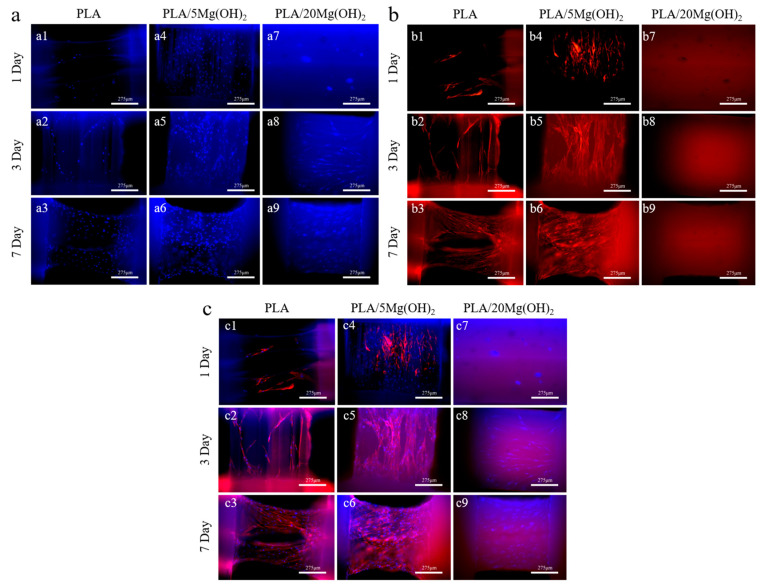
Polylactic acid (PLA) has attracted much attention in bone tissue engineering due to its good biocompatibility and processability, but it still faces problems such as a slow degradation rate, acidic degradation product, weak biomineralization ability, and poor cell response, which limits its wider application in developing bone scaffolds. In this study, Mg(OH) nanoparticles were employed as a versatile nanofiller for developing PLA/Mg(OH) composite bone scaffolds using fused deposition modeling (FDM) 3D printing technology, and its mechanical, degradation, and biological properties were evaluated. The mechanical tests revealed that a 5 wt% addition of Mg(OH) improved the tensile and compressive strengths of the PLA scaffold by 20.50% and 63.97%, respectively. The soaking experiment in phosphate buffered solution (PBS) revealed that the alkaline degradation products of Mg(OH) neutralized the acidic degradation products of PLA, thus accelerating the degradation of PLA. The weight loss rate of the PLA/20Mg(OH) scaffold (15.40%) was significantly higher than that of PLA (0.15%) on day 28. Meanwhile, the composite scaffolds showed long-term Mg release for more than 28 days. The simulated body fluid (SBF) immersion experiment indicated that Mg(OH) promoted the deposition of apatite and improved the biomineralization of PLA scaffolds. The cell culture of bone marrow mesenchymal stem cells (BMSCs) indicated that adding 5 wt% Mg(OH) effectively improved cell responses, including adhesion, proliferation, and osteogenic differentiation, due to the release of Mg. This study suggests that Mg(OH) can simultaneously address various issues related to polymer scaffolds, including degradation, mechanical properties, and cell interaction, having promising applications in tissue engineering.
聚乳酸(PLA)因其良好的生物相容性和可加工性在骨组织工程中备受关注,但它仍面临降解速率缓慢、降解产物呈酸性、生物矿化能力弱以及细胞反应差等问题,这限制了其在开发骨支架方面的更广泛应用。在本研究中,采用Mg(OH)纳米颗粒作为一种多功能纳米填料,利用熔融沉积建模(FDM)3D打印技术开发PLA/Mg(OH)复合骨支架,并对其力学、降解和生物学性能进行了评估。力学测试表明,添加5 wt%的Mg(OH)分别使PLA支架的拉伸强度和压缩强度提高了20.50%和63.97%。在磷酸盐缓冲溶液(PBS)中的浸泡实验表明,Mg(OH)的碱性降解产物中和了PLA的酸性降解产物,从而加速了PLA的降解。在第28天,PLA/20Mg(OH)支架的失重率(15.40%)显著高于PLA(0.15%)。同时,复合支架显示出超过28天的长期镁释放。模拟体液(SBF)浸泡实验表明,Mg(OH)促进了磷灰石的沉积并改善了PLA支架的生物矿化。骨髓间充质干细胞(BMSCs)的细胞培养表明,添加5 wt%的Mg(OH)由于镁的释放有效地改善了细胞反应,包括粘附、增殖和成骨分化。本研究表明,Mg(OH)可以同时解决与聚合物支架相关的各种问题,包括降解、力学性能和细胞相互作用,在组织工程中具有广阔的应用前景。