Palmer Jacqueline K, van der Pols Jolieke C, Sullivan Karen A, Staudacher Heidi M, Byrne Rebecca
School of Exercise and Nutrition Science, Faculty of Health, Queensland University of Technology, Brisbane, QLD, Australia.
School of Psychology and Counselling, Faculty of Health, Queensland University of Technology, Brisbane, QLD, Australia.
J Autism Dev Disord. 2025 Mar;55(3):775-788. doi: 10.1007/s10803-024-06239-z. Epub 2024 Jan 31.
Modifying gut bacteria in children with autism may influence behaviour, with potential to improve family functioning. We conducted a randomised controlled trial to assess the effect of prebiotics on behaviour, gastrointestinal symptoms and downstream effects on parental quality of life.
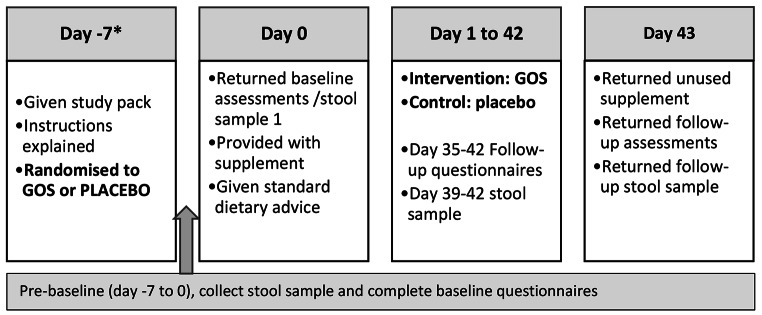
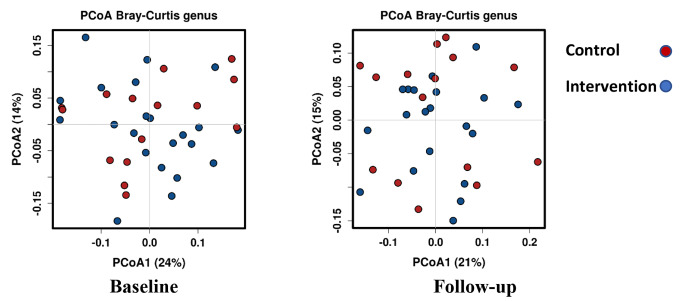
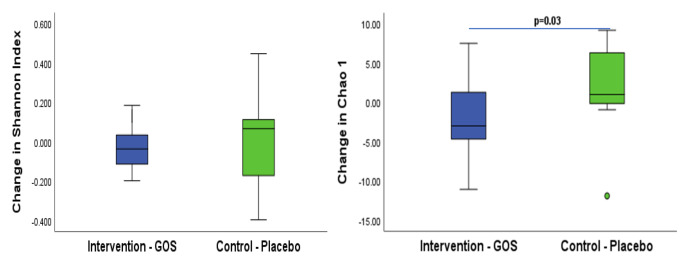
Children with autism (4-10yrs) were randomised to 2.4 g/d of prebiotic (GOS) or placebo for six weeks. Pre and post stools samples were collected, and validated questionnaires used to measure change in social and mealtime behaviours, GI symptoms and pQOL. Linear mixed models evaluated group differences for behavioural variables, and Mann Whitney U tests were used to compare change between-groups for GI symptoms, differential abundance of genera and alpha diversity of the microbiome.
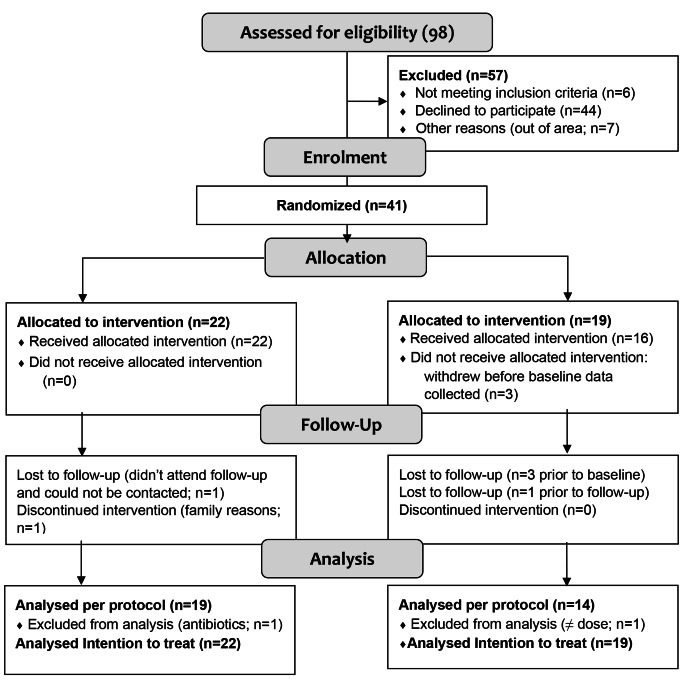
Thirty-three parent-child dyads completed the trial. No group difference was seen for behavioural variables but both groups improved significantly from baseline. There was a medium effect size between groups for GI symptoms (d = 0.47) and pQOL (d = 0.44) driven by greater improvements in the prebiotic group. Bifidobacterium increased threefold following prebiotics (1.4-5.9%, p < 0.001) with no change in controls. Supplements were well tolerated, compliance with dose 94%.
Prebiotics modify levels of Bifidobacterium and prove well tolerated but in this instance, resulted in only marginal effects on GI symptoms and pQOL. A larger sample of children with more severe symptoms could help to determine the potential of prebiotics in autism.
https://www.anzctr.org.au/Trial/Registration/TrialReview.aspx?ACTRN=12619000615189 .
改变自闭症儿童的肠道细菌可能会影响其行为,并有改善家庭功能的潜力。我们进行了一项随机对照试验,以评估益生元对行为、胃肠道症状以及对父母生活质量的下游影响。
将自闭症儿童(4至10岁)随机分为两组,一组每天服用2.4克益生元(低聚半乳糖),另一组服用安慰剂,为期六周。收集粪便样本,使用经过验证的问卷来测量社交和用餐行为、胃肠道症状和父母生活质量的变化。线性混合模型评估行为变量的组间差异,Mann Whitney U检验用于比较两组间胃肠道症状、微生物属的差异丰度和微生物组的α多样性的变化。
33对亲子完成了试验。行为变量方面未观察到组间差异,但两组均较基线有显著改善。益生元组在胃肠道症状(d = 0.47)和父母生活质量(d = 0.44)方面有中等效应大小,这是由益生元组更大的改善所驱动的。服用益生元后双歧杆菌增加了三倍(1.4 - 5.9%,p < 0.001),而对照组无变化。补充剂耐受性良好,剂量依从性为94%。
益生元可改变双歧杆菌水平且耐受性良好,但在本研究中,对胃肠道症状和父母生活质量仅产生了微小影响。对症状更严重的儿童进行更大规模的样本研究可能有助于确定益生元在自闭症治疗中的潜力。
https://www.anzctr.org.au/Trial/Registration/TrialReview.aspx?ACTRN=12619000615189 。