Department of Diagnostic and Interventional Radiology, University Hospital RWTH Aachen, Aachen, Germany.
Institute and Polyclinic for Diagnostic and Interventional Radiology, Faculty of Medicine and University Hospital Carl Gustav Carus Dresden, Technische Universität Dresden, Dresden, Germany.
Eur Radiol Exp. 2024 Feb 8;8(1):10. doi: 10.1186/s41747-023-00411-3.
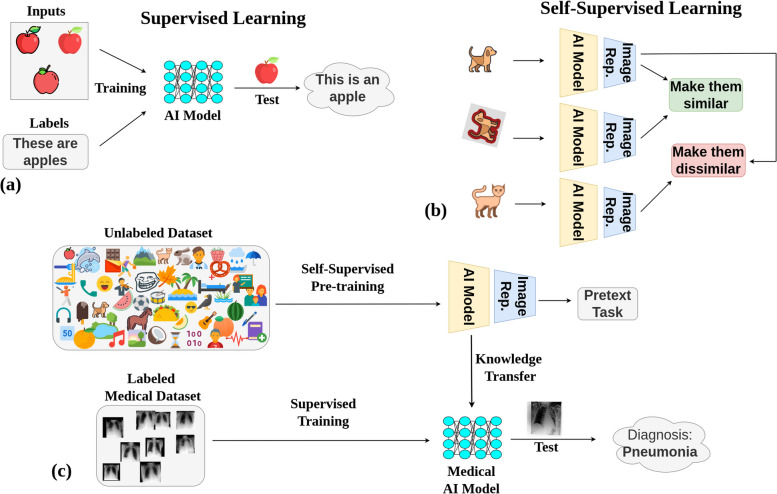
Pretraining labeled datasets, like ImageNet, have become a technical standard in advanced medical image analysis. However, the emergence of self-supervised learning (SSL), which leverages unlabeled data to learn robust features, presents an opportunity to bypass the intensive labeling process. In this study, we explored if SSL for pretraining on non-medical images can be applied to chest radiographs and how it compares to supervised pretraining on non-medical images and on medical images.
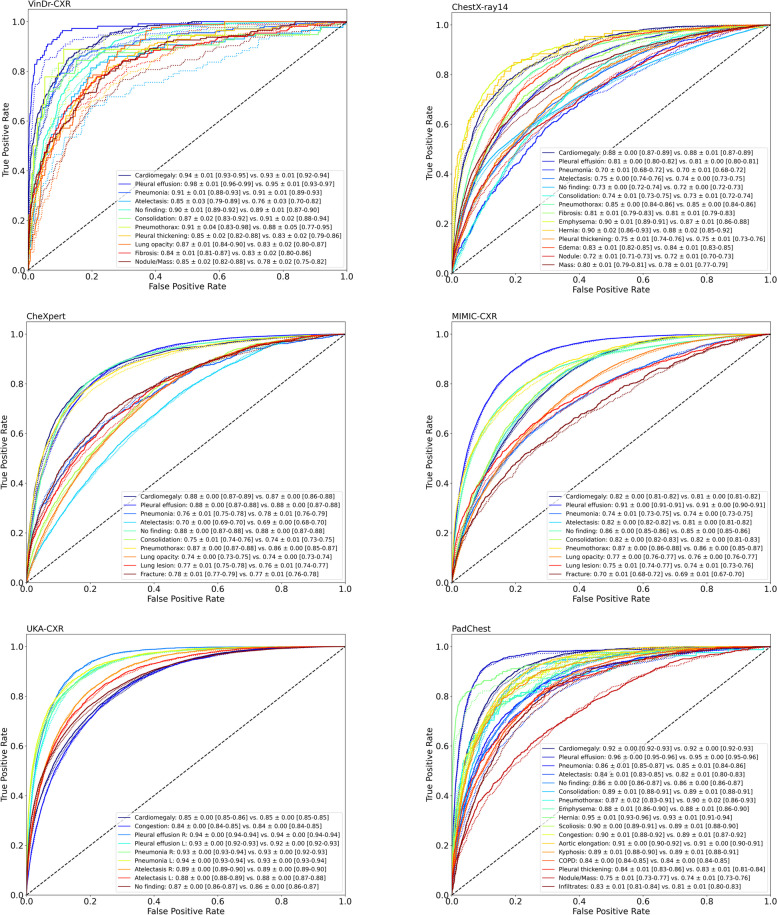
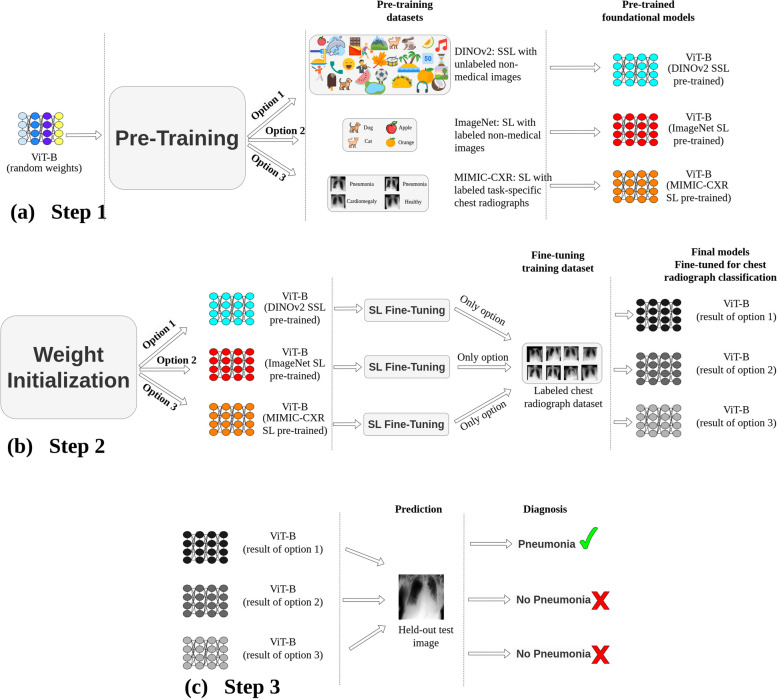
We utilized a vision transformer and initialized its weights based on the following: (i) SSL pretraining on non-medical images (DINOv2), (ii) supervised learning (SL) pretraining on non-medical images (ImageNet dataset), and (iii) SL pretraining on chest radiographs from the MIMIC-CXR database, the largest labeled public dataset of chest radiographs to date. We tested our approach on over 800,000 chest radiographs from 6 large global datasets, diagnosing more than 20 different imaging findings. Performance was quantified using the area under the receiver operating characteristic curve and evaluated for statistical significance using bootstrapping.
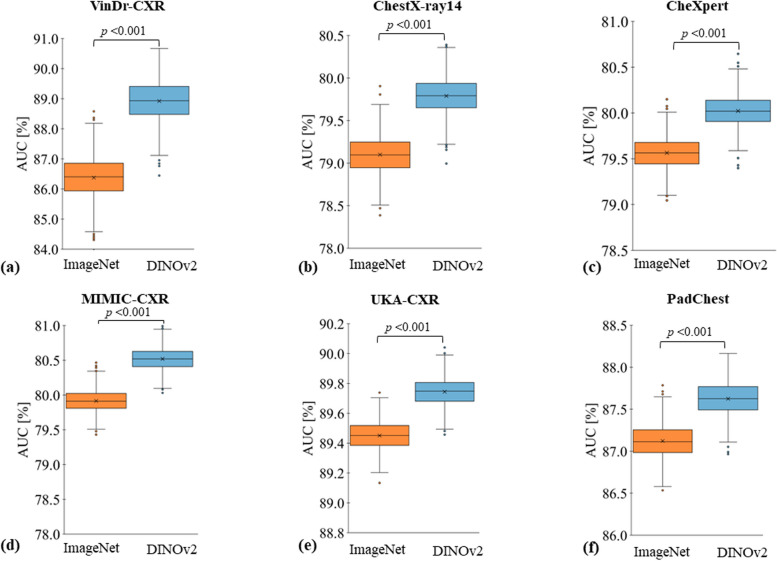
SSL pretraining on non-medical images not only outperformed ImageNet-based pretraining (p < 0.001 for all datasets) but, in certain cases, also exceeded SL on the MIMIC-CXR dataset. Our findings suggest that selecting the right pretraining strategy, especially with SSL, can be pivotal for improving diagnostic accuracy of artificial intelligence in medical imaging.
By demonstrating the promise of SSL in chest radiograph analysis, we underline a transformative shift towards more efficient and accurate AI models in medical imaging.
Self-supervised learning highlights a paradigm shift towards the enhancement of AI-driven accuracy and efficiency in medical imaging. Given its promise, the broader application of self-supervised learning in medical imaging calls for deeper exploration, particularly in contexts where comprehensive annotated datasets are limited.
在高级医学图像分析中,使用标注数据集(如 ImageNet)进行预训练已经成为一种技术标准。然而,自监督学习(SSL)的出现为利用未标注数据学习稳健特征提供了机会,从而可以绕过密集的标注过程。在这项研究中,我们探讨了在非医学图像上进行 SSL 预训练是否可以应用于胸部 X 光片,以及它与在非医学图像和医学图像上进行监督预训练的比较。
我们使用了一个视觉转换器,并基于以下内容初始化其权重:(i)在非医学图像上进行 SSL 预训练(DINOv2),(ii)在非医学图像上进行监督学习(ImageNet 数据集)预训练,以及(iii)在 MIMIC-CXR 数据库上进行胸部 X 光片的监督学习预训练,MIMIC-CXR 是迄今为止最大的胸部 X 光公共标注数据集。我们在来自 6 个大型全球数据集的超过 800,000 张胸部 X 光片上测试了我们的方法,诊断了 20 多种不同的成像结果。使用接收器操作特征曲线下的面积来量化性能,并使用引导法评估统计显著性。
在非医学图像上进行 SSL 预训练不仅优于基于 ImageNet 的预训练(所有数据集均为 p<0.001),而且在某些情况下,也优于在 MIMIC-CXR 数据集上的监督学习。我们的研究结果表明,选择正确的预训练策略,特别是使用 SSL,可以对提高医学成像中人工智能的诊断准确性起到关键作用。
通过证明 SSL 在胸部 X 光片分析中的潜力,我们强调了在医学成像中向更高效和准确的人工智能模型转变。鉴于其潜力,更广泛地应用自监督学习在医学成像中需要更深入的探索,特别是在全面标注数据集有限的情况下。
自监督学习突出了一种范式转变,即提高人工智能在医学成像中的准确性和效率。鉴于其潜力,更广泛地应用自监督学习在医学成像中需要更深入的探索,特别是在全面标注数据集有限的情况下。