Department of Psychology, Stanford University, Building 420, 450 Jane Stanford Way, Stanford, 94305, CA, USA.
Department of Psychology, University of California, San Diego, 9500 Gilman Dr., La Jolla, 92093, CA, USA.
Nat Commun. 2024 Feb 8;15(1):1191. doi: 10.1038/s41467-023-44529-9.
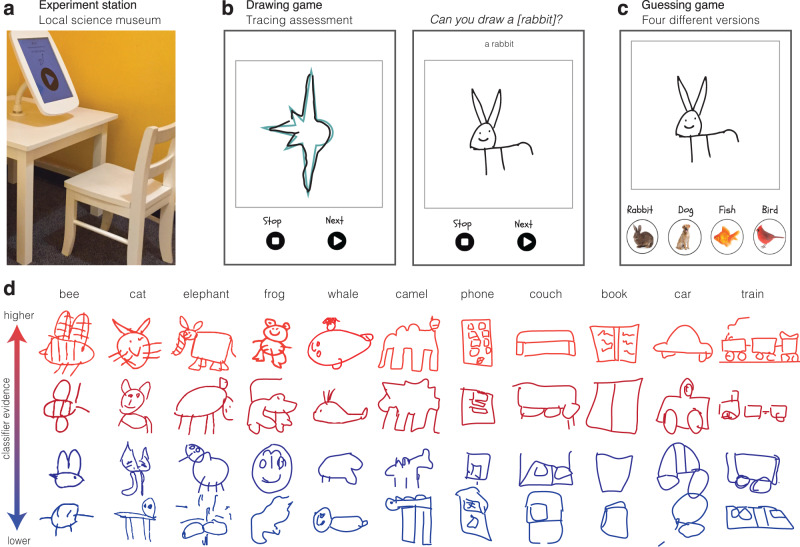
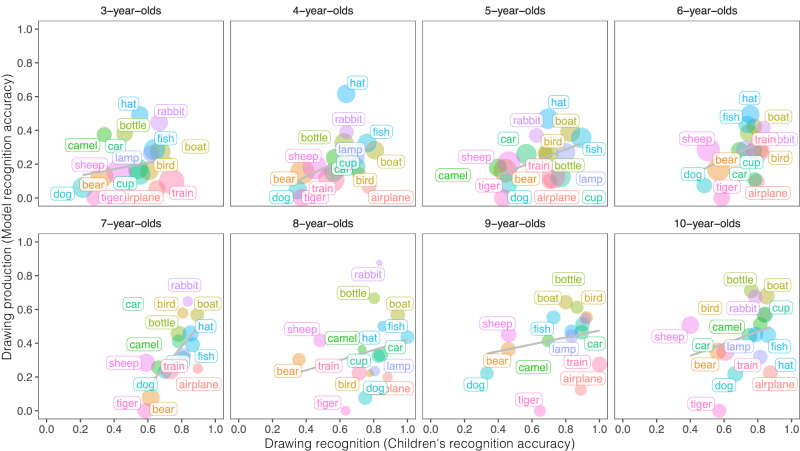
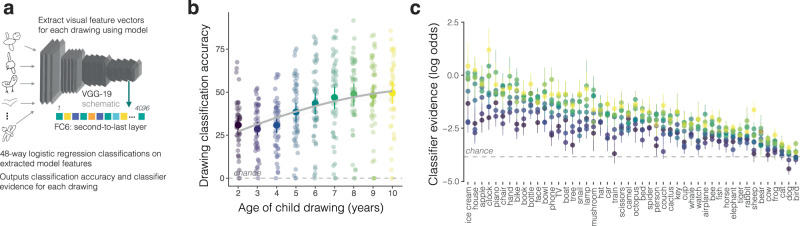
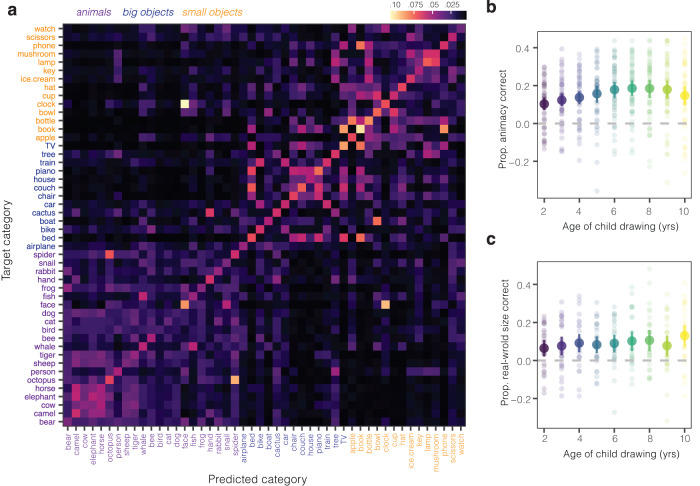
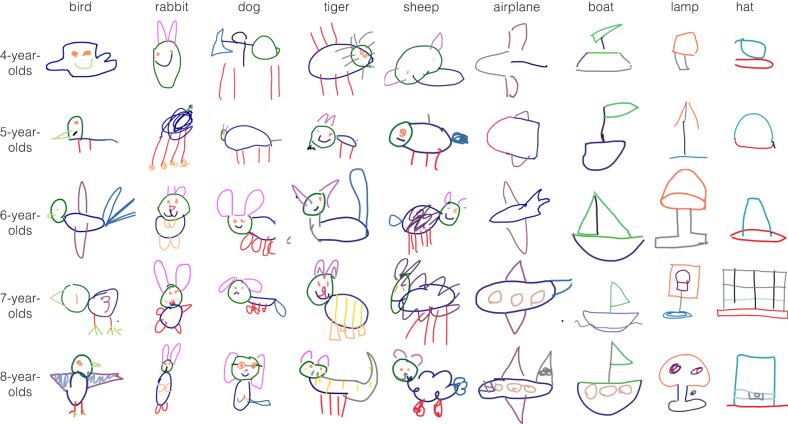
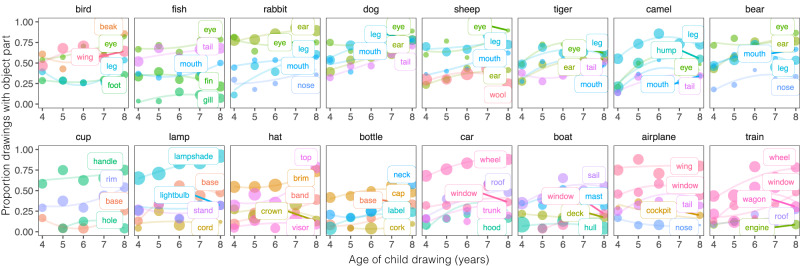
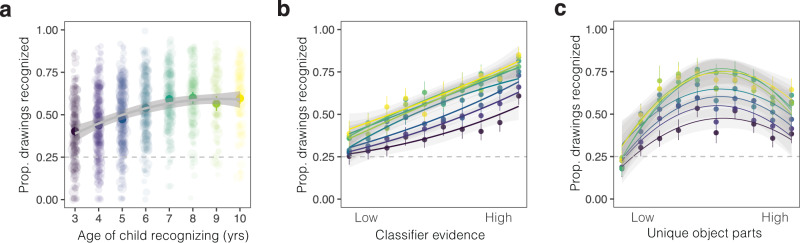
Childhood is marked by the rapid accumulation of knowledge and the prolific production of drawings. We conducted a systematic study of how children create and recognize line drawings of visual concepts. We recruited 2-10-year-olds to draw 48 categories via a kiosk at a children's museum, resulting in >37K drawings. We analyze changes in the category-diagnostic information in these drawings using vision algorithms and annotations of object parts. We find developmental gains in children's inclusion of category-diagnostic information that are not reducible to variation in visuomotor control or effort. Moreover, even unrecognizable drawings contain information about the animacy and size of the category children tried to draw. Using guessing games at the same kiosk, we find that children improve across childhood at recognizing each other's line drawings. This work leverages vision algorithms to characterize developmental changes in children's drawings and suggests that these changes reflect refinements in children's internal representations.
儿童期的特点是知识的快速积累和大量的绘画创作。我们系统地研究了儿童如何创作和识别视觉概念的线条画。我们通过儿童博物馆的信息亭招募了 2-10 岁的儿童,让他们画 48 个类别,共产生了超过 37000 张画作。我们使用视觉算法和物体部分的注释分析这些画作中类别诊断信息的变化。我们发现,儿童在纳入类别诊断信息方面的发展性进步,不能简化为运动控制或努力的变化。此外,即使是无法识别的画作也包含了儿童试图绘制的类别生物性和大小的信息。通过在同一个信息亭玩猜测游戏,我们发现孩子们在整个童年时期的识别他人的线条画能力都在提高。这项工作利用视觉算法来描述儿童绘画中发展变化,并表明这些变化反映了儿童内部表现的改进。