Lee Hyochul, Lee Junhyeok, Jang Joon, Hwang Inpyeong, Choi Kyu Sung, Park Jung Hyun, Chung Jin Wook, Choi Seung Hong
Interdisciplinary Program in Cancer Biology, Seoul National University College of Medicine, Seoul, 03080, Republic of Korea.
Department of Radiology, Seoul National University Hospital, 101 Daehak-Ro, Jongno-Gu, Seoul, 03080, Republic of Korea.
Neuroradiology. 2024 Apr;66(4):577-587. doi: 10.1007/s00234-024-03298-y. Epub 2024 Feb 10.
To predict hematoma growth in intracerebral hemorrhage patients by combining clinical findings with non-contrast CT imaging features analyzed through deep learning.
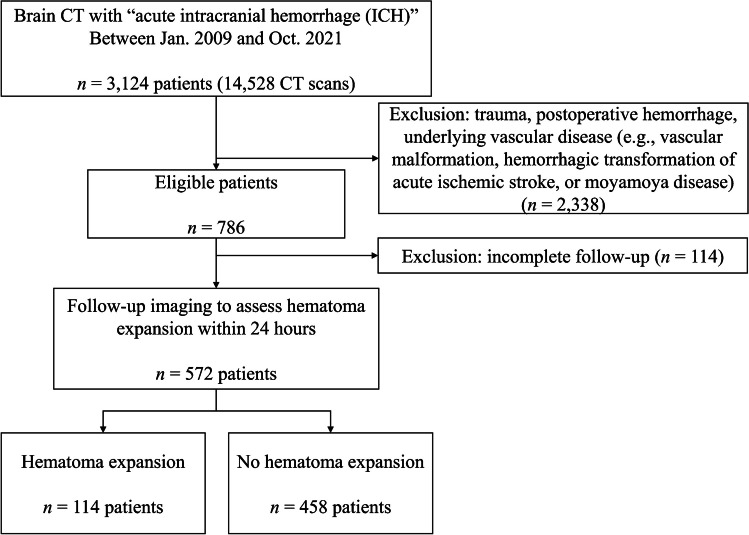
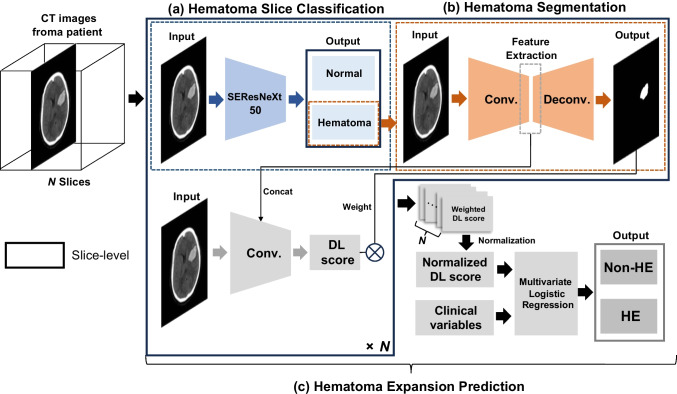
Three models were developed to predict hematoma expansion (HE) in 572 patients. We utilized multi-task learning for both hematoma segmentation and prediction of expansion: the Image-to-HE model processed hematoma slices, extracting features and computing a normalized DL score for HE prediction. The Clinical-to-HE model utilized multivariate logistic regression on clinical variables. The Integrated-to-HE model combined image-derived and clinical data. Significant clinical variables were selected using forward selection in logistic regression. The two models incorporating clinical variables were statistically validated.
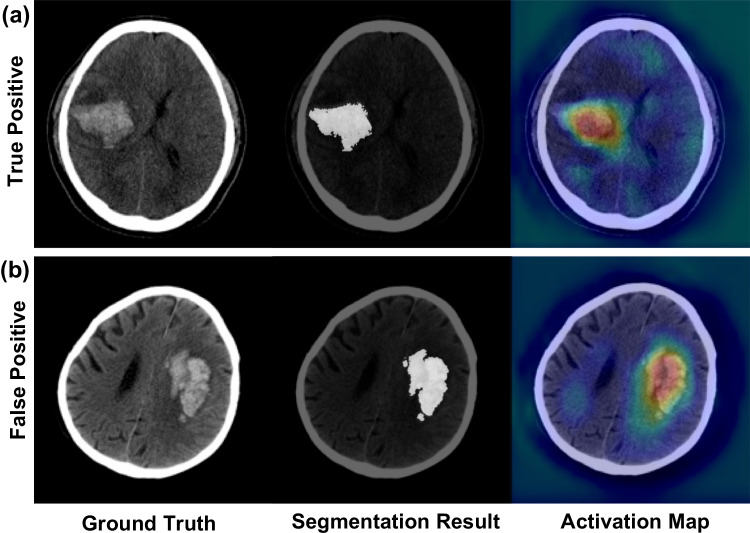
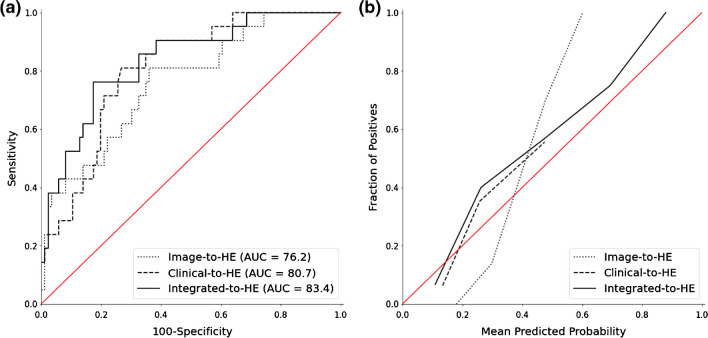
For hematoma detection, the diagnostic performance of the developed multi-task model was excellent (AUC, 0.99). For expansion prediction, three models were evaluated for predicting HE. The Image-to-HE model achieved an accuracy of 67.3%, sensitivity of 81.0%, specificity of 64.0%, and an AUC of 0.76. The Clinical-to-HE model registered an accuracy of 74.8%, sensitivity of 81.0%, specificity of 73.3%, and an AUC of 0.81. The Integrated-to-HE model, merging both image and clinical data, excelled with an accuracy of 81.3%, sensitivity of 76.2%, specificity of 82.6%, and an AUC of 0.83. The Integrated-to-HE model, aligning closest to the diagonal line and indicating the highest level of calibration, showcases superior performance in predicting HE outcomes among the three models.
The integration of clinical findings with non-contrast CT imaging features analyzed through deep learning showed the potential for improving the prediction of HE in acute spontaneous intracerebral hemorrhage patients.
通过将临床发现与通过深度学习分析的非增强CT成像特征相结合,预测脑出血患者的血肿扩大情况。
开发了三种模型来预测572例患者的血肿扩大(HE)。我们将多任务学习用于血肿分割和扩大预测:图像到HE模型处理血肿切片,提取特征并计算用于HE预测的标准化深度学习分数。临床到HE模型对临床变量进行多变量逻辑回归。综合到HE模型结合了图像衍生数据和临床数据。在逻辑回归中使用向前选择来选择显著的临床变量。对纳入临床变量的两个模型进行了统计学验证。
对于血肿检测,所开发的多任务模型的诊断性能极佳(AUC,0.99)。对于扩大预测,对三种模型进行了HE预测评估。图像到HE模型的准确率为67.3%,灵敏度为81.0%,特异性为64.0%,AUC为0.76。临床到HE模型的准确率为74.8%,灵敏度为81.0%,特异性为73.3%,AUC为0.81。综合到HE模型融合了图像和临床数据,表现出色,准确率为81.3%,灵敏度为76.2%,特异性为82.6%,AUC为0.83。综合到HE模型最接近对角线,表明校准水平最高,在三种模型中展示了预测HE结果的卓越性能。
将临床发现与通过深度学习分析的非增强CT成像特征相结合,显示出改善急性自发性脑出血患者HE预测的潜力。