Das Anuska, Rai Jay, Roth Mitchell O, Shu Yuerong, Medina Megan L, Barakat Mackenzie R, Li Hong
Institute of Molecular Biophysics, Florida State University, Tallahassee, FL, USA.
These authors contributed equally: Anuska Das, Jay Rai, Mitchell O. Roth.
Nat Catal. 2023 Oct;6(10):969-977. doi: 10.1038/s41929-023-01031-1. Epub 2023 Oct 2.
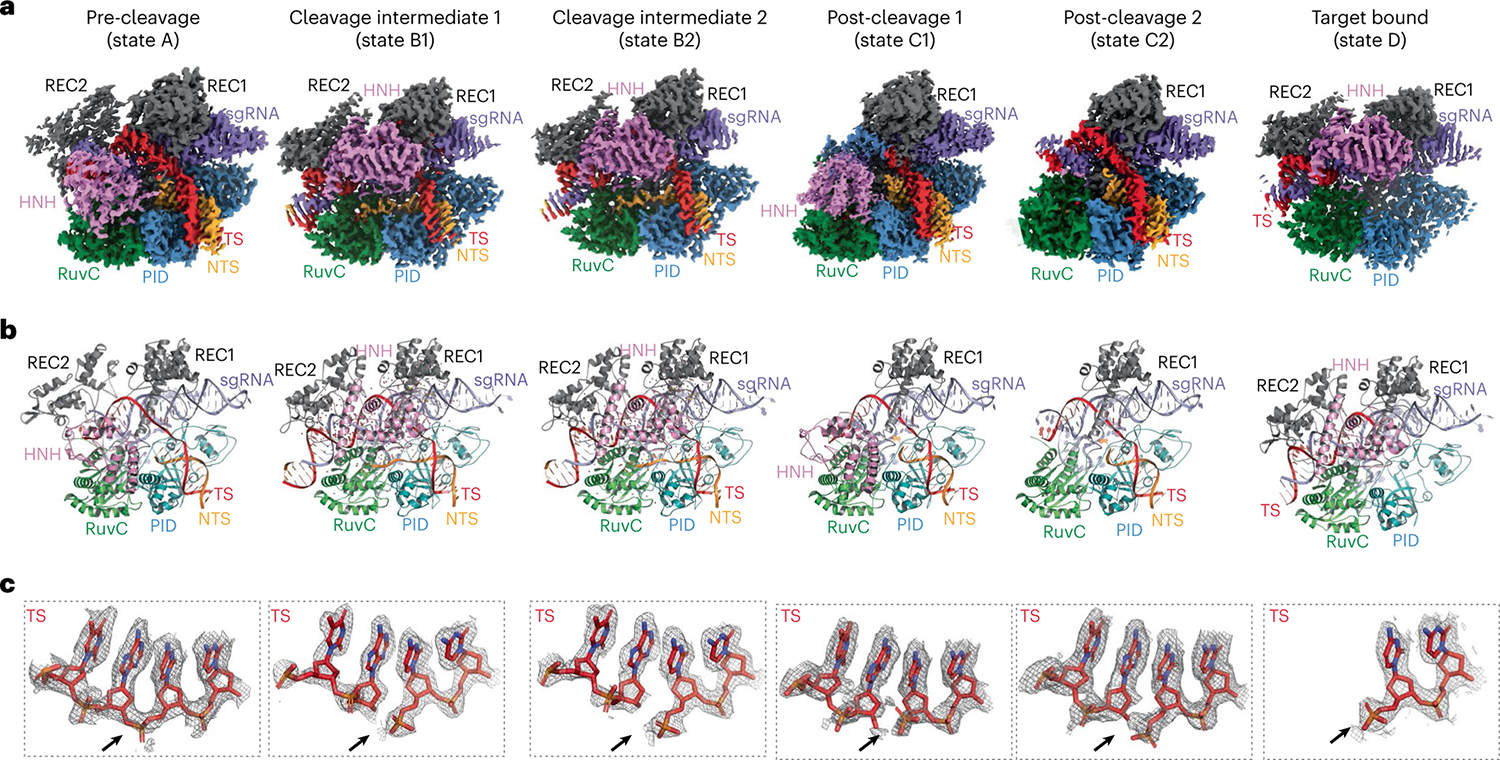
Controlling the activity of the CRISPR-Cas9 system is essential to its safe adoption for clinical and research applications. Although the conformational dynamics of Cas9 are known to control its enzymatic activity, details of how Cas9 influences the catalytic processes at both nuclease domains remain elusive. Here we report five cryo-electron microscopy structures of the active Cas9 complex along the reaction path at 2.2-2.9 Å resolution. We observed that a large movement in one nuclease domain, triggered by the cognate DNA, results in noticeable changes in the active site of the other domain that is required for metal coordination and catalysis. Furthermore, the conformations synchronize the reaction intermediates, enabling coupled cutting of the two DNA strands. Consistent with the roles of conformations in organizing the active sites, adjustments to the metal-coordination residues lead to altered metal specificity of Cas9 and commonly used Cas9 in cells.
控制CRISPR-Cas9系统的活性对于其在临床和研究应用中的安全采用至关重要。虽然已知Cas9的构象动力学控制其酶活性,但Cas9如何影响两个核酸酶结构域催化过程的细节仍不清楚。在此,我们报告了活性Cas9复合物沿反应路径的五个冷冻电子显微镜结构,分辨率为2.2-2.9埃。我们观察到,由同源DNA触发的一个核酸酶结构域的大幅移动,导致另一个结构域的活性位点发生显著变化,而这是金属配位和催化所必需的。此外,这些构象使反应中间体同步,从而实现两条DNA链的协同切割。与构象在组织活性位点中的作用一致,对金属配位残基的调整导致Cas9和细胞中常用的Cas9的金属特异性发生改变。