Casalino Lorenzo, Nierzwicki Łukasz, Jinek Martin, Palermo Giulia
Department of Chemistry and Biochemistry, University of California San Diego, La Jolla, California 92093, United States.
Department of Bioengineering, University of California Riverside, Riverside, California 92521, United States.
ACS Catal. 2020 Nov 20;10(22):13596-13605. doi: 10.1021/acscatal.0c03566. Epub 2020 Nov 10.
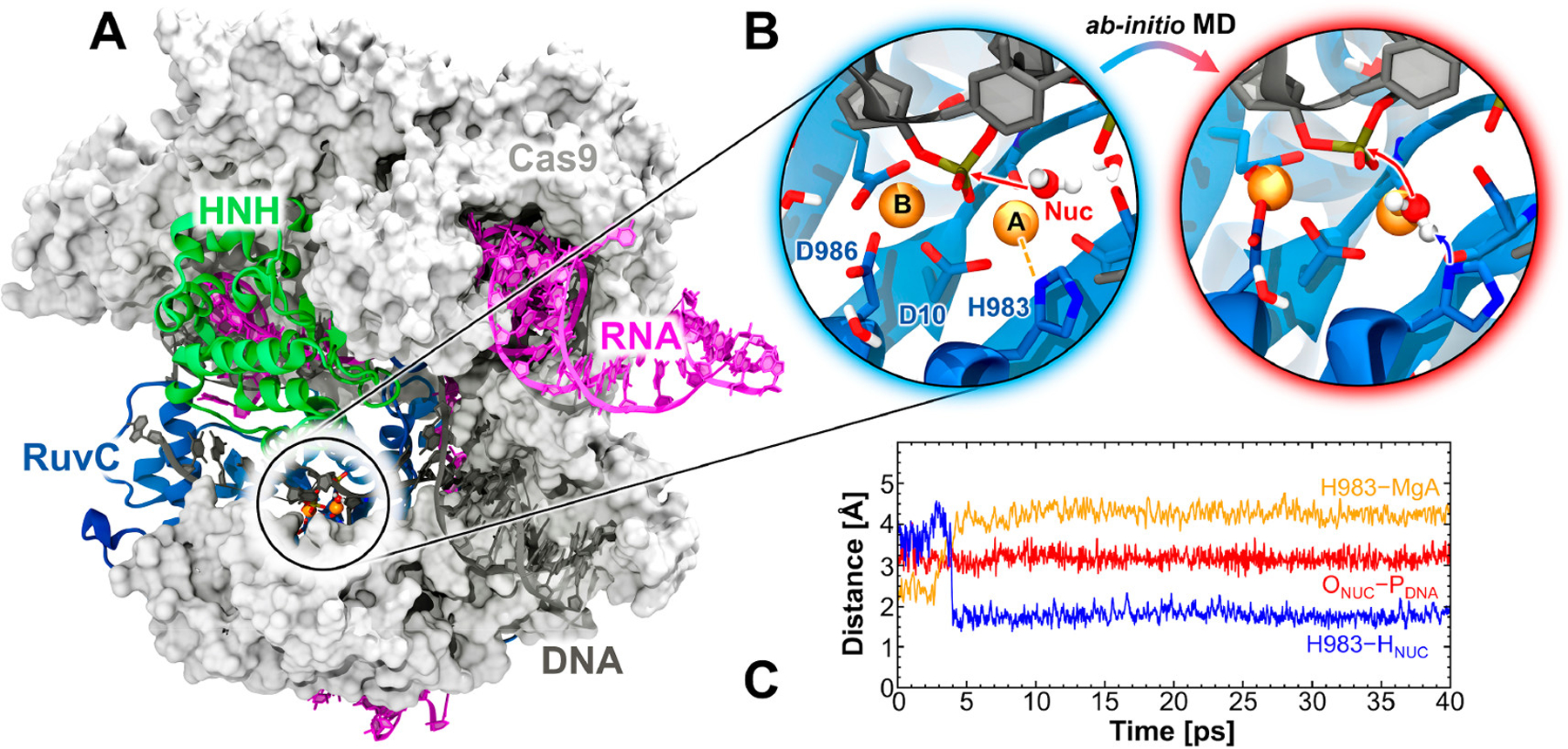
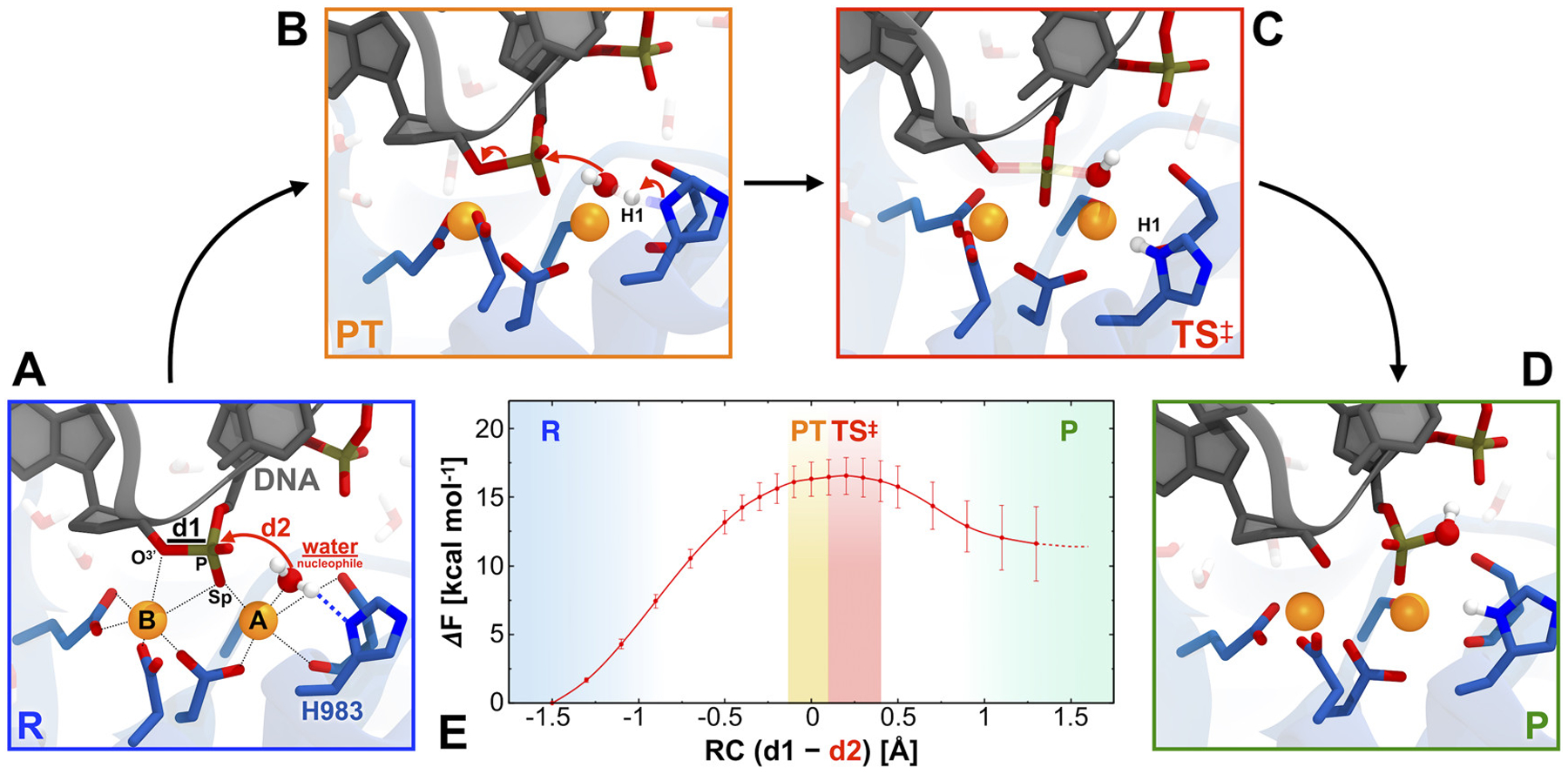
CRISPR-Cas9 is a cutting-edge genome editing technology, which uses the endonuclease Cas9 to introduce mutations at desired sites of the genome. This revolutionary tool is promising to treat a myriad of human genetic diseases. Nevertheless, the molecular basis of DNA cleavage, which is a fundamental step for genome editing, has not been established. Here, quantum-classical molecular dynamics (MD) and free energy methods are used to disclose the two-metal-dependent mechanism of phosphodiester bond cleavage in CRISPR-Cas9. MD reveals a conformational rearrangement of the Mg-bound RuvC active site, which entails the relocation of H983 to act as a general base. Then, the DNA cleavage proceeds through a concerted associative pathway fundamentally assisted by the joint dynamics of the two Mg ions. This clarifies previous controversial experimental evidence, which could not fully establish the catalytic role of the conserved H983 and the metal cluster conformation. The comparison with other two-metal-dependent enzymes supports the identified mechanism and suggests a common catalytic strategy for genome editing and recombination. Overall, the non-target DNA cleavage catalysis described here resolves a fundamental open question in the CRISPR-Cas9 biology and provides valuable insights for improving the catalytic efficiency and the metal-dependent function of the Cas9 enzyme, which are at the basis of the development of genome editing tools.
CRISPR-Cas9是一种前沿的基因组编辑技术,它利用核酸内切酶Cas9在基因组的期望位点引入突变。这一革命性工具有望治疗众多人类遗传疾病。然而,作为基因组编辑基础步骤的DNA切割的分子机制尚未明确。在此,采用量子经典分子动力学(MD)和自由能方法来揭示CRISPR-Cas9中磷酸二酯键切割的双金属依赖机制。分子动力学揭示了与镁结合的RuvC活性位点的构象重排,这需要H983重新定位以充当通用碱。然后,DNA切割通过一个协同的缔合途径进行,该途径从根本上由两个镁离子的联合动力学辅助。这澄清了先前有争议的实验证据,这些证据无法完全确定保守的H983和金属簇构象的催化作用。与其他双金属依赖酶的比较支持了所确定的机制,并提出了基因组编辑和重组的共同催化策略。总体而言,此处描述的非靶向DNA切割催化解决了CRISPR-Cas9生物学中一个基本的开放性问题,并为提高Cas9酶的催化效率和金属依赖功能提供了有价值的见解,而这是基因组编辑工具开发的基础。