Rezasoltani Sama, Azizmohammad Looha Mehdi, Asadzadeh Aghdaei Hamid, Jasemi Seyedesomayeh, Sechi Leonardo Antonio, Gazouli Maria, Sadeghi Amir, Torkashvand Shirin, Baniali Reyhaneh, Schlüter Hartmut, Zali Mohammad Reza, Feizabadi Mohammad Mehdi
Section Mass Spectrometric Proteomics, Diagnostic Center, University Medical Center Hamburg-Eppendorf (UKE), 20246, Hamburg, Germany.
Division of Oral Microbiology and Immunology, Department of Operative Dentistry, Periodontology and Preventive Dentistry, RWTH University Hospital, 52057 Aachen, Germany.
Gut Pathog. 2024 Feb 20;16(1):9. doi: 10.1186/s13099-024-00604-0.
Colorectal cancer (CRC) poses a significant healthcare challenge, accounting for nearly 6.1% of global cancer cases. Early detection, facilitated by population screening utilizing innovative biomarkers, is pivotal for mitigating CRC incidence. This study aims to scrutinize the fecal and salivary microbiomes of CRC-positive individuals (CPs) in comparison to CRC-negative counterparts (CNs) to enhance early CRC diagnosis through microbial biomarkers.
A total of 80 oral and stool samples were collected from Taleghani Hospital, Shahid Beheshti University of Medical Sciences, Tehran, Iran, encompassing both CPs and CNs undergoing screening. Microbial profiling was conducted using 16S rRNA sequencing assays, employing the Nextera XT Index Kit on an Illumina NovaSeq platform.
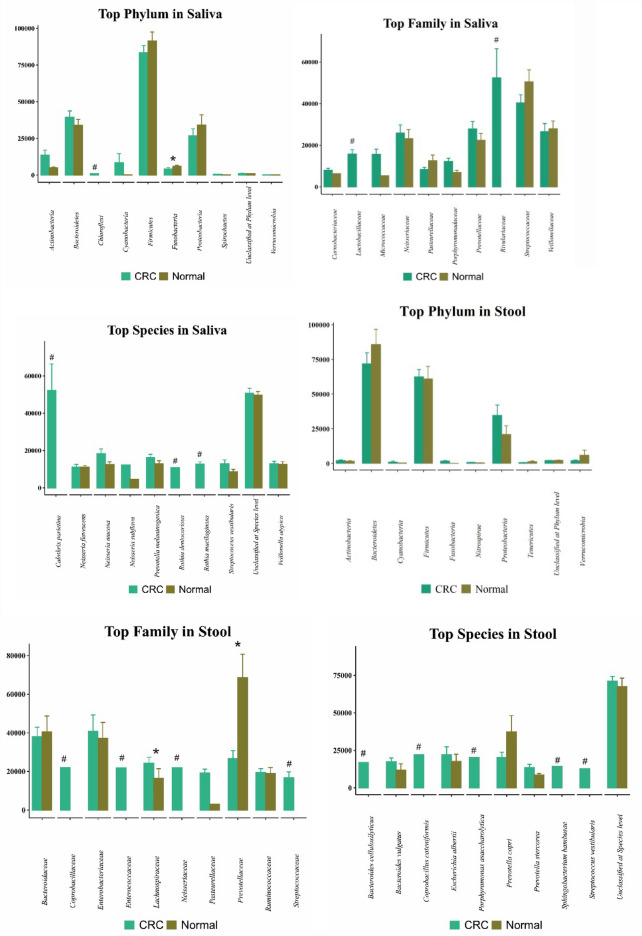
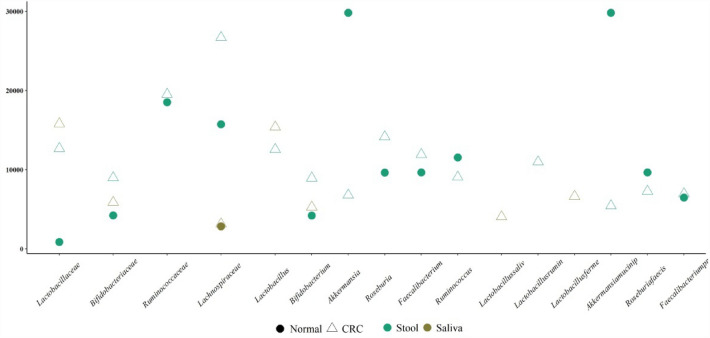
Distinct microbial profiles were observed in saliva and stool samples of CPs, diverging significantly from those of CNs at various taxonomic levels, including phylum, family, and species. Saliva samples from CPs exhibited abundance of Calothrix parietina, Granulicatella adiacens, Rothia dentocariosa, and Rothia mucilaginosa, absent in CNs. Additionally, Lachnospiraceae and Prevotellaceae were markedly higher in CPs' feces, while the Fusobacteria phylum was significantly elevated in CPs' saliva. Conversely, the non-pathogenic bacterium Akkermansia muciniphila exhibited a significant decrease in CPs' fecal samples compared to CNs.
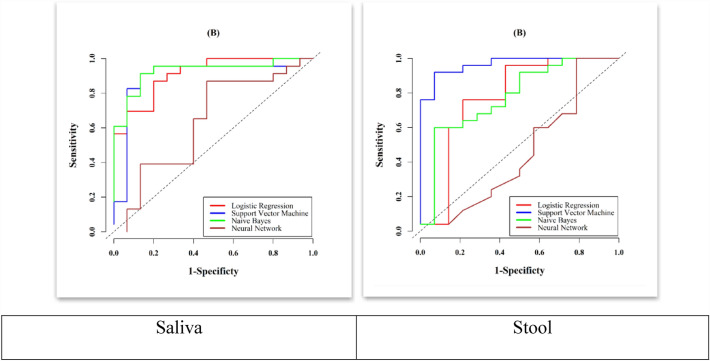
Through meticulous selection of saliva and stool microbes based on Mean Decrease GINI values and employing logistic regression for saliva and support vector machine models for stool, we successfully developed a microbiota test with heightened sensitivity and specificity for early CRC detection.
结直肠癌(CRC)对医疗保健构成重大挑战,占全球癌症病例的近6.1%。利用创新生物标志物进行人群筛查以促进早期检测,对于降低CRC发病率至关重要。本研究旨在仔细研究CRC阳性个体(CPs)与CRC阴性个体(CNs)的粪便和唾液微生物群,以通过微生物生物标志物加强CRC的早期诊断。
从伊朗德黑兰沙希德·贝赫什提医科大学塔莱加尼医院收集了80份口腔和粪便样本,包括接受筛查的CPs和CNs。使用16S rRNA测序分析进行微生物谱分析,在Illumina NovaSeq平台上使用Nextera XT索引试剂盒。
在CPs的唾液和粪便样本中观察到不同的微生物谱,在包括门、科和种在内的各个分类水平上与CNs的微生物谱有显著差异。CPs的唾液样本中显示出壁生眉藻、毗邻颗粒链菌、龋齿罗氏菌和黏液罗氏菌的丰度,而CNs中不存在这些菌。此外,毛螺菌科和普雷沃氏菌科在CPs的粪便中明显更高,而梭杆菌门在CPs的唾液中显著升高。相反,与CNs相比,非致病性细菌嗜黏蛋白阿克曼氏菌在CPs的粪便样本中显著减少。
通过基于平均减少GINI值精心选择唾液和粪便微生物,并对唾液采用逻辑回归以及对粪便采用支持向量机模型,我们成功开发了一种对CRC早期检测具有更高灵敏度和特异性的微生物群检测方法。