Department of Chemistry, University of New Hampshire, Durham, New Hampshire 03824, United States.
Department of Chemical Engineering & Bioengineering, University of New Hampshire, Durham, New Hampshire 03824, United States.
Bioconjug Chem. 2024 Mar 20;35(3):371-380. doi: 10.1021/acs.bioconjchem.3c00561. Epub 2024 Feb 25.
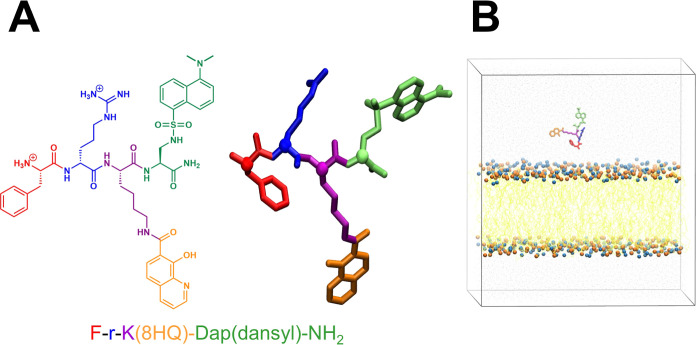
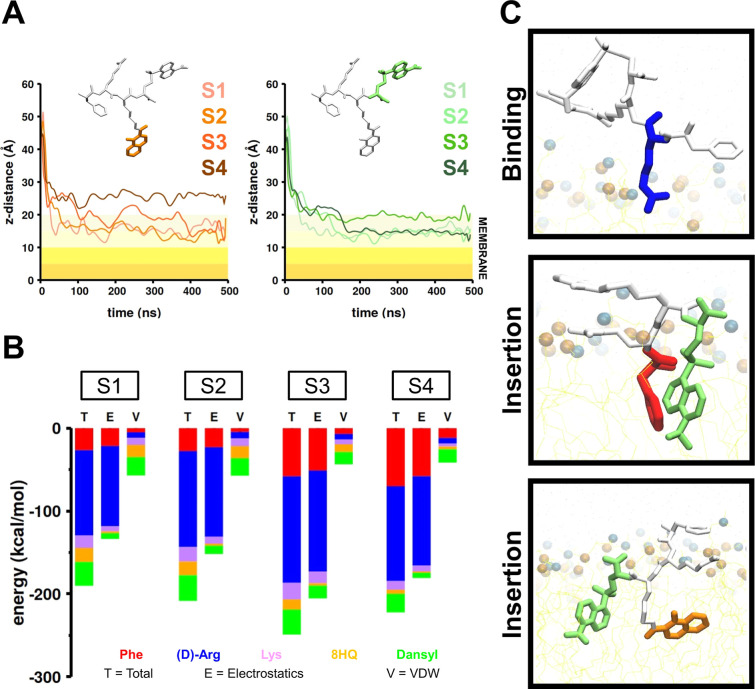
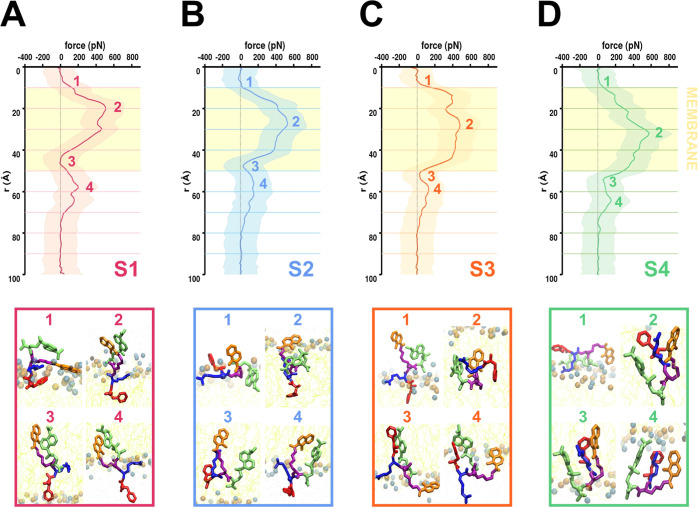
The Szeto-Schiller (SS) peptides are a subclass of cell-penetrating peptides that can specifically target mitochondria and mediate conditions caused by mitochondrial dysfunction. In this work, we constructed an iron-chelating SS peptide and studied its interaction with a mitochondrial-mimicking membrane using atomistic molecular dynamics (MD) simulations. We report that the peptide/membrane interaction is thermodynamically favorable, and the localization of the peptide to the membrane is driven by electrostatic interactions between the cationic residues and the anionic phospholipid headgroups. The insertion of the peptide into the membrane is driven by hydrophobic interactions between the aromatic side chains in the peptide and the lipid acyl tails. We also probed the translocation of the peptide across the membrane by applying nonequilibrium steered MD simulations and resolved the translocation pathway, free energy profile, and metastable states. We explored four distinct orientations of the peptide along the translocation pathway and found that one orientation was energetically more favorable than the other orientations. We tested a significantly slower pulling velocity on the most thermodynamically favorable system and compared metastable states during peptide translocation. We found that the peptide can optimize hydrophobic interactions with the membrane by having aromatic side chains interacting with the lipid acyl tails instead of forming π-π interactions with each other. The mechanistic insights emerging from our work will potentially facilitate improved peptide design with enhanced activity.
Szeto-Schiller(SS)肽是一类细胞穿透肽,可特异性靶向线粒体,并介导由线粒体功能障碍引起的疾病。在这项工作中,我们构建了一种铁螯合 SS 肽,并使用原子分子动力学(MD)模拟研究了它与模拟线粒体的膜的相互作用。我们报告说,肽/膜的相互作用在热力学上是有利的,并且肽在膜上的定位是由阳离子残基与带负电荷的磷脂头基之间的静电相互作用驱动的。肽插入膜是由肽中的芳香侧链与脂质酰基尾部之间的疏水相互作用驱动的。我们还通过应用非平衡导向 MD 模拟来探测肽穿过膜的易位,并解析了易位途径、自由能谱和亚稳态。我们沿着易位途径探索了肽的四个不同取向,发现一种取向比其他取向在能量上更有利。我们在最热力学有利的系统上测试了显著较慢的拉动速度,并比较了肽易位过程中的亚稳态。我们发现,通过让芳香侧链与脂质酰基尾部相互作用,而不是彼此形成 π-π 相互作用,肽可以优化与膜的疏水相互作用。我们的工作中出现的机制见解将有助于改进具有增强活性的肽设计。