Division of Structural Studies, Medical Research Council Laboratory of Molecular Biology, Cambridge, UK.
Wellcome Sanger Institute, Wellcome Genome Campus, Hinxton, UK.
J Cell Biol. 2024 May 6;223(5). doi: 10.1083/jcb.202309084. Epub 2024 Feb 26.
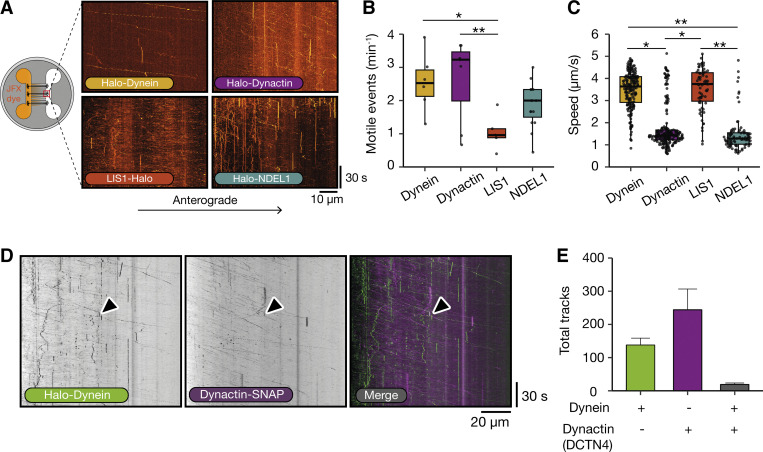
Axonal transport is essential for neuronal survival. This is driven by microtubule motors including dynein, which transports cargo from the axon tip back to the cell body. This function requires its cofactor dynactin and regulators LIS1 and NDEL1. Due to difficulties imaging dynein at a single-molecule level, it is unclear how this motor and its regulators coordinate transport along the length of the axon. Here, we use a neuron-inducible human stem cell line (NGN2-OPTi-OX) to endogenously tag dynein components and visualize them at a near-single molecule regime. In the retrograde direction, we find that dynein and dynactin can move the entire length of the axon (>500 µm). Furthermore, LIS1 and NDEL1 also undergo long-distance movement, despite being mainly implicated with the initiation of dynein transport. Intriguingly, in the anterograde direction, dynein/LIS1 moves faster than dynactin/NDEL1, consistent with transport on different cargos. Therefore, neurons ensure efficient transport by holding dynein/dynactin on cargos over long distances but keeping them separate until required.
轴突运输对于神经元的存活至关重要。这是由微管马达驱动的,包括向细胞体运输货物的动力蛋白,其功能需要共因子 dynactin 以及调节剂 LIS1 和 NDEL1。由于在单分子水平上对动力蛋白进行成像存在困难,因此尚不清楚该马达及其调节剂如何协调沿轴突长度的运输。在这里,我们使用神经元诱导的人类干细胞系(NGN2-OPTi-OX)对动力蛋白成分进行内源性标记,并在近单分子水平下对其进行可视化。在逆行方向上,我们发现动力蛋白和 dynactin 可以移动整个轴突长度(>500 µm)。此外,LIS1 和 NDEL1 也会发生长距离运动,尽管它们主要与动力蛋白运输的起始有关。有趣的是,在顺行方向上,动力蛋白/LIS1 的移动速度快于 dynactin/NDEL1,这与不同货物上的运输一致。因此,神经元通过在长距离上保持动力蛋白/dynactin 在货物上,同时在需要时将它们分开,从而确保有效的运输。