Rowett Institute, University of Aberdeen, Aberdeen, Scotland.
Institue of Medical Sciences, University of Aberdeen, Aberdeen, Scotland.
PLoS One. 2024 Feb 29;19(2):e0290052. doi: 10.1371/journal.pone.0290052. eCollection 2024.
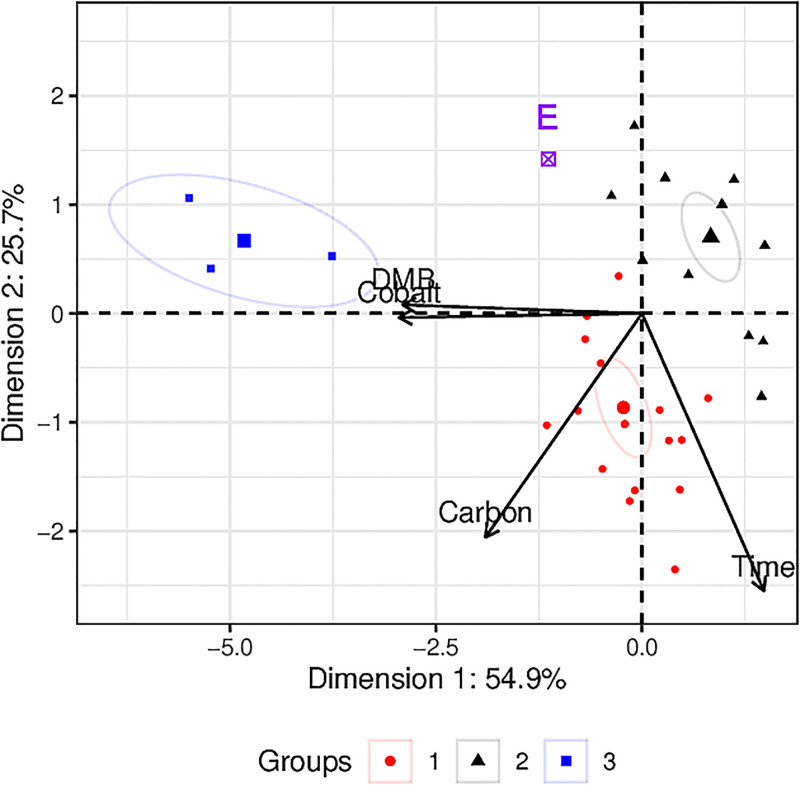
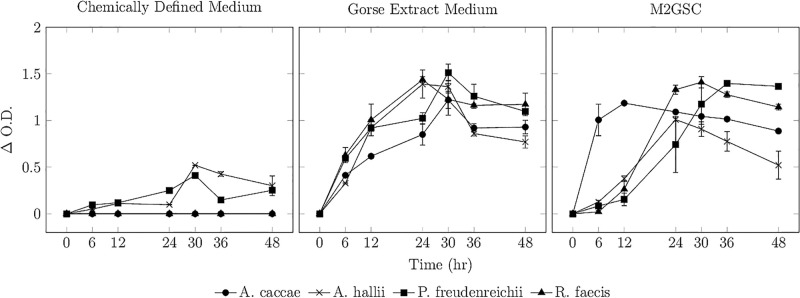
Many commensal gut microbes are recognized for their potential to synthesize vitamin B12, offering a promising avenue to address deficiencies through probiotic supplementation. While bioinformatics tools aid in predicting B12 biosynthetic potential, empirical validation remains crucial to confirm production, identify cobalamin vitamers, and establish biosynthetic yields. This study investigates vitamin B12 production in three human colonic bacterial species: Anaerobutyricum hallii DSM 3353, Roseburia faecis DSM 16840, and Anaerostipes caccae DSM 14662, along with Propionibacterium freudenreichii DSM 4902 as a positive control. These strains were selected for their potential use as probiotics, based on speculated B12 production from prior bioinformatic analyses. Cultures were grown in M2GSC, chemically defined media (CDM), and Gorse extract medium (GEM). The composition of GEM was similar to CDM, except that the carbon and nitrogen sources were replaced with the protein-depleted liquid waste obtained after subjecting Gorse to a leaf protein extraction process. B12 yields were quantified using liquid chromatography with tandem mass spectrometry. The results suggested that the three butyrate-producing strains could indeed produce B12, although the yields were notably low and were detected only in the cell lysates. Furthermore, B12 production was higher in GEM compared to M2GSC medium. The positive control, P. freudenreichii DSM 4902 produced B12 at concentrations ranging from 7 ng mL-1 to 12 ng mL-1. Univariate-scaled Principal Component Analysis (PCA) of data from previous publications investigating B12 production in P. freudenreichii revealed that B12 yields diminished when the carbon source concentration was ≤30 g L-1. In conclusion, the protein-depleted wastes from the leaf protein extraction process from Gorse can be valorised as a viable substrate for culturing B12-producing colonic gut microbes. Furthermore, this is the first report attesting to the ability of A. hallii, R. faecis, and A. caccae to produce B12. However, these microbes seem unsuitable for industrial applications owing to low B12 yields.
许多共生肠道微生物因其合成维生素 B12 的潜力而受到关注,通过益生菌补充来解决维生素 B12 缺乏症提供了一种有前途的途径。虽然生物信息学工具有助于预测 B12 生物合成潜力,但经验验证对于确认生产、识别钴胺素变体和建立生物合成产量仍然至关重要。本研究调查了三种人类结肠细菌物种(Anaerobutyricum hallii DSM 3353、Roseburia faecis DSM 16840 和 Anaerostipes caccae DSM 14662)以及丙酸杆菌(Propionibacterium freudenreichii DSM 4902)生产维生素 B12 的情况,后者作为阳性对照。这些菌株是根据先前的生物信息学分析推测出的 B12 生产情况,被选为潜在的益生菌使用。培养物在 M2GSC、化学定义培养基 (CDM) 和金雀花提取物培养基 (GEM) 中生长。GEM 的组成与 CDM 相似,只是将碳源和氮源替换为经过金雀花叶片蛋白提取过程后获得的富含蛋白质的液体废物。使用液相色谱-串联质谱法定量 B12 产量。结果表明,这三种丁酸盐产生菌确实可以产生 B12,尽管产量明显较低,仅在细胞裂解物中检测到。此外,与 M2GSC 培养基相比,GEM 中 B12 的产量更高。阳性对照,丙酸杆菌(Propionibacterium freudenreichii DSM 4902)产生的 B12 浓度范围为 7ng/mL 至 12ng/mL。对以前研究丙酸杆菌(Propionibacterium freudenreichii)B12 生产的数据进行单变量比例主成分分析(PCA)表明,当碳源浓度≤30g/L 时,B12 产量会降低。总之,金雀花叶片蛋白提取过程中的富含蛋白质的废物可以作为培养结肠肠道微生物生产 B12 的可行底物加以利用。此外,这是首次证明 A. hallii、R. faecis 和 A. caccae 能够产生 B12。然而,由于 B12 产量低,这些微生物似乎不适合工业应用。