Departments of Ophthalmology and Neuroscience, Baylor College of Medicine, Houston, Texas 77030.
Departments of Ophthalmology and Neuroscience, Baylor College of Medicine, Houston, Texas 77030
J Neurosci. 2024 Apr 17;44(16):e1433232024. doi: 10.1523/JNEUROSCI.1433-23.2024.
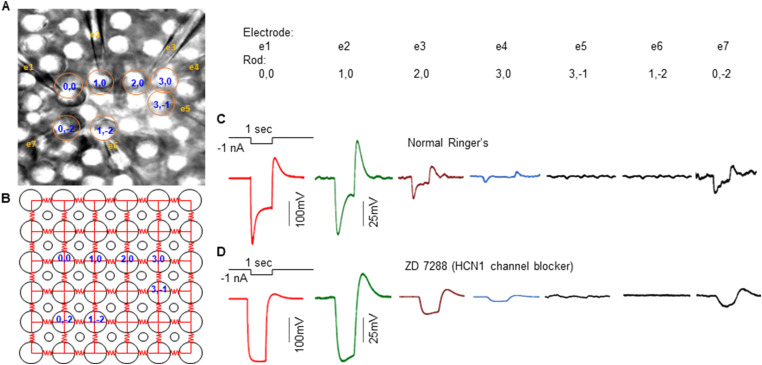
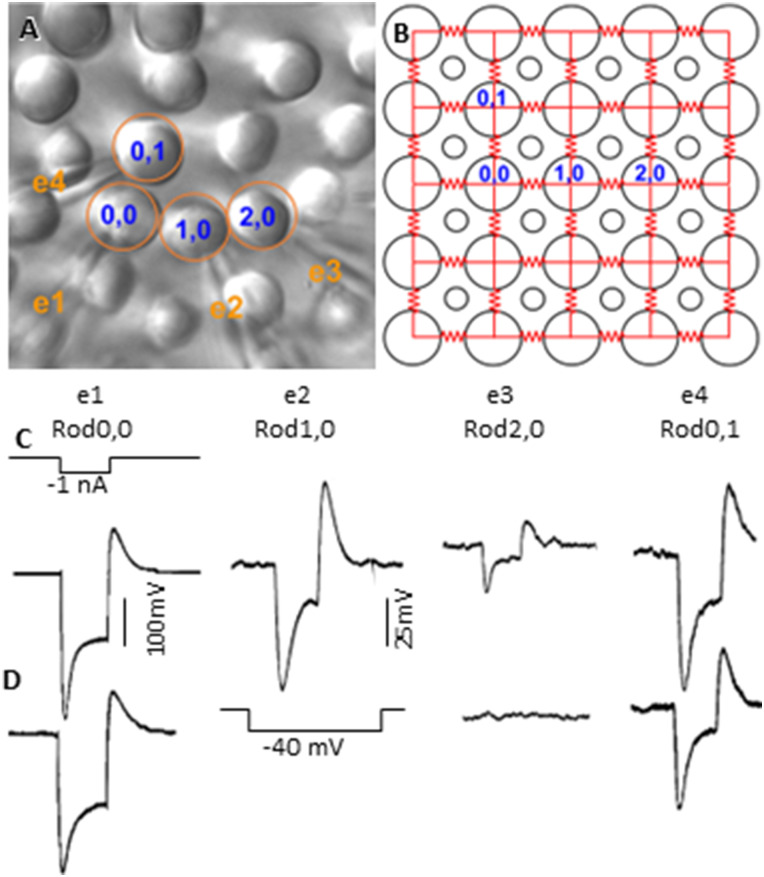
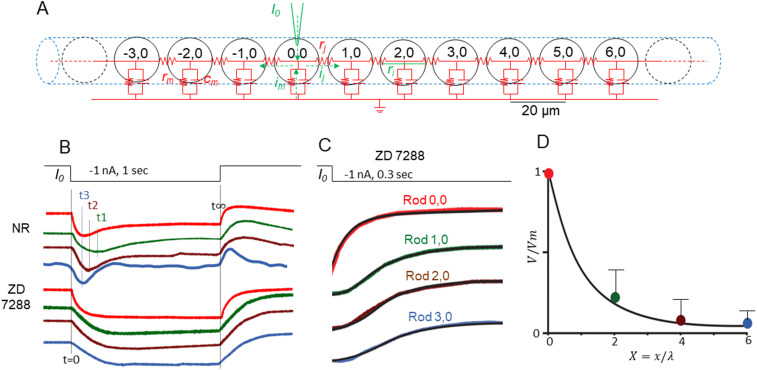
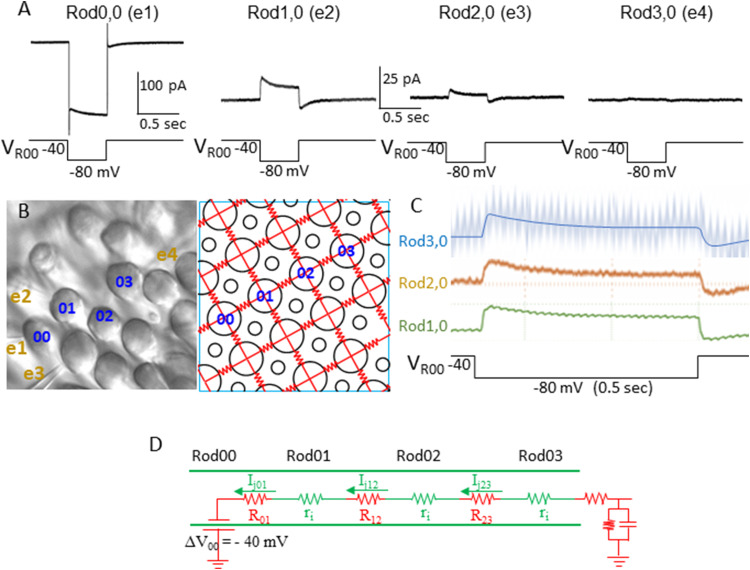
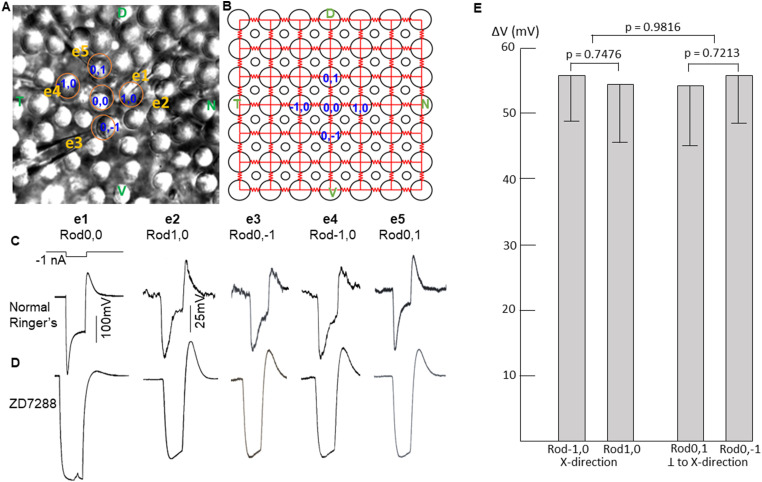
Photoreceptors are electrically coupled to one another, and the spatiotemporal properties of electrical synapses in a two-dimensional retinal network are still not well studied, because of the limitation of the single electrode or pair recording techniques which do not allow simultaneously measuring responses of multiple photoreceptors at various locations in the retina. A multiple electrode recording system is needed. In this study, we investigate the network properties of the two-dimensional rod coupled array of the salamander retina (both sexes were used) by using the newly available multiple patch electrode system that allows simultaneous recordings from up to eight cells and to determine the electrical connectivity among multiple rods. We found direct evidence that voltage signal spread in the rod-rod coupling network in the absence of (mediated by HCN channels) is passive and follows the linear cable equation. Under physiological conditions, shapes the network signal by progressively shortening the response time-to-peak of distant rods, compensating the time loss of signal traveling from distant rods to bipolar cell somas and facilitating synchronization of rod output signals. Under voltage-clamp conditions, current flow within the coupled rods follows Ohm's law, supporting the idea that nonlinear behaviors of the rod network are dependent on membrane voltage. Rod-rod coupling is largely symmetrical in the 2D array, and voltage-clamp blocking the next neighboring rod largely suppresses rod signal spread into the second neighboring rod, suggesting that indirect coupling pathways play a minor role in rod-rod coupling.
光感受器相互电耦合,二维视网膜网络中电突触的时空特性仍未得到很好的研究,这是因为单个电极或对电极记录技术的限制,这些技术不允许同时测量视网膜不同位置的多个光感受器的反应。需要一种多电极记录系统。在这项研究中,我们使用新的多通道微电极系统研究了蝾螈视网膜的二维杆状细胞偶联阵列的网络特性(使用了两性),该系统允许同时从多达 8 个细胞进行记录,并确定多个杆之间的电连接。我们发现了直接的证据表明,在没有(由 HCN 通道介导)的情况下,电压信号在杆-杆偶联网络中的传播是被动的,并遵循线性电缆方程。在生理条件下,通过逐渐缩短远距离杆的峰值响应时间,来塑造网络信号,补偿信号从远距离杆传播到双极细胞体的时间损失,并促进杆输出信号的同步。在电压钳条件下,耦合杆内的电流流动遵循欧姆定律,支持杆网络的非线性行为依赖于膜电压的观点。2D 阵列中的杆-杆耦合基本上是对称的,电压钳阻断下一个相邻的杆,很大程度上抑制了杆信号向第二个相邻的杆传播,表明间接耦合途径在杆-杆耦合中起次要作用。