Feng Yudong, Tu Chen, Li Ruijie, Wu Di, Yang Jie, Xia Yankai, Peijnenburg Willie J G M, Luo Yongming
CAS Key Laboratory of Soil Environment and Pollution Remediation, Institute of Soil Science, Chinese Academy of Sciences, Nanjing 210008, China.
University of Chinese Academy of Sciences, Beijing 100049, China.
Eco Environ Health. 2023 Aug 21;2(4):195-207. doi: 10.1016/j.eehl.2023.08.002. eCollection 2023 Dec.
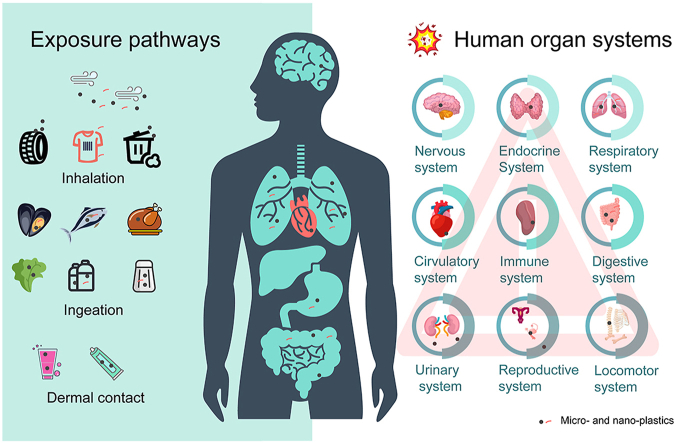
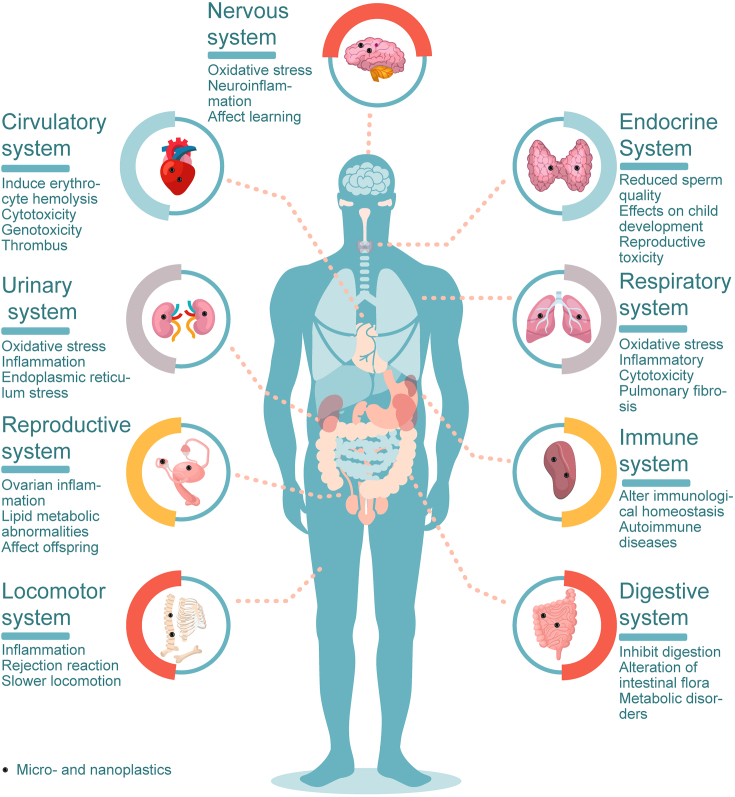
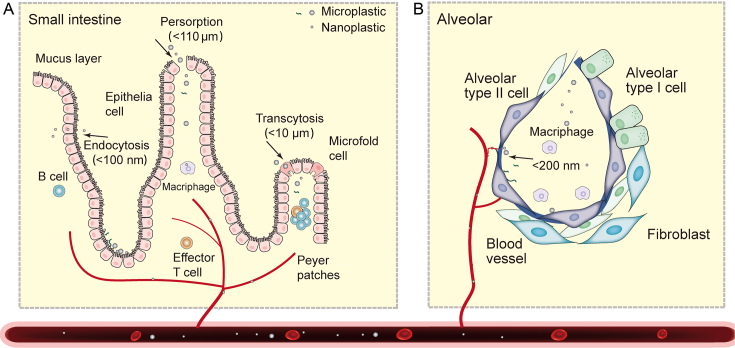
Micro- and nano-plastics (MNPs) pollution has become a pressing global environmental issue, with growing concerns regarding its impact on human health. However, evidence on the effects of MNPs on human health remains limited. This paper reviews the three routes of human exposure to MNPs, which include ingestion, inhalation, and dermal contact. It further discusses the potential routes of translocation of MNPs in human lungs, intestines, and skin, analyses the potential impact of MNPs on the homeostasis of human organ systems, and provides an outlook on future research priorities for MNPs in human health. There is growing evidence that MNPs are present in human tissues or fluids. Lab studies, including animal models and human-derived cell cultures, revealed that MNPs exposure could negatively affect human health. MNPs exposure could cause oxidative stress, cytotoxicity, disruption of internal barriers like the intestinal, the air-blood and the placental barrier, tissue damage, as well as immune homeostasis imbalance, endocrine disruption, and reproductive and developmental toxicity. Limitedly available epidemiological studies suggest that disorders like lung nodules, asthma, and blood thrombus might be caused or exacerbated by MNPs exposure. However, direct evidence for the effects of MNPs on human health is still scarce, and future research in this area is needed to provide quantitative support for assessing the risk of MNPs to human health.
微塑料和纳米塑料(MNPs)污染已成为一个紧迫的全球环境问题,人们对其对人类健康的影响越来越担忧。然而,关于MNPs对人类健康影响的证据仍然有限。本文综述了人类接触MNPs的三种途径,包括摄入、吸入和皮肤接触。进一步讨论了MNPs在人肺、肠道和皮肤中的潜在转运途径,分析了MNPs对人体器官系统稳态的潜在影响,并对MNPs在人类健康方面未来的研究重点进行了展望。越来越多的证据表明MNPs存在于人体组织或体液中。包括动物模型和人类细胞培养在内的实验室研究表明,接触MNPs会对人类健康产生负面影响。接触MNPs会导致氧化应激、细胞毒性、破坏肠道、气血和胎盘屏障等内部屏障、组织损伤,以及免疫稳态失衡、内分泌紊乱、生殖和发育毒性。有限的流行病学研究表明,肺结节、哮喘和血栓等疾病可能由接触MNPs引起或加重。然而,MNPs对人类健康影响的直接证据仍然很少,该领域未来的研究需要为评估MNPs对人类健康的风险提供定量支持。