John Awena, Bouillon-Minois Jean-Baptiste, Bagheri Reza, Pélissier Carole, Charbotel Barbara, Llorca Pierre-Michel, Zak Marek, Ugbolue Ukadike C, Baker Julien S, Dutheil Frederic
Université Clermont Auvergne, CHU Clermont-Ferrand, Occupational Medicine, Clermont-Ferrand, France.
Université Clermont Auvergne, CNRS, LaPSCo, Physiological and Psychosocial Stress, CHU Clermont-Ferrand, Emergency Medicine, Clermont-Ferrand, France.
Front Psychiatry. 2024 Feb 19;15:1326745. doi: 10.3389/fpsyt.2024.1326745. eCollection 2024.
Burnout is a public health problem with various health consequences, among which cardiovascular disease is the most investigated but still under debate. Our objective was to conduct a systematic review and meta-analysis on the influence of burnout on cardiovascular disease.
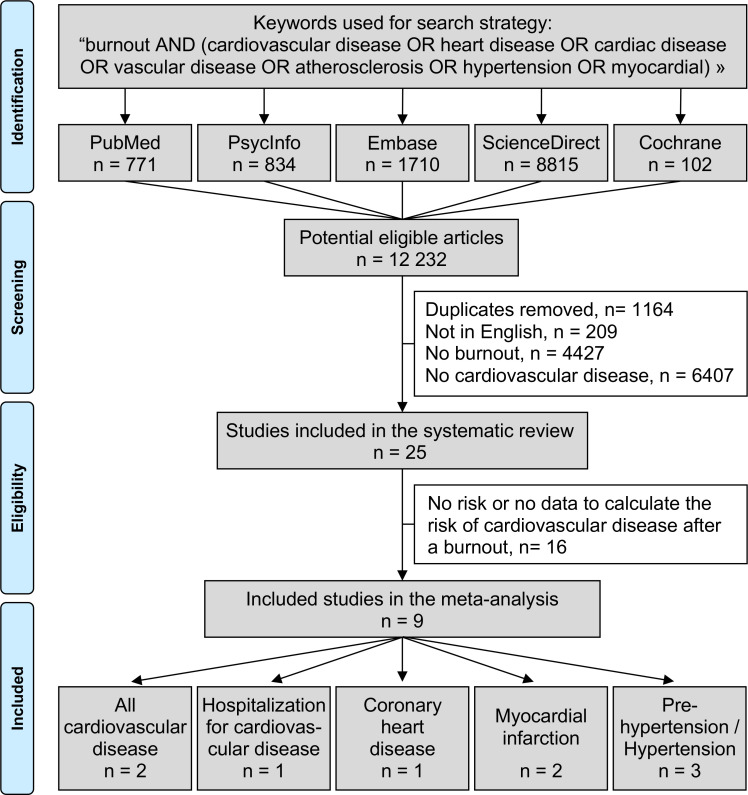
Studies reporting risk (odds ratio, relative risk, and hazard ratio) of cardiovascular disease following burnout were searched in PubMed, PsycINFO, Cochrane, Embase, and ScienceDirect. We performed a random-effect meta-analysis stratified by type of cardiovascular disease and searched for putative influencing variables. We performed sensitivity analyses using the most adjusted models and crude risks.
We included 25 studies in the systematic review and 9 studies in the meta-analysis (4 cross-sectional, 4 cohort, and 1 case-control study) for a total of 26,916 participants. Burnout increased the risk of cardiovascular disease by 21% (OR = 1.21, 95% CI 1.03 to 1.39) using the most adjusted risks and by 27% (OR = 1.27, 95% CI 1.10 to 1.43) using crude risks. Using stratification by type of cardiovascular disease and the most adjusted risks, having experienced burnout significantly increased the risk of prehypertension by 85% (OR = 1.85, 95% CI 1.00 to 2.70) and cardiovascular disease-related hospitalization by 10% (OR = 1.10, 95% CI 1.02 to 1.18), whereas the risk increase for coronary heart disease (OR = 1.79, 95% CI 0.79 to 2.79) and myocardial infarction (OR = 1.78, 95% CI 0.85 to 2.71) was not significant. Results were also similar using crude odds ratio. The risk of cardiovascular disease after a burnout was not influenced by gender. Insufficient data precluded other meta-regressions.
Burnout seems to increase the risk of cardiovascular disease, despite the few retrieved studies and a causality weakened by cross-sectional studies. However, numerous studies focused on the pathophysiology of cardiovascular risk linked to burnout, which may help to build a preventive strategy in the workplace.
职业倦怠是一个具有多种健康后果的公共卫生问题,其中心血管疾病是研究最多但仍存在争议的方面。我们的目的是对职业倦怠对心血管疾病的影响进行系统评价和荟萃分析。
在PubMed、PsycINFO、Cochrane、Embase和ScienceDirect数据库中检索关于职业倦怠后心血管疾病风险(比值比、相对风险和风险比)的研究。我们按心血管疾病类型进行随机效应荟萃分析,并寻找可能的影响变量。我们使用调整最充分的模型和粗略风险进行敏感性分析。
我们在系统评价中纳入了25项研究,在荟萃分析中纳入了9项研究(4项横断面研究、4项队列研究和1项病例对照研究),共有26916名参与者。使用调整最充分的风险时,职业倦怠使心血管疾病风险增加21%(比值比=1.21,95%置信区间1.03至1.39);使用粗略风险时,风险增加27%(比值比=1.27,95%置信区间1.10至1.43)。按心血管疾病类型分层并使用调整最充分的风险时,经历过职业倦怠显著使高血压前期风险增加85%(比值比=1.85,95%置信区间1.00至2.70),使心血管疾病相关住院风险增加10%(比值比=1.10,95%置信区间1.02至1.18),而冠心病(比值比=1.79,95%置信区间0.79至2.79)和心肌梗死(比值比=1.78,95%置信区间0.85至2.71)的风险增加不显著。使用粗略比值比时结果也相似。职业倦怠后的心血管疾病风险不受性别影响。数据不足无法进行其他meta回归分析。
尽管检索到的研究较少且横断面研究削弱了因果关系,但职业倦怠似乎会增加心血管疾病风险。然而,许多研究关注与职业倦怠相关的心血管风险的病理生理学,这可能有助于制定工作场所的预防策略。