Mohamed Nur Adam, Mohamed Yusuf Abdirisak, Haji Mohamud Rahma Yusuf, Gabow Adan Ali
Department of Psychiatry and Behavioral Sciences, Mogadishu Somali-Turkiye Recep Tayyip Erdogan Training and Research Hospital, Mogadishu 2526, Somalia.
Faculty of Medicine and Surgery, Somali National University, Mogadishu 2526, Somalia.
World J Psychiatry. 2025 Feb 19;15(2):98496. doi: 10.5498/wjp.v15.i2.98496.
Burnout syndrome is a significant issue among healthcare professionals worldwide, marked by depersonalization, emotional exhaustion, and a reduced sense of personal achievement. This psychological and physical burden profoundly affects healthcare professionals' quality of care and overall well-being. In Somalia, where the healthcare system faces numerous challenges, the escalating demand for medical services and inadequate resources, coupled with overwhelming workloads, long hours, and high-stress levels, make healthcare providers particularly vulnerable to burnout syndrome. This, in turn, affects both the mental health of healthcare personnel and the quality of care they provide.
To examine the prevalence and determinants of burnout syndrome among healthcare practitioners in Mogadishu, Somalia.
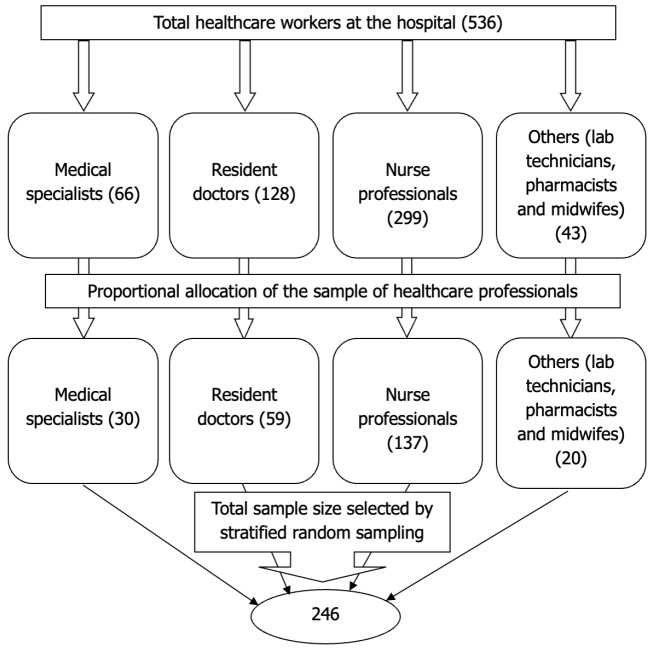
This cross-sectional prospective study was performed among 246 healthcare providers employed at a tertiary care hospital in Mogadishu, Somalia, who were recruited random sampling. Data were collected using questionnaires that covered sociodemographic, psychological, work-related characteristics, and burnout syndrome. Bivariate and multivariate logistic regression analyses were performed to identify the variables that correlated with burnout syndrome. The results were presented using adjusted odds ratios (AORs), 95%CIs, and values, with a cutoff of 0.05 for identifying significant associations.
Among the participants, 24% (95%CI: 18.8%-29.8%) exhibited symptoms of burnout syndrome. Factors associated with burnout included female gender (AOR = 6.60; 95%CI: 2.29-19.04), being married (AOR = 3.07; 95%CI: 1.14-8.28), being divorced or widowed (AOR = 5.84; 95%CI: 1.35-25.35), working more than 7 night shifts (AOR = 3.19; 95%CI: 1.30-7.82), having less than 5 years of job experience (AOR = 5.28; 95%CI: 1.29-21.65), experiencing poor sleep quality (AOR = 5.29; 95%CI: 1.88-14.89), and exhibiting depressive (AOR = 4.46; 95%CI: 1.59-12.53) and anxiety symptoms (AOR = 7.34; 95%CI: 2.49-21.60).
This study found that nearly one in four healthcare professionals suffers from burnout syndrome. Improving sleep quality, monitoring, and providing mental health support could enhance their well-being and patient care.
职业倦怠综合征是全球医疗保健专业人员面临的一个重大问题,其特征是人格解体、情感耗竭和个人成就感降低。这种心理和生理负担深刻影响着医疗保健专业人员的护理质量和整体幸福感。在索马里,医疗系统面临众多挑战,医疗服务需求不断增加而资源不足,再加上工作量过大、工作时间长和压力水平高,使得医疗保健提供者特别容易患上职业倦怠综合征。这反过来又影响了医护人员的心理健康及其提供的护理质量。
研究索马里摩加迪沙医疗从业者中职业倦怠综合征的患病率及其决定因素。
这项横断面前瞻性研究在索马里摩加迪沙一家三级护理医院工作的246名医疗保健提供者中进行,他们通过随机抽样招募。使用涵盖社会人口统计学、心理、工作相关特征和职业倦怠综合征的问卷收集数据。进行二元和多因素逻辑回归分析以确定与职业倦怠综合征相关的变量。结果以调整后的优势比(AOR)、95%置信区间(CI)和P值表示,以0.05为界值来确定显著关联。
在参与者中,24%(95%CI:18.8%-29.8%)表现出职业倦怠综合征的症状。与职业倦怠相关的因素包括女性(AOR = 6.60;95%CI:2.29-19.04)、已婚(AOR = 3.07;9%CI:1.14-8.28)、离婚或丧偶(AOR = 5.84;95%CI:1.35-25.35)、值7个以上夜班(AOR = 3.19;95%CI:1.30-7.82)、工作经验少于5年(AOR = 5.28;95%CI:1.29-21.65)、睡眠质量差(AOR = 5.29;95%CI:1.88-14.89)以及表现出抑郁(AOR = 4.46;95%CI:1.59-12.53)和焦虑症状(AOR = 7.34;95%CI:2.49-21.60)。
本研究发现,近四分之一的医疗保健专业人员患有职业倦怠综合征。改善睡眠质量、进行监测并提供心理健康支持可以提高他们的幸福感和患者护理水平。