Noh Young Ho, Jung Kyoung In
Department of Ophthalmology, Seoul St. Mary's Hospital, College of Medicine, The Catholic University of Korea, Seoul, Korea.
Korean J Ophthalmol. 2024 Apr;38(2):137-146. doi: 10.3341/kjo.2023.0102. Epub 2024 Mar 7.
To investigate the relationship between myopia and obesity through direct measurements of fat content.
A cross-sectional study used a stratified, multistage survey, the Korea National Health and Nutrition Examination Survey (2008-2010). Subjects 19 years or older (n = 10,305) were included. Participants were divided into three groups according to refractive status: myopia (spherical equivalent [SE] ≤ -1.0 diopter [D]), emmetropia (-1.0 D < SE ≤ 1.0 D), and hyperopia (SE > 1.0 D). Obesity was investigated with assessment of fat mass and body mass index or waist circumference. Fat mass was measured with whole-body dual energy x-ray absorptiometry. Body fat percentage was calculated as (total fat mass / body weight × 100).
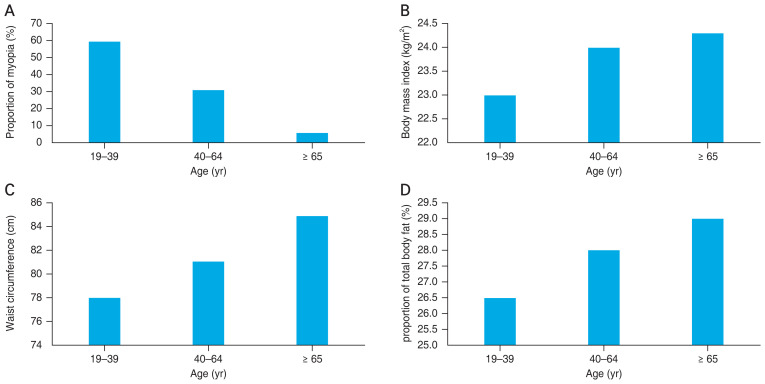
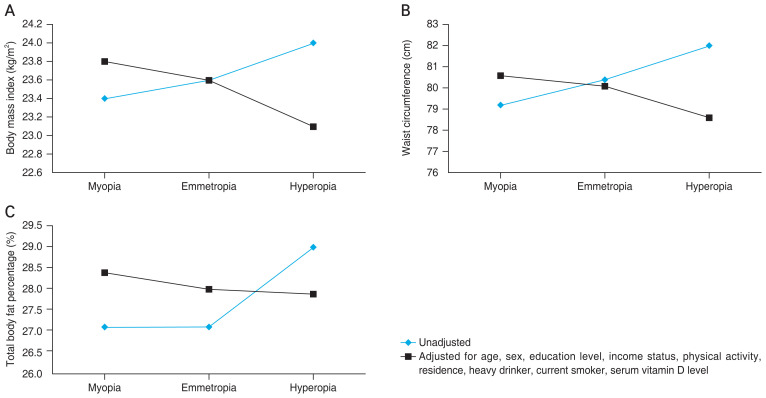
Higher obesity index was found in individuals with myopic eyes after adjustment for age, sex, education level, income status, physical activity, residence, and serum vitamin D level. The significant difference in total body fat percentages among myopia, emmetropia, and hyperopia was significant in the young age group (19-39 years, p < 0.05) but not in the middle age group (40-64 years) and the old age group (≥65 years). Individuals with a higher percentage of total body fat had greater odds ratios for myopia (fourth quartile of body fat; odds ratio, 1.352; 95% confidence interval, 1.178-1.551).
An association was found between adiposity and myopia in relatively young adults using direct measurements of fat mass.
通过直接测量脂肪含量来研究近视与肥胖之间的关系。
一项横断面研究采用分层多阶段调查,即韩国国家健康与营养检查调查(2008 - 2010年)。纳入19岁及以上的受试者(n = 10305)。参与者根据屈光状态分为三组:近视(等效球镜度[SE]≤ -1.0屈光度[D])、正视眼(-1.0 D<SE≤1.0 D)和远视(SE>1.0 D)。通过评估脂肪量、体重指数或腰围来调查肥胖情况。使用全身双能X线吸收法测量脂肪量。体脂百分比计算为(总脂肪量/体重×100)。
在对年龄、性别、教育水平、收入状况、身体活动、居住地和血清维生素D水平进行调整后,发现近视个体的肥胖指数更高。近视、正视眼和远视人群的全身脂肪百分比在年轻年龄组(19 - 39岁,p<0.05)存在显著差异,但在中年组(40 - 64岁)和老年组(≥65岁)中无显著差异。全身脂肪百分比更高的个体患近视的比值比更大(体脂第四四分位数;比值比,1.352;95%置信区间,1.178 - 1.551)。
通过直接测量脂肪量发现,在相对年轻的成年人中,肥胖与近视之间存在关联。