da Silva Fillipe de Biaggi Borges, Silva Luis Claudio Pimentel, Cunha Leonardo Provetti, Zacharias Leandro Cabral, Navajas Eduardo V, Monteiro Mario L R, Preti Rony C
Division of Ophthalmology, University of São Paulo Medical School, São Paulo, São Paulo, Brazil.
Division of Ophthalmology, Federal University of Juiz de Fora, Minas Gerais, Brazil.
Int J Retina Vitreous. 2024 Mar 8;10(1):26. doi: 10.1186/s40942-024-00541-9.
To assess the relationship between macular choroidal thickness (CT) measurements and retinal sensitivity (RS) in eyes with myopia and different stages of myopic maculopathy.
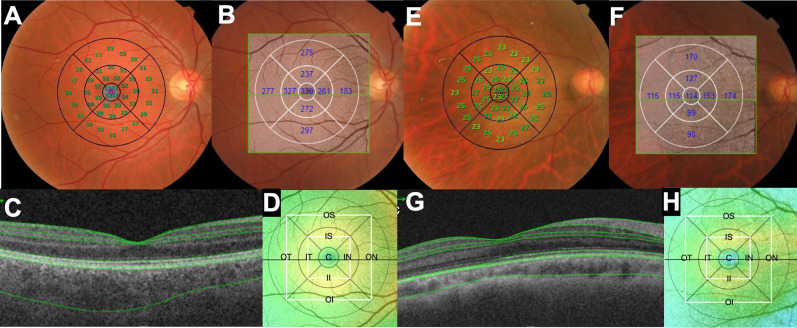
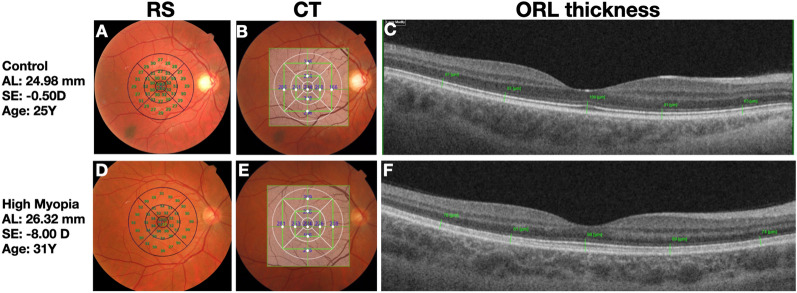
A masked, cross-sectional, and consecutive study involving patients with emmetropia/myopia (control group) and high myopia (HM) eyes. Automated choroidal thickness (CT) and manual outer retinal layer (ORL) thickness were acquired using swept-source optical coherence tomography, while retinal sensitivity (RS) assessed by microperimetry (MP3) in all regions of the macular Early Treatment Diabetic Retinopathy Study (ETDRS) grid. Comparisons were made between groups, and correlations were performed among these measurements, demographic and ocular parameters and myopic maculopathy classification.
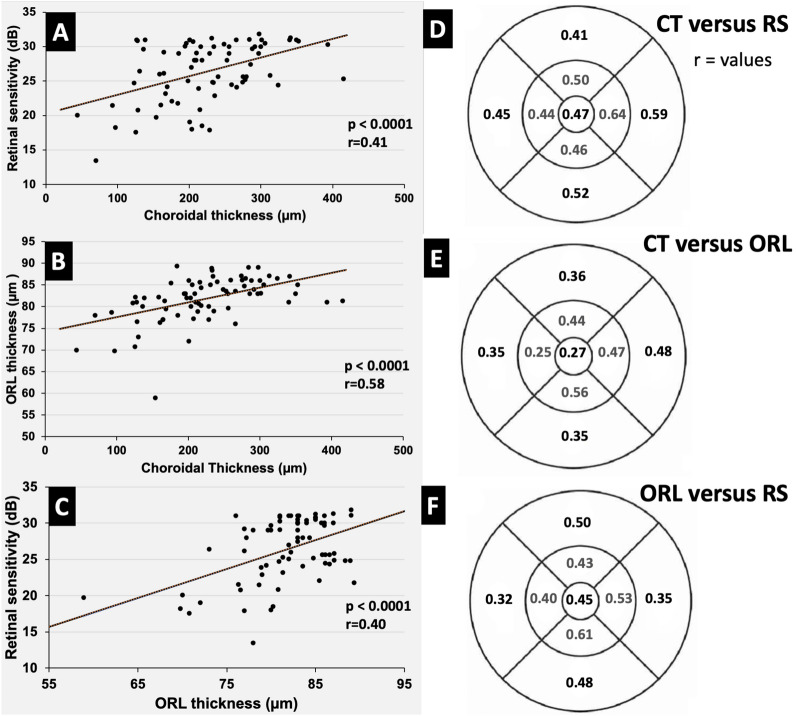
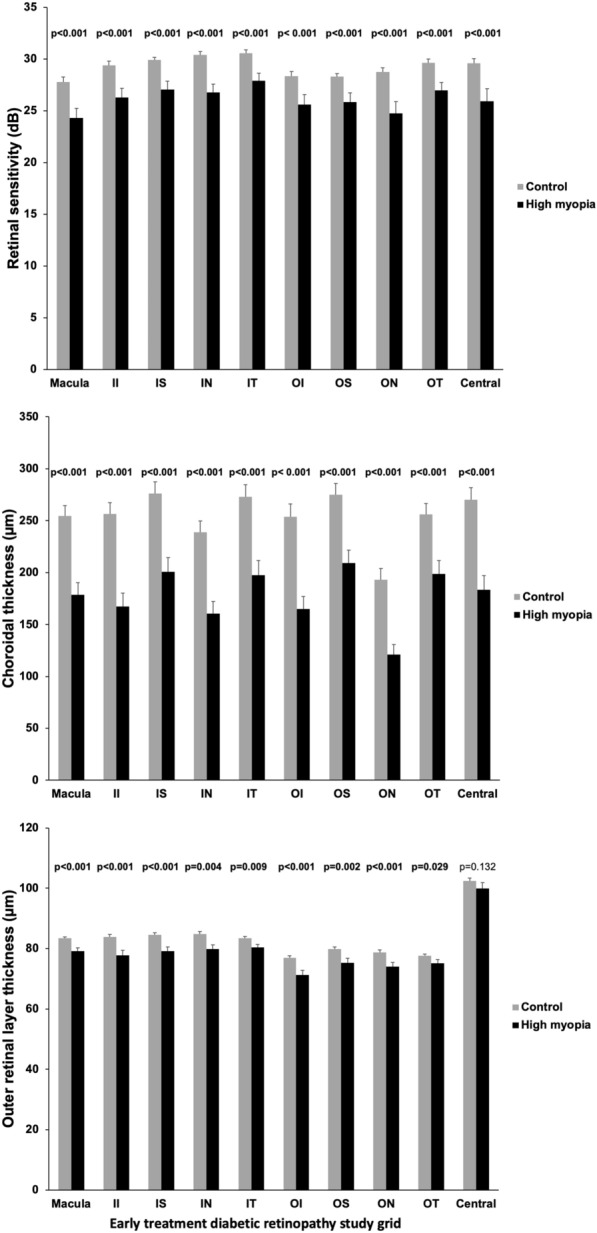
A total of 37 (74 eyes) patients were included in the study. The mean age was 39 ± 13 years, and 28 patients (76%) were female. HM eyes exhibited inferior best-corrected visual acuity and a more advanced myopic maculopathy classification compared to the control group. The mean macular CT were 255 and 179 μm in the control and HM eyes (P < 0.001), respectively. In the HM eyes, superior ETDRS region presented the greatest values. Mean RS in control and HM groups was 28 and 24 dB (P = 0.001), respectively. Inner temporal followed by superior, were the regions of higher RS. Mean ORL thickness was 83 and 79 μm (P < 0.001), in the control and HM groups, respectively. The inner temporal ETDRS region presented the thickest measure. CT correlated significantly with RS (r = 0.41, P < 0.001) and ORL thickness, (r = 0.58, P < 0.001), which also correlated with RS (r = 0.40, P < 0.001). Spherical equivalent, axial length and myopic maculopathy stage were the parameters that most correlated with CT, RS and ORL thickness. For every 100 μm increase in thickening of CT there was an average increase of 3.4 μm in ORL thickness and 2.7 dB in RS. Myopic maculopathy classification demonstrated influence only with CT.
Myopia degree is related to ORL and choroidal thinning and deterioration of retinal sensitivity in some ETDRS regions of the macula. Choroidal thinning is associated to with a decline of retinal sensitivity, thinning of ORL, and worsening of myopic maculopathy classification, so new treatments are necessary to prevent myopia progression.
评估近视及不同阶段近视性黄斑病变患者的黄斑脉络膜厚度(CT)测量值与视网膜敏感度(RS)之间的关系。
一项涉及正视眼/近视眼(对照组)和高度近视眼(HM)患者的单盲、横断面、连续性研究。使用扫频光学相干断层扫描获取自动脉络膜厚度(CT)和手动测量的外层视网膜(ORL)厚度,同时通过微视野计(MP3)评估黄斑早期糖尿病性视网膜病变研究(ETDRS)网格所有区域的视网膜敏感度(RS)。进行组间比较,并对这些测量值、人口统计学和眼部参数以及近视性黄斑病变分类之间进行相关性分析。
本研究共纳入37例(74只眼)患者。平均年龄为39±13岁,28例(76%)为女性。相比于对照组,HM眼的最佳矫正视力较差,近视性黄斑病变分类更严重。对照组和HM眼的平均黄斑CT分别为255μm和179μm(P<0.0