Department of Psychiatry, School of Medicine, College of Health Sciences, Addis Ababa University, Addis Ababa, Ethiopia
Department of Psychiatry, College of Health Sciences and Medicine, Debre Berhan University, Debre Berhan, Ethiopia.
BMJ Open. 2024 Mar 8;14(3):e080657. doi: 10.1136/bmjopen-2023-080657.
The term "problem drinking" includes a spectrum of alcohol problems ranging from excessive or heavy drinking to alcohol use disorder. Problem drinking is a leading risk factor for death and disability globally. It has been measured and conceptualised in different ways, which has made it difficult to identify common risk factors for problem alcohol use. This scoping review aims to synthesise what is known about the assessment of problem drinking, its magnitude and associated factors.
Four databases (PubMed, Embase, PsycINFO, Global Index Medicus) and Google Scholar were searched from inception to 25 November 2023. Studies were eligible if they focused on people aged 15 and above, were population-based studies reporting problem alcohol use and published in the English language. This review was reported based on guidelines from the 'Preferred Reporting Items for Systematic Reviews and Meta-Analyses extension for Scoping Reviews Checklist'. Critical appraisal was done using the Newcastle-Ottawa Scale.
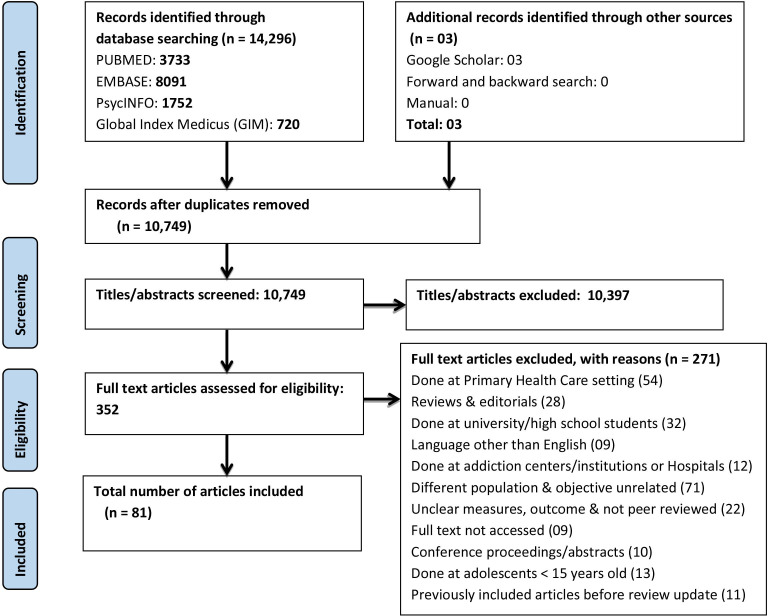
From the 14 296 records identified, 10 749 underwent title/abstract screening, of which 352 full-text articles were assessed, and 81 articles were included for data extraction. Included studies assessed alcohol use with self-report quantity/frequency questionnaires, criteria to determine risky single occasion drinking, validated screening tools, or structured clinical and diagnostic interviews. The most widely used screening tool was the Alcohol Use Disorder Identification Test. Studies defined problem drinking in various ways, including excessive/heavy drinking, binge drinking, alcohol use disorder, alcohol abuse and alcohol dependence. Across studies, the prevalence of heavy drinking ranged from <1.0% to 53.0%, binge drinking from 2.7% to 48.2%, alcohol abuse from 4.0% to 19.0%, alcohol dependence from 0.1% to 39.0% and alcohol use disorder from 2.0% to 66.6%. Factors associated with problem drinking varied across studies. These included sociodemographic and economic factors (age, sex, relationship status, education, employment, income level, religion, race, location and alcohol outlet density) and clinical factors (like medical problems, mental disorders, other substance use and quality of life).
Due to differences in measurement, study designs and assessed risk factors, the prevalence of and factors associated with problem drinking varied widely across studies and settings. The alcohol field would benefit from harmonised measurements of alcohol use and problem drinking as this would allow for comparisons to be made across countries and for meta-analyses to be conducted.
Open Science Framework ID: https://osf.io/2anj3.
“问题饮酒”一词包括从过度或大量饮酒到酒精使用障碍等一系列酒精问题。问题饮酒是全球范围内导致死亡和残疾的主要风险因素。它已经以不同的方式进行了测量和概念化,这使得确定问题饮酒的共同风险因素变得困难。本范围综述旨在综合了解问题饮酒的评估、其程度和相关因素。
从 2023 年 11 月 25 日开始,在四个数据库(PubMed、Embase、PsycINFO、全球索引医学)和 Google Scholar 中进行了搜索。如果研究重点是 15 岁及以上的人群、基于人群的报告问题饮酒的研究以及以英文发表的研究,则符合入选标准。本综述是根据“系统评价和荟萃分析扩展的首选报告项目用于范围综述清单”的指南报告的。使用纽卡斯尔-渥太华量表进行批判性评估。
从 14296 条记录中,有 10749 条经过标题/摘要筛选,其中 352 篇全文文章进行了评估,81 篇文章被纳入数据提取。纳入的研究使用自我报告的数量/频率问卷、确定危险单次饮酒的标准、经过验证的筛选工具或结构化的临床和诊断访谈来评估饮酒情况。使用最广泛的筛选工具是酒精使用障碍识别测试。研究以各种方式定义问题饮酒,包括过度/大量饮酒、 binge 饮酒、酒精使用障碍、酒精滥用和酒精依赖。在研究中,重度饮酒的患病率从<1.0%到 53.0%不等, binge 饮酒的患病率从 2.7%到 48.2%不等,酒精滥用的患病率从 4.0%到 19.0%不等,酒精依赖的患病率从 0.1%到 39.0%不等,酒精使用障碍的患病率从 2.0%到 66.6%不等。与问题饮酒相关的因素因研究而异。这些因素包括社会人口和经济因素(年龄、性别、关系状况、教育、就业、收入水平、宗教、种族、地点和酒精销售点密度)和临床因素(如医疗问题、精神障碍、其他物质使用和生活质量)。
由于测量、研究设计和评估的风险因素存在差异,问题饮酒的流行程度和相关因素在不同的研究和环境中差异很大。如果在酒精领域使用统一的酒精使用和问题饮酒测量方法,这将允许在国家之间进行比较并进行荟萃分析,那么该领域将从中受益。
开放科学框架 ID:https://osf.io/2anj3。
