Faculty of Medicine, University of Bahri, Khartoum, Sudan.
Faculty of Dentistry, University of Jordan, Amman, Jordan.
BMC Anesthesiol. 2024 Mar 9;24(1):95. doi: 10.1186/s12871-024-02476-y.
Fascia iliaca compartment block (FICB) is one of the regional nerve blocks used to reduce pain after total hip arthroplasty (THA). We aim to assess the efficacy of FICB in reducing post-operative pain and opioid consumption.
We searched PubMed, Web of Science, Cochrane Library, Embase, and Scopus on February 19, 2023, and we updated our search in august 2023 using relevant search strategy. Studies were extensively screened for eligibility by title and abstract screening, followed by full-text screening. We extracted the data from the included studies, and then pooled the data as mean difference (MD) or odds ratio (OR) with a 95% confidence interval (CI), using Review Manager Software (ver. 3.5).
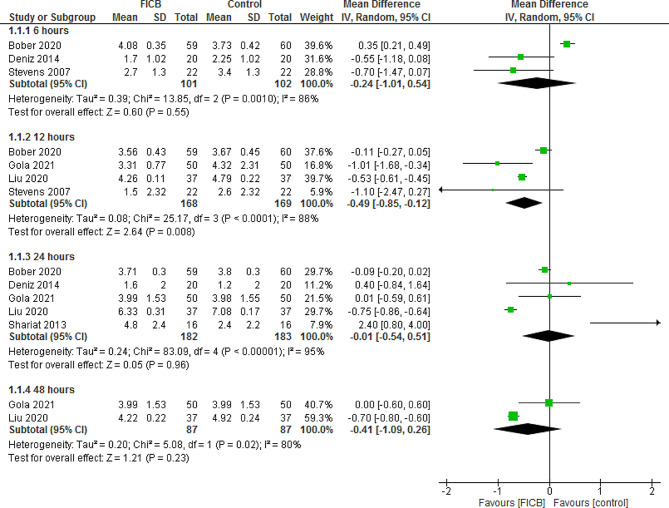
FIBC significantly reduced analgesic consumption at 24 h (MD = -8.75, 95% CI [-9.62, -7.88] P < 0.00001), and at 48 h post-operatively. (MD = -15.51, 95% CI [-26.45, -4.57], P = 0.005), with a significant sensory block of the femoral nerve (P = 0.0004), obturator nerve (P = 0.0009), and lateral femoral cutaneous nerve (P = 0.002). However, FICB was not associated with a significant pain relief at 6, 24, and 48 h postoperatively, except at 12 h where it significantly reduced pain intensity (MD = -0.49, 95% CI [-0.85, -0.12], P = 0.008). FICB was also not effective in reducing post-operative nausea and vomiting (MD = 0.55, 95% CI [0.21, 1.45], P = 0.23), and was associated with high rates of quadriceps muscle weakness (OR = 9.09, % CI [3.70, 22.30], P = < 0.00001).
FICB significantly reduces the total analgesic consumption up to 48 h; however, it is not effective in reducing post-operative pain, nausea and vomiting and it induced postoperative muscle weakness.
股外侧肌间隙阻滞(FICB)是用于减少全髋关节置换术后疼痛的区域神经阻滞之一。我们旨在评估 FICB 在减少术后疼痛和阿片类药物消耗方面的效果。
我们于 2023 年 2 月 19 日在 PubMed、Web of Science、Cochrane 图书馆、Embase 和 Scopus 上进行了搜索,并于 2023 年 8 月使用相关搜索策略进行了更新。通过标题和摘要筛选对研究进行广泛筛选,然后进行全文筛选。我们从纳入的研究中提取数据,并使用 Review Manager 软件(版本 3.5)以均数差(MD)或比值比(OR)和 95%置信区间(CI)汇总数据。
FICB 显著减少术后 24 小时(MD=-8.75,95%CI[-9.62,-7.88],P<0.00001)和术后 48 小时的镇痛药物消耗(MD=-15.51,95%CI[-26.45,-4.57],P=0.005),并伴有股神经(P=0.0004)、闭孔神经(P=0.0009)和股外侧皮神经(P=0.002)的感觉阻滞。然而,FICB 在术后 6、24 和 48 小时时与疼痛缓解无关,除了在 12 小时时,FICB 显著降低了疼痛强度(MD=-0.49,95%CI[-0.85,-0.12],P=0.008)。FICB 也不能有效减少术后恶心和呕吐(MD=0.55,95%CI[0.21,1.45],P=0.23),并伴有股四头肌无力的高发生率(OR=9.09,95%CI[3.70,22.30],P<0.00001)。
FICB 显著减少了术后 48 小时内的总镇痛药物消耗;然而,它在减轻术后疼痛、恶心和呕吐方面无效,并且会导致术后肌肉无力。