• 文献检索
  • 文档翻译
  • 深度研究
  • 学术资讯
  • Suppr Zotero 插件Zotero 插件
  • 邀请有礼
  • 套餐&价格
  • 历史记录
应用&插件
Suppr Zotero 插件Zotero 插件浏览器插件Mac 客户端Windows 客户端微信小程序
定价
高级版会员购买积分包购买API积分包
服务
文献检索文档翻译深度研究API 文档MCP 服务
关于我们
关于 Suppr公司介绍联系我们用户协议隐私条款
关注我们

Suppr 超能文献

核心技术专利:CN118964589B侵权必究
粤ICP备2023148730 号-1Suppr @ 2026

文献检索

告别复杂PubMed语法,用中文像聊天一样搜索,搜遍4000万医学文献。AI智能推荐,让科研检索更轻松。

立即免费搜索

文件翻译

保留排版,准确专业,支持PDF/Word/PPT等文件格式,支持 12+语言互译。

免费翻译文档

深度研究

AI帮你快速写综述,25分钟生成高质量综述,智能提取关键信息,辅助科研写作。

立即免费体验

人参根衍生的外泌体样纳米颗粒通过抑制激活蛋白-1信号传导和限制活性氧的产生来保护皮肤免受紫外线照射和氧化应激。

Ginseng root-derived exosome-like nanoparticles protect skin from UV irradiation and oxidative stress by suppressing activator protein-1 signaling and limiting the generation of reactive oxygen species.

作者信息

Choi Wooram, Cho Jeong Hun, Park Sang Hee, Kim Dong Seon, Lee Hwa Pyoung, Kim Donghyun, Kim Hyun Soo, Kim Ji Hye, Cho Jae Youl

机构信息

Department of Integrative Biotechnology, Sungkyunkwan University, Suwon, Republic of Korea.

Research and Innovation Center, AMOREPACIFIC, Yongin, Republic of Korea.

出版信息

J Ginseng Res. 2024 Mar;48(2):211-219. doi: 10.1016/j.jgr.2024.01.001. Epub 2024 Jan 14.

DOI:10.1016/j.jgr.2024.01.001
PMID:38465216
原文链接:https://pmc.ncbi.nlm.nih.gov/articles/PMC10920011/
Abstract

BACKGROUND

Recently, plant-derived exosome-like nanoparticles (PDENs) have been isolated, and active research was focusing on understanding their properties and functions. In this study, the characteristics and molecular properties of ginseng root-derived exosome-like nanoparticles (GrDENs) were examined in terms of skin protection.

METHODS

HPLC-MS protocols were used to analyze the ginsenoside contents in GrDENs. To investigate the beneficial effect of GrDENs on skin, HaCaT cells were pre-treated with GrDENs (0-2 × 10 particles/mL), and followed by UVB irradiation or HO exposure. In addition, the antioxidant activity of GrDENs was measured using a fluorescence microscope or flow cytometry. Finally, molecular mechanisms were examined with immunoblotting analysis.

RESULTS

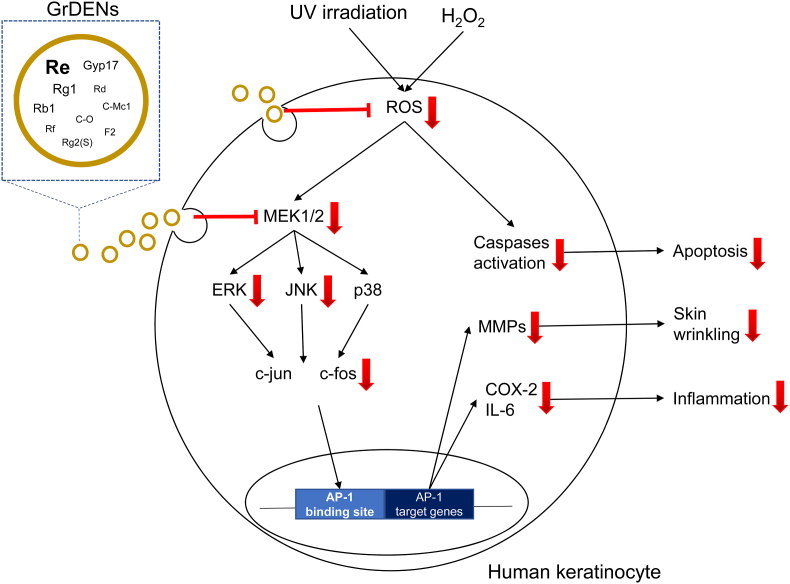
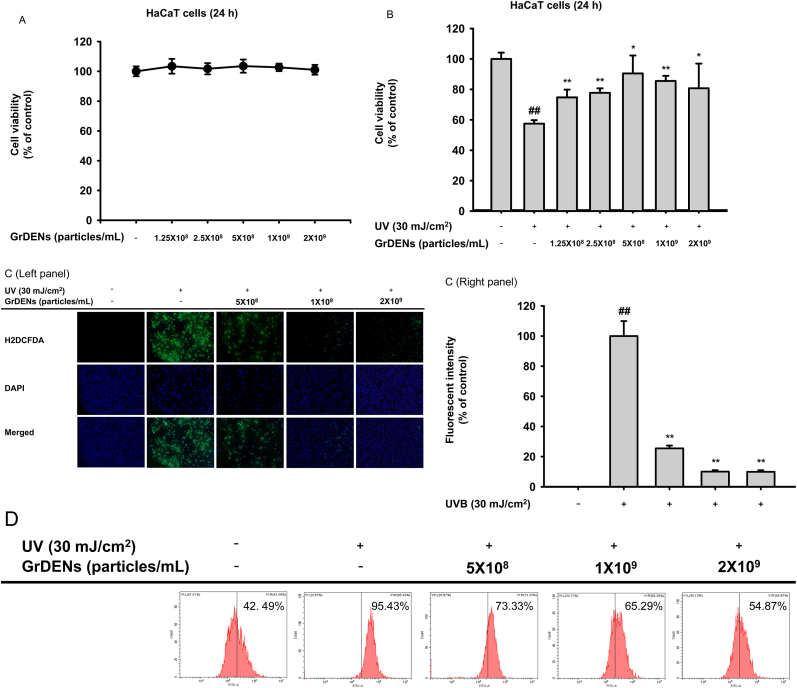
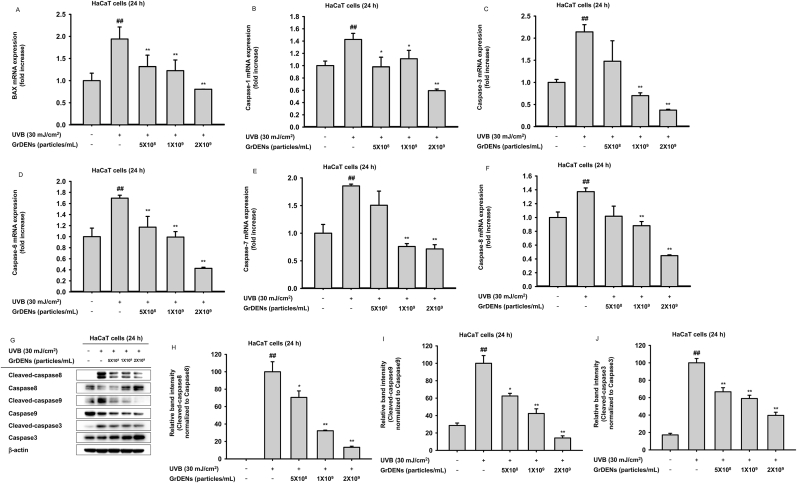
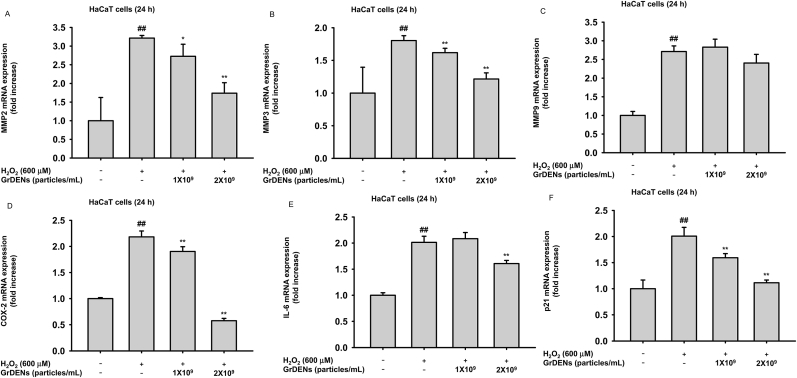
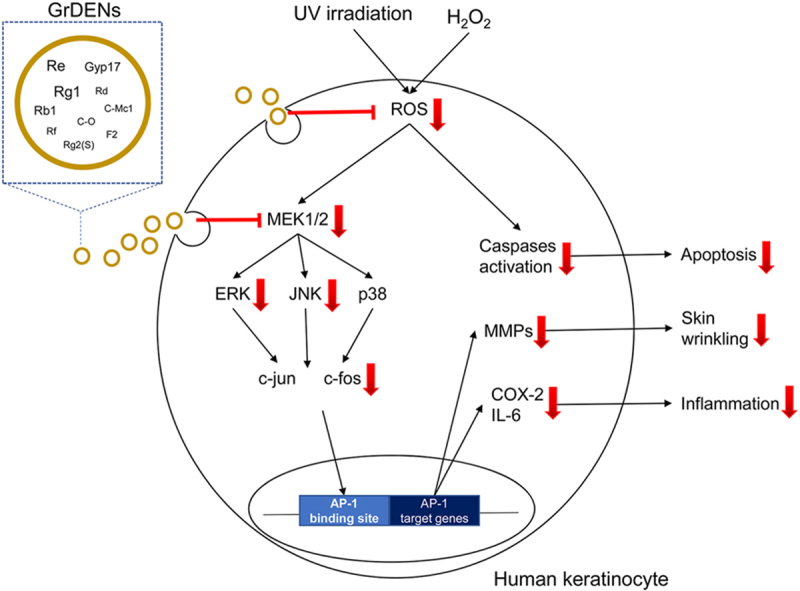
GrDENs contained detectable levels of ginsenosides (Re, Rg1, Rb1, Rf, Rg2 (), Gyp17, Rd, C-Mc1, C-O, and F2). In UVB-irradiated HaCaT cells, GrDENs protected cells from death and reduced ROS production. GrDENs downregulated the mRNA expression of proapoptotic genes, including BAX, caspase-1, -3, -6, -7, and -8 and the ratio of cleaved caspase-8, -9, and -3 in a dose-dependent manner. In addition, GrDENs reduced the mRNA levels of aging-related genes (MMP2 and 3), proinflammatory genes (COX-2 and IL-6), and cellular senescence biomarker p21, possibly by suppressing activator protein-1 signaling.

CONCLUSIONS

This study demonstrates the protective effects of GrDENs against skin damage caused by UV and oxidative stress, providing new insights into beneficial uses of ginseng In particular, our results suggest GrDENs as a potential active ingredient in cosmeceuticals to promote skin health.

摘要

背景

最近,已分离出植物来源的外泌体样纳米颗粒(PDENs),并且积极的研究集中在了解它们的特性和功能。在本研究中,从皮肤保护方面研究了人参根来源的外泌体样纳米颗粒(GrDENs)的特征和分子特性。

方法

采用高效液相色谱-质谱法(HPLC-MS)分析GrDENs中的人参皂苷含量。为了研究GrDENs对皮肤的有益作用,用GrDENs(0-2×10颗粒/毫升)预处理HaCaT细胞,然后进行紫外线B(UVB)照射或过氧化氢(HO)暴露。此外,使用荧光显微镜或流式细胞术测量GrDENs的抗氧化活性。最后,通过免疫印迹分析研究分子机制。

结果

GrDENs含有可检测水平的人参皂苷(Re、Rg1、Rb1、Rf、Rg2()、Gyp17、Rd、C-Mc1、C-O和F2)。在UVB照射的HaCaT细胞中,GrDENs保护细胞免于死亡并减少活性氧(ROS)的产生。GrDENs以剂量依赖性方式下调促凋亡基因(包括BAX、半胱天冬酶-1、-3、-6、-7和-8)的mRNA表达以及裂解的半胱天冬酶-8、-9和-3的比例。此外,GrDENs可能通过抑制激活蛋白-1信号传导降低衰老相关基因(基质金属蛋白酶2和3)、促炎基因(环氧化酶-2和白细胞介素-6)和细胞衰老生物标志物p21的mRNA水平。

结论

本研究证明了GrDENs对紫外线和氧化应激引起的皮肤损伤具有保护作用,为参的有益用途提供了新的见解。特别是,我们的结果表明GrDENs作为一种潜在的活性成分可用于化妆品中以促进皮肤健康。
https://cdn.ncbi.nlm.nih.gov/pmc/blobs/380c/10920011/a2024fb39dc9/gr7.jpg
https://cdn.ncbi.nlm.nih.gov/pmc/blobs/380c/10920011/5448e0563ab8/ga1.jpg
https://cdn.ncbi.nlm.nih.gov/pmc/blobs/380c/10920011/c6ed817f1252/gr1.jpg
https://cdn.ncbi.nlm.nih.gov/pmc/blobs/380c/10920011/87cb5ee4358d/gr2.jpg
https://cdn.ncbi.nlm.nih.gov/pmc/blobs/380c/10920011/ad745d25c351/gr3.jpg
https://cdn.ncbi.nlm.nih.gov/pmc/blobs/380c/10920011/0b1a10d2427b/gr4.jpg
https://cdn.ncbi.nlm.nih.gov/pmc/blobs/380c/10920011/00b402450787/gr5.jpg
https://cdn.ncbi.nlm.nih.gov/pmc/blobs/380c/10920011/0e3b76a1656e/gr6.jpg
https://cdn.ncbi.nlm.nih.gov/pmc/blobs/380c/10920011/a2024fb39dc9/gr7.jpg
https://cdn.ncbi.nlm.nih.gov/pmc/blobs/380c/10920011/5448e0563ab8/ga1.jpg
https://cdn.ncbi.nlm.nih.gov/pmc/blobs/380c/10920011/c6ed817f1252/gr1.jpg
https://cdn.ncbi.nlm.nih.gov/pmc/blobs/380c/10920011/87cb5ee4358d/gr2.jpg
https://cdn.ncbi.nlm.nih.gov/pmc/blobs/380c/10920011/ad745d25c351/gr3.jpg
https://cdn.ncbi.nlm.nih.gov/pmc/blobs/380c/10920011/0b1a10d2427b/gr4.jpg
https://cdn.ncbi.nlm.nih.gov/pmc/blobs/380c/10920011/00b402450787/gr5.jpg
https://cdn.ncbi.nlm.nih.gov/pmc/blobs/380c/10920011/0e3b76a1656e/gr6.jpg
https://cdn.ncbi.nlm.nih.gov/pmc/blobs/380c/10920011/a2024fb39dc9/gr7.jpg

相似文献

1
Ginseng root-derived exosome-like nanoparticles protect skin from UV irradiation and oxidative stress by suppressing activator protein-1 signaling and limiting the generation of reactive oxygen species.人参根衍生的外泌体样纳米颗粒通过抑制激活蛋白-1信号传导和限制活性氧的产生来保护皮肤免受紫外线照射和氧化应激。
J Ginseng Res. 2024 Mar;48(2):211-219. doi: 10.1016/j.jgr.2024.01.001. Epub 2024 Jan 14.
2
Protective properties of ginsenoside Rb1 against UV-B radiation-induced oxidative stress in human dermal keratinocytes.人参皂苷Rb1对紫外线B辐射诱导的人皮肤角质形成细胞氧化应激的保护作用。
Pharmazie. 2015 Jun;70(6):381-7.
3
Stereospecificity of ginsenoside Rg2 epimers in the protective response against UV-B radiation-induced oxidative stress in human epidermal keratinocytes.人参皂苷Rg2差向异构体在人表皮角质形成细胞抵御紫外线B辐射诱导的氧化应激保护反应中的立体特异性
J Photochem Photobiol B. 2016 Dec;165:232-239. doi: 10.1016/j.jphotobiol.2016.10.034. Epub 2016 Oct 29.
4
Ginsenoside Rk1 Prevents UVB Irradiation-Mediated Oxidative Stress, Inflammatory Response, and Collagen Degradation the PI3K/AKT/NF-κB Pathway and .人参皂苷 Rk1 通过抑制 PI3K/AKT/NF-κB 通路预防 UVB 辐射诱导的氧化应激、炎症反应和胶原降解。
J Agric Food Chem. 2022 Dec 21;70(50):15804-15817. doi: 10.1021/acs.jafc.2c06377. Epub 2022 Dec 6.
5
Protective Effect of Ginsenoside Rg1 on Hematopoietic Stem/Progenitor Cells through Attenuating Oxidative Stress and the Wnt/β-Catenin Signaling Pathway in a Mouse Model of d-Galactose-induced Aging.人参皂苷Rg1通过减轻氧化应激和Wnt/β-连环蛋白信号通路对d-半乳糖诱导的衰老小鼠模型造血干/祖细胞的保护作用
Int J Mol Sci. 2016 Jun 9;17(6):849. doi: 10.3390/ijms17060849.
6
Enzyme-modified Panax ginseng inhibits UVB-induced skin aging through the regulation of procollagen type I and MMP-1 expression.酶修饰的人参通过调节 I 型前胶原和 MMP-1 的表达抑制 UVB 诱导的皮肤衰老。
Food Funct. 2014 Feb;5(2):265-74. doi: 10.1039/c3fo60418g.
7
Defensive Properties of Ginsenoside Re against UV-B-Induced Oxidative Stress through Up-Regulating Glutathione and Superoxide Dismutase in HaCaT Keratinocytes.人参皂苷Re通过上调HaCaT角质形成细胞中的谷胱甘肽和超氧化物歧化酶对UV-B诱导的氧化应激的防御特性。
Iran J Pharm Res. 2018 Winter;17(1):249-260.
8
Ginseng glycoprotein and ginsenoside facilitate anti UV damage effects in diabetic rats.人参糖蛋白和人参皂苷有助于减轻糖尿病大鼠的紫外线损伤。
Front Pharmacol. 2022 Dec 16;13:1075594. doi: 10.3389/fphar.2022.1075594. eCollection 2022.
9
Ginsenoside Rg1 attenuates lipopolysaccharide-induced chronic liver damage by activating Nrf2 signaling and inhibiting inflammasomes in hepatic cells.人参皂苷Rg1通过激活Nrf2信号通路并抑制肝细胞中的炎性小体,减轻脂多糖诱导的慢性肝损伤。
J Ethnopharmacol. 2024 Apr 24;324:117794. doi: 10.1016/j.jep.2024.117794. Epub 2024 Jan 19.
10
Effects of red ginseng extract on UVB irradiation-induced skin aging in hairless mice.红参提取物对紫外线B照射诱导的无毛小鼠皮肤衰老的影响。
J Ethnopharmacol. 2009 Jun 25;123(3):446-51. doi: 10.1016/j.jep.2009.03.022. Epub 2009 Mar 26.

引用本文的文献

1
Unveiling exosomes in combating skin aging: insights into resources, mechanisms and challenges.揭示外泌体在对抗皮肤衰老中的作用:对资源、机制和挑战的见解
Stem Cell Res Ther. 2025 Aug 29;16(1):474. doi: 10.1186/s13287-025-04620-y.
2
Ginseng Nanosizing: The Second Spring of Ginseng Therapeutic Applications.人参纳米化:人参治疗应用的又一春天。
Antioxidants (Basel). 2025 Aug 5;14(8):961. doi: 10.3390/antiox14080961.
3
Protopanaxatriol, a ginsenoside metabolite, induces apoptosis in colorectal cancer cells and arrests their cell cycle by targeting AKT.

本文引用的文献

1
Effect of anti-skin disorders of ginsenosides- A Systematic Review.人参皂苷对皮肤疾病的影响——一项系统评价
J Ginseng Res. 2023 Sep;47(5):605-614. doi: 10.1016/j.jgr.2023.04.005. Epub 2023 May 4.
2
Microbiota and plant-derived vesicles that serve as therapeutic agents and delivery carriers to regulate metabolic syndrome.作为治疗剂和递送载体以调节代谢综合征的微生物群和植物来源的囊泡。
Adv Drug Deliv Rev. 2023 May;196:114774. doi: 10.1016/j.addr.2023.114774. Epub 2023 Mar 9.
3
Safety and antifatigue effect of Korean Red Ginseng capsule: A randomized, double-blind and placebo-controlled clinical trial.
原人参三醇,一种人参皂苷代谢产物,通过靶向AKT诱导结肠癌细胞凋亡并使其细胞周期停滞。
J Ginseng Res. 2025 Sep;49(5):488-501. doi: 10.1016/j.jgr.2025.03.012. Epub 2025 Apr 3.
4
The potential of plant-derived vesicles in treating periodontitis and associated systemic diseases: current advances and future directions.植物源囊泡在治疗牙周炎及相关全身性疾病中的潜力:当前进展与未来方向
J Nanobiotechnology. 2025 Aug 18;23(1):568. doi: 10.1186/s12951-025-03651-0.
5
Can Panax ginseng help protect the body from the harmful effects of airborne particulate matter?人参能帮助保护身体免受空气中颗粒物的有害影响吗?
J Ginseng Res. 2025 Jul;49(4):331-341. doi: 10.1016/j.jgr.2025.03.001. Epub 2025 Mar 4.
6
Ginsenoside-Enriched Sprouts Cultivated from Aquaponic System with a Novel Nutrient Solution Regulate LPS-Induced Inflammatory Cytokines and UVB-Induced Photoaging Responses via MAPK/AP-1 Signaling Pathways.采用新型营养液水培系统培育的富含人参皂苷的豆芽通过MAPK/AP-1信号通路调节脂多糖诱导的炎性细胞因子和紫外线B诱导的光老化反应。
Plants (Basel). 2025 Jun 4;14(11):1712. doi: 10.3390/plants14111712.
7
Plant-Derived Nanovesicles: A Promising Frontier in Tissue Repair and Antiaging.植物源纳米囊泡:组织修复与抗衰老领域的前沿希望
J Agric Food Chem. 2025 Jun 4;73(22):13159-13177. doi: 10.1021/acs.jafc.5c01547. Epub 2025 May 22.
8
Advancements in Plant-Derived sRNAs Therapeutics: Classification, Delivery Strategies, and Therapeutic Applications.植物源小RNA疗法的进展:分类、递送策略及治疗应用
Int J Mol Sci. 2025 Apr 30;26(9):4277. doi: 10.3390/ijms26094277.
9
Multifunctional cosmetic potential of extracellular vesicle‑like nanoparticles derived from the stem of in treating pigmentation disorders.来源于[植物名称]茎的细胞外囊泡样纳米颗粒在治疗色素沉着紊乱方面的多功能美容潜力。 (你原文中“in treating pigmentation disorders”前的内容缺失,请补充完整以便能准确翻译完整句子)
Mol Med Rep. 2025 Jun;31(6). doi: 10.3892/mmr.2025.13512. Epub 2025 Apr 4.
10
Recent Advances in the Isolation Strategies of Plant-Derived Exosomes and Their Therapeutic Applications.植物源外泌体分离策略及其治疗应用的最新进展
Curr Issues Mol Biol. 2025 Feb 22;47(3):144. doi: 10.3390/cimb47030144.
高丽红参胶囊的安全性及抗疲劳作用:一项随机、双盲、安慰剂对照临床试验
J Ginseng Res. 2022 Jul;46(4):543-549. doi: 10.1016/j.jgr.2021.09.001. Epub 2021 Sep 11.
4
Photoaging: UV radiation-induced inflammation and immunosuppression accelerate the aging process in the skin.光老化:紫外线辐射诱导的炎症和免疫抑制加速皮肤的衰老过程。
Inflamm Res. 2022 Aug;71(7-8):817-831. doi: 10.1007/s00011-022-01598-8. Epub 2022 Jun 24.
5
Bacterial extracellular vesicles as bioactive nanocarriers for drug delivery: Advances and perspectives.细菌细胞外囊泡作为药物递送的生物活性纳米载体:进展与展望
Bioact Mater. 2021 Dec 17;14:169-181. doi: 10.1016/j.bioactmat.2021.12.006. eCollection 2022 Aug.
6
Korean Red Ginseng exerts anti-inflammatory and autophagy-promoting activities in aged mice.韩国红参对老年小鼠具有抗炎和促进自噬的作用。
J Ginseng Res. 2021 Nov;45(6):717-725. doi: 10.1016/j.jgr.2021.03.009. Epub 2021 Apr 6.
7
Faces of cellular senescence in skin aging.皮肤衰老过程中的细胞衰老的特征。
Mech Ageing Dev. 2021 Sep;198:111525. doi: 10.1016/j.mad.2021.111525. Epub 2021 Jun 21.
8
Inhibition of the Ras/ERK1/2 pathway contributes to the protective effect of ginsenoside Re against intimal hyperplasia.抑制 Ras/ERK1/2 通路有助于人参皂苷 Re 发挥抗内膜增生的保护作用。
Food Funct. 2021 Aug 2;12(15):6755-6765. doi: 10.1039/d1fo00015b.
9
-Derived Extracellular Vesicles Facilitate Anti-Senescence Effects in Human Skin Cells: An Eco-Friendly and Sustainable Way to Use Ginseng Substances.- 外泌体促进人皮肤细胞抗衰老作用:一种环保且可持续利用人参物质的方法。
Cells. 2021 Feb 24;10(3):486. doi: 10.3390/cells10030486.
10
Strawberry-Derived Exosome-Like Nanoparticles Prevent Oxidative Stress in Human Mesenchymal Stromal Cells.草莓衍生的外泌体样纳米颗粒可预防人间质基质细胞的氧化应激。
Biomolecules. 2021 Jan 12;11(1):87. doi: 10.3390/biom11010087.