Gashi Shkurta, Oldrati Pietro, Moebus Max, Hilty Marc, Barrios Liliana, Ozdemir Firat, Kana Veronika, Lutterotti Andreas, Rätsch Gunnar, Holz Christian
Department of Computer Science, ETH Zürich, Zürich, Switzerland.
ETH AI Center, ETH Zürich, Zürich, Switzerland.
NPJ Digit Med. 2024 Mar 11;7(1):64. doi: 10.1038/s41746-024-01025-8.
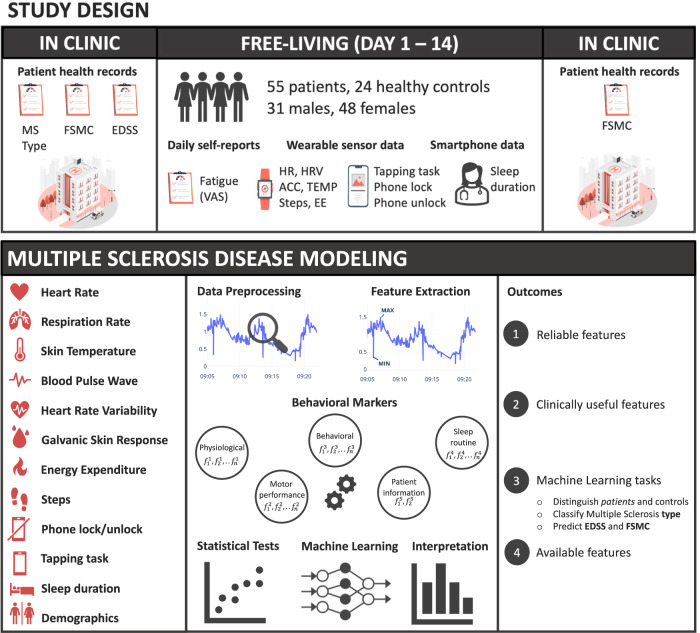
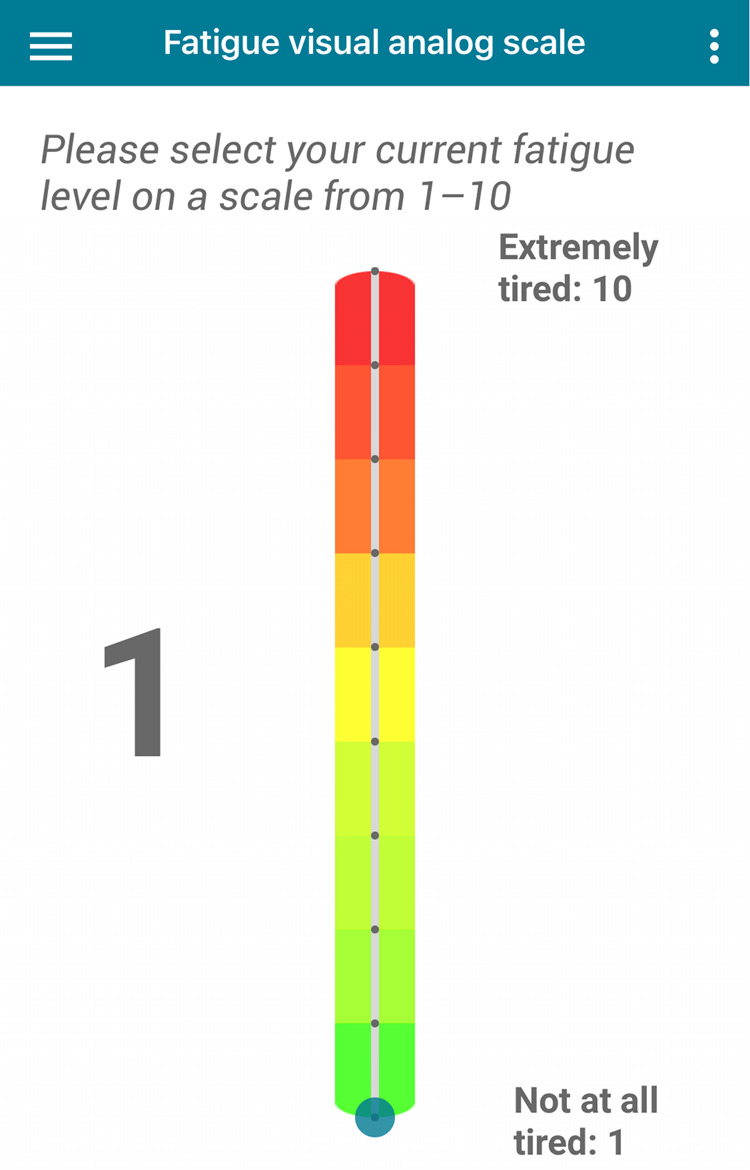
Multiple sclerosis (MS) is a neurological disease of the central nervous system that is the leading cause of non-traumatic disability in young adults. Clinical laboratory tests and neuroimaging studies are the standard methods to diagnose and monitor MS. However, due to infrequent clinic visits, it is fundamental to identify remote and frequent approaches for monitoring MS, which enable timely diagnosis, early access to treatment, and slowing down disease progression. In this work, we investigate the most reliable, clinically useful, and available features derived from mobile and wearable devices as well as their ability to distinguish people with MS (PwMS) from healthy controls, recognize MS disability and fatigue levels. To this end, we formalize clinical knowledge and derive behavioral markers to characterize MS. We evaluate our approach on a dataset we collected from 55 PwMS and 24 healthy controls for a total of 489 days conducted in free-living conditions. The dataset contains wearable sensor data - e.g., heart rate - collected using an arm-worn device, smartphone data - e.g., phone locks - collected through a mobile application, patient health records - e.g., MS type - obtained from the hospital, and self-reports - e.g., fatigue level - collected using validated questionnaires administered via the mobile application. Our results demonstrate the feasibility of using features derived from mobile and wearable sensors to monitor MS. Our findings open up opportunities for continuous monitoring of MS in free-living conditions and can be used to evaluate and guide the effectiveness of treatments, manage the disease, and identify participants for clinical trials.
多发性硬化症(MS)是一种中枢神经系统的神经疾病,是年轻成年人非创伤性残疾的主要原因。临床实验室检查和神经影像学研究是诊断和监测MS的标准方法。然而,由于门诊就诊次数较少,确定远程和频繁的MS监测方法至关重要,这些方法能够实现及时诊断、尽早接受治疗并减缓疾病进展。在这项工作中,我们研究了从移动和可穿戴设备中获取的最可靠、临床上有用且可获得的特征,以及它们区分MS患者(PwMS)和健康对照者、识别MS残疾和疲劳水平的能力。为此,我们将临床知识形式化并得出行为标志物来表征MS。我们在一个数据集上评估了我们的方法,该数据集是我们从55名PwMS和24名健康对照者中收集的,在自由生活条件下共进行了489天。该数据集包含使用手臂佩戴设备收集的可穿戴传感器数据,例如心率;通过移动应用程序收集的智能手机数据,例如手机锁定情况;从医院获取的患者健康记录,例如MS类型;以及使用通过移动应用程序管理的经过验证的问卷收集的自我报告,例如疲劳水平。我们的结果证明了使用从移动和可穿戴传感器获得的特征来监测MS的可行性。我们的发现为在自由生活条件下持续监测MS开辟了机会,可用于评估和指导治疗效果、管理疾病以及确定临床试验的参与者。