Psychology, Tampere University, Tampere, Finland.
Tampere University Hospital, Tampere, Finland.
Int J Behav Med. 2024 Dec;31(6):944-958. doi: 10.1007/s12529-024-10274-6. Epub 2024 Mar 11.
Multiple systematic reviews have found that type 2 diabetes is associated with cognitive decrements. However, these reviews are heterogeneous in terms of methodology, quality and results, making it difficult for researchers and clinicians to build an informed overall picture. We therefore conducted a review of systematic reviews on the association between type 2 diabetes and cognitive decrements in relation to healthy controls.
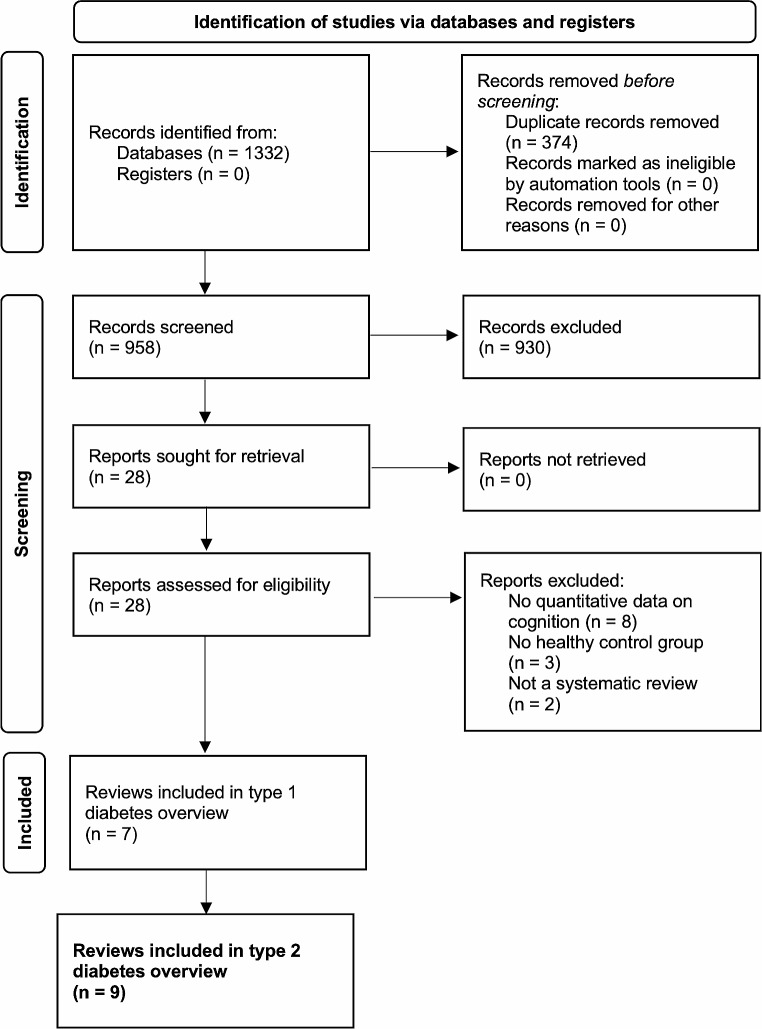
Following a pre-registered research protocol, we searched four major databases. Nine systematic reviews met our inclusion criteria: seven were meta-analyses and two were narrative syntheses. We assessed the risk of bias in each review and reported all effect sizes and confidence intervals obtained.
Type 2 diabetes was associated with cognitive decrements in all reviews, with small or negligible effect sizes obtained in the largest meta-analyses. The most studied cognitive domains were attention, executive functions, memory, processing speed and working memory. All reviews had methodological issues and were rated as having a high or an unclear risk of bias.
Type 2 diabetes appears to be associated with lower cognitive performance in several cognitive domains and in different age groups. However, high-quality meta-analyses on the subject are still needed. Future reviews must follow the PRISMA guidelines and take into account the risk of bias of the original studies through sensitivity analyses and the heterogeneity of the studies by conducting subgroup analyses for example according to age group and disease duration. The meta-analyses that aim to study the entire type 2 diabetes population without excluding severe comorbidities, should assess concept formation and reasoning, construction and motor performance, perception, and verbal functions and language skills in addition to the cognitive domains that have been most frequently analysed in the reviews conducted so far.
多项系统评价发现 2 型糖尿病与认知能力下降有关。然而,这些评价在方法学、质量和结果方面存在异质性,使得研究人员和临床医生难以全面了解情况。因此,我们对关于 2 型糖尿病与认知能力下降与健康对照组之间关系的系统评价进行了综述。
根据预先注册的研究方案,我们搜索了四个主要数据库。有 9 项系统评价符合我们的纳入标准:7 项是荟萃分析,2 项是叙述性综合。我们评估了每项评价的偏倚风险,并报告了获得的所有效应大小和置信区间。
所有评价均表明 2 型糖尿病与认知能力下降有关,最大荟萃分析中获得的效应量较小或可忽略不计。研究最多的认知领域是注意力、执行功能、记忆、处理速度和工作记忆。所有评价都存在方法学问题,被评为高风险或不确定风险。
2 型糖尿病似乎与多个认知领域和不同年龄组的认知表现下降有关。然而,仍需要进行高质量的荟萃分析。未来的评价必须遵循 PRISMA 指南,并通过敏感性分析和亚组分析(例如按年龄组和疾病持续时间)考虑原始研究的偏倚风险和研究的异质性。旨在研究整个 2 型糖尿病人群而不排除严重合并症的荟萃分析,除了迄今为止在评价中最常分析的认知领域外,还应评估概念形成和推理、构建和运动表现、感知以及言语功能和语言技能。