Wang Hui, Qi Li-Li, Shema Clement, Jiang Kui-Ying, Ren Ping, Wang He, Wang Lei
Department of Orthopedics, The First Hospital of Hebei Medical University, Shijiazhuang, Hebei, China.
Experimental Center for Teaching of Hebei Medical University, Shijiazhuang, Hebei, China.
Front Endocrinol (Lausanne). 2024 Feb 26;15:1350958. doi: 10.3389/fendo.2024.1350958. eCollection 2024.
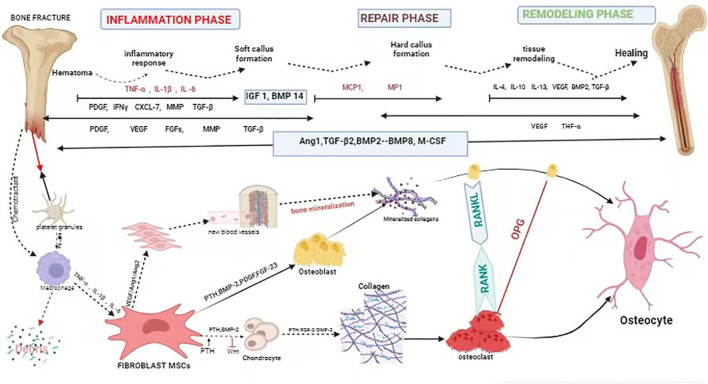
With the development of social population ageing, bone fracture has become a global public health problem due to its high morbidity, disability and mortality. Fracture healing is a complex phenomenon involving the coordinated participation of immigration, differentiation and proliferation of inflammatory cells, angioblasts, fibroblasts, chondroblasts and osteoblasts which synthesize and release bioactive substances of extracellular matrix components, Mortality caused by age-related bone fractures or osteoporosis is steadily increasing worldwide as the population ages. Fibroblasts play an important role in the process of fracture healing. However, it is not clear how the growth factors and extracellular matrix stiffness of the bone-regeneration microenvironment affects the function of osteoblasts and fibroblasts in healing process. Therefore, this article focuses on the role of fibroblasts in the process of fracture healing and mechanisms of research progress.
随着社会人口老龄化的发展,骨折因其高发病率、高致残率和高死亡率已成为一个全球性的公共卫生问题。骨折愈合是一个复杂的过程,涉及炎症细胞、成血管细胞、成纤维细胞、成软骨细胞和成骨细胞的迁移、分化和增殖的协同参与,这些细胞合成并释放细胞外基质成分的生物活性物质。随着全球人口老龄化,与年龄相关的骨折或骨质疏松症导致的死亡率正在稳步上升。成纤维细胞在骨折愈合过程中发挥着重要作用。然而,骨再生微环境的生长因子和细胞外基质硬度如何影响愈合过程中骨细胞和成纤维细胞的功能尚不清楚。因此,本文重点探讨成纤维细胞在骨折愈合过程中的作用及研究进展机制。