• 文献检索
  • 文档翻译
  • 深度研究
  • 学术资讯
  • Suppr Zotero 插件Zotero 插件
  • 邀请有礼
  • 套餐&价格
  • 历史记录
应用&插件
Suppr Zotero 插件Zotero 插件浏览器插件Mac 客户端Windows 客户端微信小程序
定价
高级版会员购买积分包购买API积分包
服务
文献检索文档翻译深度研究API 文档MCP 服务
关于我们
关于 Suppr公司介绍联系我们用户协议隐私条款
关注我们

Suppr 超能文献

核心技术专利:CN118964589B侵权必究
粤ICP备2023148730 号-1Suppr @ 2026

文献检索

告别复杂PubMed语法,用中文像聊天一样搜索,搜遍4000万医学文献。AI智能推荐,让科研检索更轻松。

立即免费搜索

文件翻译

保留排版,准确专业,支持PDF/Word/PPT等文件格式,支持 12+语言互译。

免费翻译文档

深度研究

AI帮你快速写综述,25分钟生成高质量综述,智能提取关键信息,辅助科研写作。

立即免费体验

积极的时间利用:时间观、时间管理与幸福感之间缺失的一环。

Positive time use: a missing link between time perspective, time management, and well-being.

作者信息

Osin Evgeny, Boniwell Ilona

机构信息

LINP2, University of Paris Nanterre, Nanterre, France.

International Laboratory of Positive Psychology of Personality and Motivation, HSE University, Moscow, Russia.

出版信息

Front Psychol. 2024 Feb 26;15:1087932. doi: 10.3389/fpsyg.2024.1087932. eCollection 2024.

DOI:10.3389/fpsyg.2024.1087932
PMID:38469211
原文链接:https://pmc.ncbi.nlm.nih.gov/articles/PMC10927010/
Abstract

INTRODUCTION

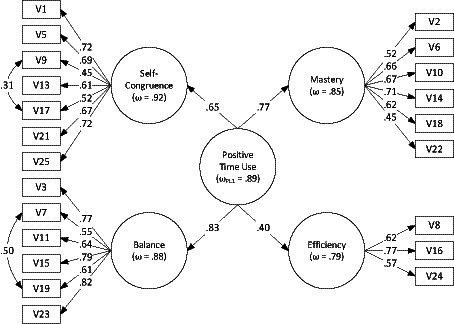
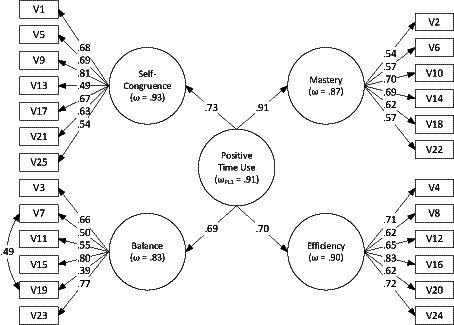
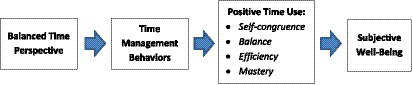
The notion of satisfaction with the use of one's time has not been operationalized previously. Based on qualitative interviews, we propose a concept of positive time use comprised by four components: self-congruence of daily activities, balance between activities, efficient use of time, and a sense of mastery over one's time.

METHODS

Using data from two UK adult samples ( = 173 and  = 357), we developed a new measure, Positive Time Use Inventory (PTUI), and investigated its structural and convergent validity.

RESULTS AND DISCUSSION

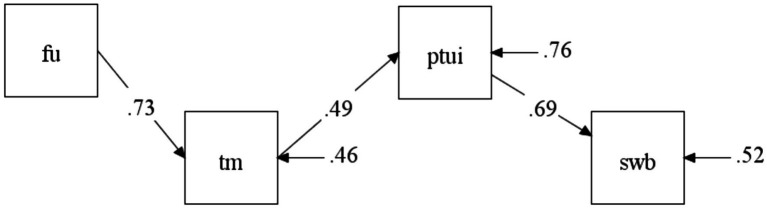
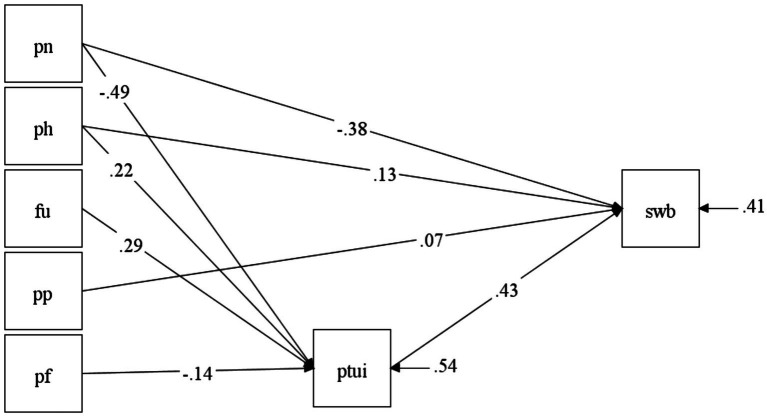
The associations of positive time use with balanced time perspective, affect balance, satisfaction with life, sense of coherence, and self-reported satisfaction with time use indicate convergent and discriminant validity of the new measure. Positive time use partially explained the associations of balanced time perspective with subjective well-being and fully mediated the effects of future time perspective and time management on subjective well-being. We propose positive time use as a new model of temporal well-being, which brings together the notions of work-life balance, time efficiency, and time mastery in a single comprehensive framework, helping to inform the time management coaching interventions.

摘要

引言

此前尚未对时间使用满意度这一概念进行实际应用。基于定性访谈,我们提出了一个由四个要素构成的积极时间使用概念:日常活动的自我一致性、活动之间的平衡、时间的有效利用以及对自身时间的掌控感。

方法

利用来自两个英国成年人样本(分别为173人和357人)的数据,我们开发了一种新的测量工具——积极时间使用量表(PTUI),并对其结构效度和收敛效度进行了研究。

结果与讨论

积极时间使用与平衡时间观、情感平衡、生活满意度、连贯感以及自我报告的时间使用满意度之间的关联表明了该新测量工具的收敛效度和区分效度。积极时间使用部分解释了平衡时间观与主观幸福感之间的关联,并完全中介了未来时间观和时间管理对主观幸福感的影响。我们提出积极时间使用作为一种新的时间幸福感模型,它将工作与生活平衡、时间效率和时间掌控等概念整合在一个单一的综合框架中,有助于为时间管理指导干预提供信息。
https://cdn.ncbi.nlm.nih.gov/pmc/blobs/f2e1/10927010/1d22352d6a3e/fpsyg-15-1087932-g005.jpg
https://cdn.ncbi.nlm.nih.gov/pmc/blobs/f2e1/10927010/ab47b5110da2/fpsyg-15-1087932-g001.jpg
https://cdn.ncbi.nlm.nih.gov/pmc/blobs/f2e1/10927010/fdaaad738729/fpsyg-15-1087932-g002.jpg
https://cdn.ncbi.nlm.nih.gov/pmc/blobs/f2e1/10927010/2ab712b51556/fpsyg-15-1087932-g003.jpg
https://cdn.ncbi.nlm.nih.gov/pmc/blobs/f2e1/10927010/a9c4605458fb/fpsyg-15-1087932-g004.jpg
https://cdn.ncbi.nlm.nih.gov/pmc/blobs/f2e1/10927010/1d22352d6a3e/fpsyg-15-1087932-g005.jpg
https://cdn.ncbi.nlm.nih.gov/pmc/blobs/f2e1/10927010/ab47b5110da2/fpsyg-15-1087932-g001.jpg
https://cdn.ncbi.nlm.nih.gov/pmc/blobs/f2e1/10927010/fdaaad738729/fpsyg-15-1087932-g002.jpg
https://cdn.ncbi.nlm.nih.gov/pmc/blobs/f2e1/10927010/2ab712b51556/fpsyg-15-1087932-g003.jpg
https://cdn.ncbi.nlm.nih.gov/pmc/blobs/f2e1/10927010/a9c4605458fb/fpsyg-15-1087932-g004.jpg
https://cdn.ncbi.nlm.nih.gov/pmc/blobs/f2e1/10927010/1d22352d6a3e/fpsyg-15-1087932-g005.jpg

相似文献

1
Positive time use: a missing link between time perspective, time management, and well-being.积极的时间利用:时间观、时间管理与幸福感之间缺失的一环。
Front Psychol. 2024 Feb 26;15:1087932. doi: 10.3389/fpsyg.2024.1087932. eCollection 2024.
2
The role of balanced time perspective mediating the relationship between mindfulness as a trait and life satisfaction in Catalan University students.平衡时间观在加泰罗尼亚大学生中作为特质正念与生活满意度之间关系的中介作用。
Curr Psychol. 2022 Nov 9:1-10. doi: 10.1007/s12144-022-03795-4.
3
What Are the Optimal Levels of Time Perspectives? Deviation from the Balanced Time Perspective-Revisited (DBTP-r).时间视角的最佳水平是什么?重新审视偏离平衡时间视角(DBTP-r)。
Psychol Belg. 2020 Jun 25;60(1):164-183. doi: 10.5334/pb.487.
4
The Meaning of Temporal Balance: Does Meaning in Life Mediate the Relationship Between a Balanced Time Perspective and Mental Health?时间平衡的意义:生活意义是否在平衡的时间观与心理健康之间起中介作用?
Eur J Psychol. 2021 Feb 26;17(1):119-133. doi: 10.5964/ejop.2415. eCollection 2021 Feb.
5
A happier and less sinister past, a more hedonistic and less fatalistic present and a more structured future: time perspective and well-being.一个更快乐、不那么阴险的过去,一个更享乐、不那么宿命论的现在,以及一个更有结构的未来:时间视角与幸福感。
PeerJ. 2014 Mar 11;2:e303. doi: 10.7717/peerj.303. eCollection 2014.
6
A Time to Sleep Well and Be Contented: Time Perspective, Sleep Quality, and Life Satisfaction.安然入眠、心怀满足之时:时间视角、睡眠质量与生活满意度
Front Psychol. 2021 Apr 16;12:627836. doi: 10.3389/fpsyg.2021.627836. eCollection 2021.
7
Psychological Flexibility and Self-Compassion as Predictors of Well-Being: Mediating Role of a Balanced Time Perspective.心理灵活性和自我同情作为幸福感的预测指标:平衡时间观的中介作用。
Front Psychol. 2021 Jun 10;12:671746. doi: 10.3389/fpsyg.2021.671746. eCollection 2021.
8
Questions of time and affect: a person's affectivity profile, time perspective, and well-being.时间与情感问题:一个人的情感特征、时间观念与幸福感。
PeerJ. 2016 Mar 22;4:e1826. doi: 10.7717/peerj.1826. eCollection 2016.
9
The mediating role of thinking styles in the relationship between adolescent time perspective and subjective well-being.思维方式在青少年时间观与主观幸福感关系中的中介作用。
J Adolesc. 2023 Apr;95(3):479-493. doi: 10.1002/jad.12130. Epub 2022 Nov 30.
10
Self-Compassion and Subjective Well-Being Mediate the Impact of Mindfulness on Balanced Time Perspective in Chinese College Students.自我同情与主观幸福感在正念对中国大学生平衡时间观的影响中起中介作用。
Front Psychol. 2019 Feb 22;10:367. doi: 10.3389/fpsyg.2019.00367. eCollection 2019.

引用本文的文献

1
The relationship between time perspective and fear of cancer recurrence among Chinese gastric cancer patients: the chain mediating role of rumination and catastrophizing.中国胃癌患者的时间观与癌症复发恐惧之间的关系:沉思和灾难化思维的链式中介作用
Support Care Cancer. 2025 Mar 12;33(4):271. doi: 10.1007/s00520-025-09342-8.
2
Mindfulness-Based Programs Improve Psychological Flexibility, Mental Health, Well-Being, and Time Management in Academics.基于正念的方案可改善大学生的心理灵活性、心理健康、幸福感和时间管理能力。
Eur J Investig Health Psychol Educ. 2020 Nov 3;10(4):1035-1050. doi: 10.3390/ejihpe10040073.

本文引用的文献

1
Exploratory Structural Equation Modeling: Practical Guidelines and Tutorial With a Convenient Online Tool for Mplus.探索性结构方程建模:实用指南及使用Mplus便捷在线工具的教程
Front Psychiatry. 2022 Jan 7;12:795672. doi: 10.3389/fpsyt.2021.795672. eCollection 2021.
2
Bifactor and Hierarchical Models: Specification, Inference, and Interpretation.双因子和层次模型:规范、推断和解释。
Annu Rev Clin Psychol. 2019 May 7;15:51-69. doi: 10.1146/annurev-clinpsy-050718-095522. Epub 2019 Jan 16.
3
Buying time promotes happiness.花钱买时间能提升幸福感。
Proc Natl Acad Sci U S A. 2017 Aug 8;114(32):8523-8527. doi: 10.1073/pnas.1706541114. Epub 2017 Jul 24.
4
Evaluating bifactor models: Calculating and interpreting statistical indices.评估双因子模型:计算和解释统计指数。
Psychol Methods. 2016 Jun;21(2):137-50. doi: 10.1037/met0000045. Epub 2015 Nov 2.
5
Effect size measures for mediation models: quantitative strategies for communicating indirect effects.中介模型的效应量度量:沟通间接效应的定量策略。
Psychol Methods. 2011 Jun;16(2):93-115. doi: 10.1037/a0022658.
6
Life balance and well-being: testing a novel conceptual and measurement approach.生活平衡与幸福感:一种新型概念和测量方法的测试。
J Pers. 2010 Aug 1;78(4):1093-134. doi: 10.1111/j.1467-6494.2010.00644.x. Epub 2010 Jun 2.
7
The Satisfaction With Life Scale.生活满意度量表。
J Pers Assess. 1985 Feb;49(1):71-5. doi: 10.1207/s15327752jpa4901_13.
8
Cross-national changes in time-use: some sociological (hi)stories re-examined.时间利用的跨国变化:对一些社会学(历史)故事的重新审视。
Br J Sociol. 2001 Jun;52(2):331-47. doi: 10.1080/00071310120045015.
9
Development and validation of brief measures of positive and negative affect: the PANAS scales.积极和消极情绪简短测量方法的编制与验证:PANAS量表
J Pers Soc Psychol. 1988 Jun;54(6):1063-70. doi: 10.1037//0022-3514.54.6.1063.