Department of Environmental Health, School of Public Health, Shanghai Jiao Tong University, 280 South Chongqing Rd, Shanghai, 200025, People's Republic of China.
Huangpu Center for Disease Control and Prevention, 309 Xietu Rd, Shanghai, 200023, People's Republic of China.
Sci Rep. 2024 Mar 14;14(1):6190. doi: 10.1038/s41598-024-54445-7.
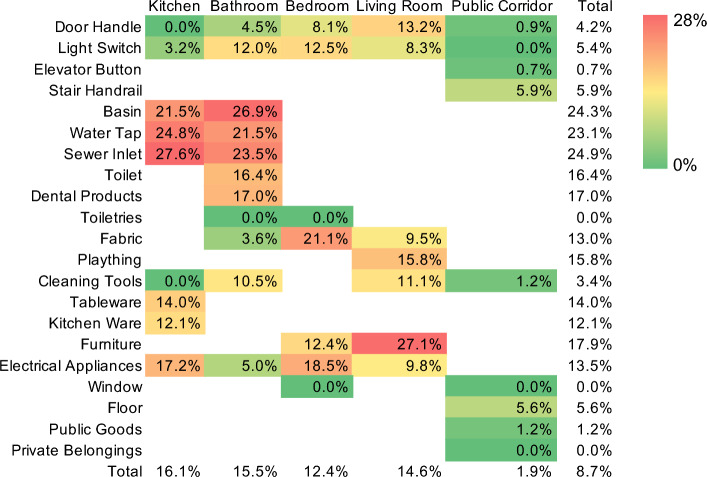
The COVID-19 pandemic has provided valuable lessons that deserve deep thought to prepare for the future. The decay pattern of surface contamination by SARS-CoV-2 RNA in the residences of COVID-19 patients is important but still unknown. We collected 2,233 surface samples from 21 categories of objects in 141 residences of COVID-19 patients in Shanghai when attacked by the omicron variant in spring 2022. Several characteristics of the patients and their residences were investigated to identify relevant associations. The decay of contamination was explored to determine the persistence. Approximately 8.7% of the surface samples were tested positive for SARS-CoV-2 RNA. The basin, water tap, and sewer inlet had the highest positive rates, all exceeding 20%. Only time was significantly associated with the level of surface contamination with SARS-CoV-2, showing a negative association. The decrease fit a first-order decay model with a decay rate of 0.77 ± 0.07 day, suggesting a 90% reduction in three days. Positive associations between the cumulative number of newly diagnosed patients in the same building and the positive rate of SARS-CoV-2 RNA in the public corridor were significant during the three days. Our results, in conjunction with the likely lower infectivity or viability, demonstrate that fomite transmission played a limited role in COVID-19 spread. The time determined SARS-CoV-2 RNA contamination, which was reduced by three days. This study is the first to show the decay patterns of SARS-CoV-2 contamination in real residential environments, providing insight into the patterns of transmission, as well as community-based prevention and control of similar threats.
新冠疫情提供了值得深入思考的宝贵经验教训,以便为未来做好准备。SARS-CoV-2 RNA 在新冠患者居住环境中表面污染的衰减模式很重要,但仍不清楚。我们在 2022 年春季奥密克戎变异株侵袭期间,从上海 141 户新冠患者家中的 21 类物体上采集了 2233 个表面样本。调查了患者及其住所的几个特征,以确定相关关联。通过探索污染衰减来确定污染物的持久性。大约 8.7%的表面样本检测出 SARS-CoV-2 RNA 呈阳性。盆、水龙头和下水道入口的阳性率最高,均超过 20%。只有时间与 SARS-CoV-2 表面污染程度显著相关,呈负相关。下降拟合一阶衰减模型,衰减率为 0.77±0.07 天,表明三天内减少 90%。同一栋楼中新增确诊患者人数的累积与公共走廊中 SARS-CoV-2 RNA 阳性率之间存在显著的正相关关系,持续三天。我们的结果表明,与较低的传染性或生存力结合,表明接触传播在新冠病毒传播中发挥的作用有限。时间决定了 SARS-CoV-2 RNA 污染,污染减少了三天。本研究首次展示了真实居住环境中 SARS-CoV-2 污染的衰减模式,深入了解了传播模式,以及对类似威胁的社区为基础的预防和控制。