Central Department of Chemistry, Tribhuvan University, Kirtipur, Kathmandu, Nepal.
ScientificWorldJournal. 2024 Mar 14;2024:5080176. doi: 10.1155/2024/5080176. eCollection 2024.
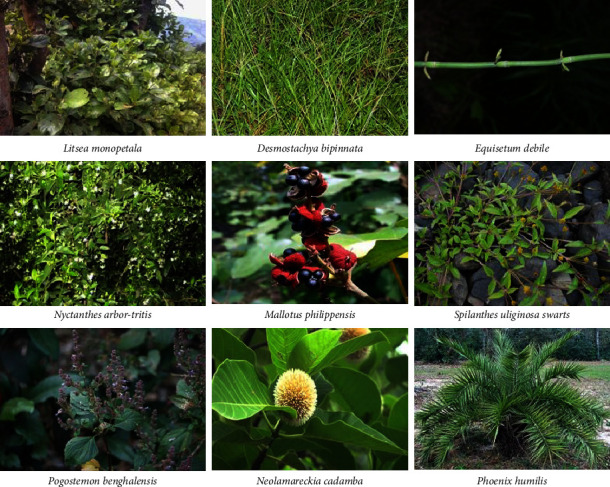
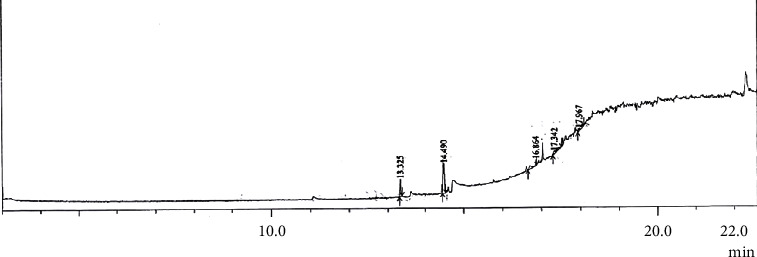
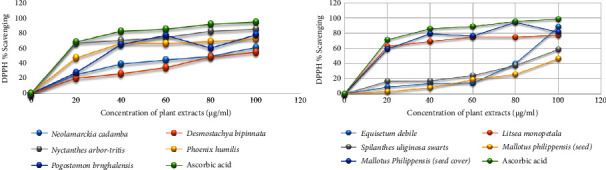
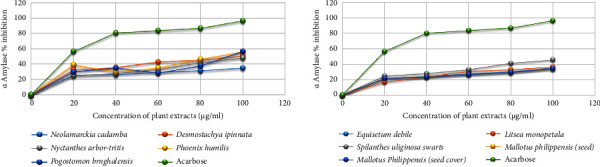
The importance of medicinal plants for the treatment of different diseases is high from the aspects of the pharmaceutical industry and traditional healers. The present study involves nine different medicinal plants, namely, and collected from Chitwan district of Nepal for biochemical analysis followed by the isolation of active plant fractions from the bioactive plant extract. The methanolic extracts of roots, barks, seeds, seed cover, and the other aerial parts of plants were used for the phytochemical analysis and biological activities. The DPPH (2,2-diphenyl-1-picrylhydrazyl) free radical scavenging assay was adopted to evaluate the antioxidant activity. Antibacterial activity was evaluated using the agar well diffusion method. The antidiabetic activity was studied by the -amylase enzyme inhibition assay. The highest antioxidant activity was observed in extracts of followed by , , , with IC values of 27.38 ± 1.35, 32.08 ± 2.81, 32.75 ± 2.13, 33.82 ± 1.07, 40.14 ± 0.93, and 50.44 ± 3.75 g/mL, respectively. The highest antidiabetic activity was observed in extracts of followed by with IC values of 95.69 ± 6.97, 99.24 ± 12.6, and 106.3 ± 12.89 g/mL, respectively. The mild -amylase enzyme inhibition was found in extracts of showing IC values of 110.4 ± 7.78, 115.98 ± 10.24, 149.83 ± 8.3, and 196.45 ± 6.04 g/mL, whereas (seed cover), (seed), and showed weak -amylase inhibition with IC values of 208.87 ± 1.76, 215.41 ± 2.09, and 238.89 ± 9.27 g/mL, respectively. The extract of showed high zones of inhibition against (ATCC 25923) and (ATCC 25922) of ZOI 26 and 22 mm, respectively. The chemical constituents isolated from the active plant were subjected to GCMS analysis where the major chemical compounds were 11,14,17-eicosatrienoic acid and methyl ester. These results support the partial scientific validation for the traditional uses of these medicinal plants in the treatment of diabetes and infectious diseases by the people living in different communities of Chitwan, Nepal.
药用植物在治疗各种疾病方面具有重要意义,无论是从制药行业还是传统医学的角度来看都是如此。本研究涉及从尼泊尔奇特万地区采集的 9 种不同药用植物,即 和 ,对其进行生物化学分析,并从生物活性植物提取物中分离出活性植物成分。采用甲醇提取物对植物的根、树皮、种子、种皮和其他地上部分进行植物化学分析和生物活性分析。采用 DPPH(2,2-二苯基-1-苦基肼)自由基清除法评价抗氧化活性。采用琼脂孔扩散法评价抗菌活性。采用 -淀粉酶酶抑制试验研究抗糖尿病活性。抗氧化活性最高的提取物来自 ,其次是 、 、 ,IC 值分别为 27.38 ± 1.35、32.08 ± 2.81、32.75 ± 2.13、33.82 ± 1.07、40.14 ± 0.93 和 50.44 ± 3.75 μg/mL。抗糖尿病活性最高的提取物来自 ,其次是 ,IC 值分别为 95.69 ± 6.97、99.24 ± 12.6 和 106.3 ± 12.89 μg/mL。从 中提取的提取物显示出轻度的 -淀粉酶抑制活性,IC 值分别为 110.4 ± 7.78、115.98 ± 10.24、149.83 ± 8.3 和 196.45 ± 6.04 μg/mL,而 (种皮)、 (种子)和 显示出较弱的 -淀粉酶抑制活性,IC 值分别为 208.87 ± 1.76、215.41 ± 2.09 和 238.89 ± 9.27 μg/mL。提取物 对 (ATCC 25923)和 (ATCC 25922)的抑菌环直径达到 26 和 22mm。从活性植物 中分离得到的化学成分通过 GCMS 分析,主要化学成分为 11,14,17-二十碳三烯酸和甲酯。这些结果为生活在尼泊尔奇特万不同社区的人们使用这些药用植物治疗糖尿病和传染病的传统用途提供了部分科学依据。