Budapest University of Technology and Economics, Faculty of Chemical Technology and Biotechnology, Department of Applied Biotechnology and Food Science, Műegyetem rkp. 3., Budapest, H-1111, Hungary.
CycloLab Cyclodextrin R&D Laboratory Ltd., Illatos u. 7., Budapest, H-1097, Hungary.
Appl Microbiol Biotechnol. 2024 Mar 22;108(1):271. doi: 10.1007/s00253-024-13104-7.
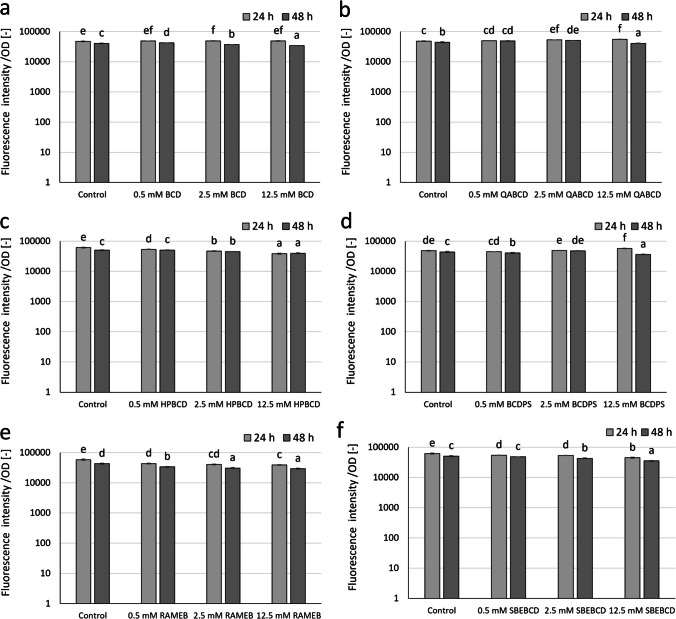
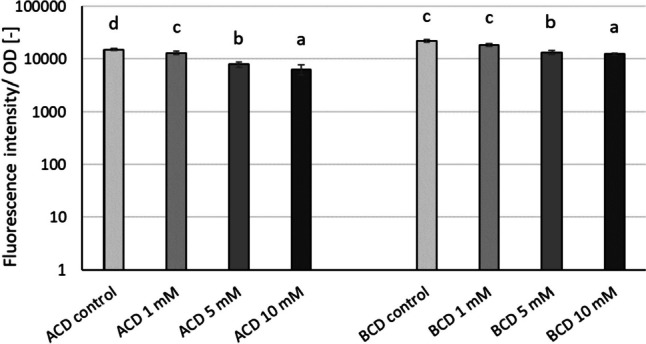
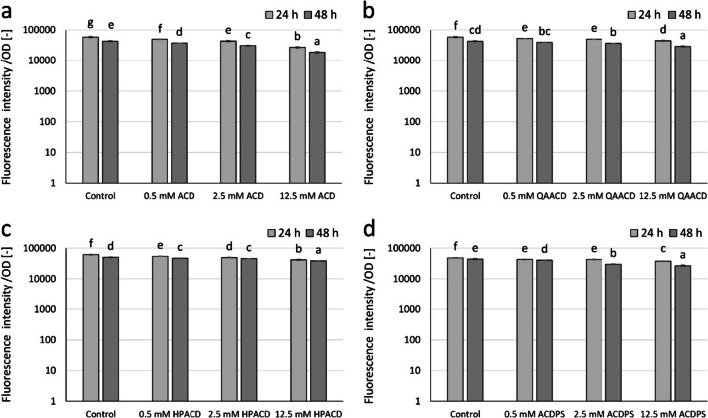
Various virulence determinants in Pseudomonas aeruginosa are regulated by the quorum sensing (QS) network producing and releasing signalling molecules. Two of these virulence determinants are the pyocyanin and pyoverdine, which interfere with multiple cellular functions during infection. The application of QS-inhibiting agents, such as cyclodextrins (CDs), appears to be a promising approach. Further to method development, this research tested in large-volume test systems the effect of α- and β-CD (ACD, BCD) at 1, 5, and 10 mM concentrations on the production of pyocyanin in the P. aeruginosa model system. The concentration and time-dependent quorum quenching effect of native CDs and their derivatives on pyoverdine production was tested in a small-volume high-throughput system. In the large-volume system, both ACD and BCD significantly inhibited pyocyanin production, but ACD to a greater extent. 10 mM ACD resulted in 58% inhibition, while BCD only ~40%. Similarly, ACD was more effective in the inhibition of pyoverdine production; nevertheless, the results of RMANOVA demonstrated the significant efficiency of both ACD and BCD, as well as their derivatives. Both the contact time and the cyclodextrin treatments significantly influenced pyoverdine production. In this case, the inhibitory effect of ACD after 48 h at 12.5 mM was 57%, while the inhibitory effect of BCD and its derivatives was lower than 40%. The high-level significant inhibition of both pyocyanin and pyoverdine production by ACD was detectable. Consequently, the potential value of CDs as QS inhibitors and the antivirulence strategy should be considered. KEYPOINTS: • Applicability of a simplified method for quantification of pyocyanin production was demonstrated. • The cyclodextrins significantly affected the pyocyanin and pyoverdine production. • The native ACD exhibited the highest attenuation in pyoverdine production.
铜绿假单胞菌中的各种毒力决定因子受群体感应(QS)网络的调节,该网络产生并释放信号分子。这两种毒力决定因子是绿脓菌素和吡咯菌素,它们在感染过程中干扰多种细胞功能。应用群体感应抑制剂,如环糊精(CDs),似乎是一种很有前途的方法。除了方法开发外,本研究还在大容量测试系统中测试了 1、5 和 10 mM 浓度的 α-和 β-环糊精(ACD、BCD)对铜绿假单胞菌模型系统中绿脓菌素产生的影响。在小体积高通量系统中测试了天然 CD 及其衍生物对吡咯菌素产生的浓度和时间依赖性群体猝灭作用。在大容量系统中,ACD 和 BCD 均显著抑制绿脓菌素的产生,但 ACD 的抑制作用更强。10 mM ACD 导致 58%的抑制,而 BCD 仅为约 40%。同样,ACD 在抑制吡咯菌素产生方面更有效;然而,RMANOVA 的结果表明 ACD 和 BCD 及其衍生物均具有显著的效率。接触时间和环糊精处理均显著影响吡咯菌素的产生。在这种情况下,12.5 mM 时 48 小时后的 ACD 抑制作用为 57%,而 BCD 和其衍生物的抑制作用低于 40%。ACD 对绿脓菌素和吡咯菌素产生的高水平显著抑制作用是可以检测到的。因此,应考虑将 CDs 作为群体感应抑制剂和抗毒力策略的潜在价值。要点:• 证明了简化方法用于定量测定绿脓菌素产生的适用性。• 环糊精对绿脓菌素和吡咯菌素的产生有显著影响。• 天然 ACD 对吡咯菌素产生的衰减作用最高。