Berckx Fede, Wibberg Daniel, Brachmann Andreas, Morrison Ciara, Obaid Nadia B, Blom Jochen, Kalinowski Jörn, Wall Luis G, Pawlowski Katharina
Department of Ecology, Environment and Plant Science, Stockholm University, 106 91 Stockholm, Sweden.
Department of Crop Production Ecology, Swedish University of Agricultural Sciences, 756 51 Uppsala, Sweden.
FEMS Microbiol Ecol. 2024 Apr 10;100(5). doi: 10.1093/femsec/fiae042.
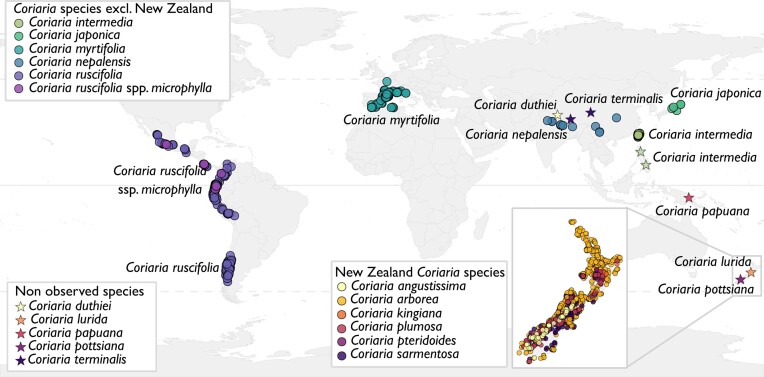
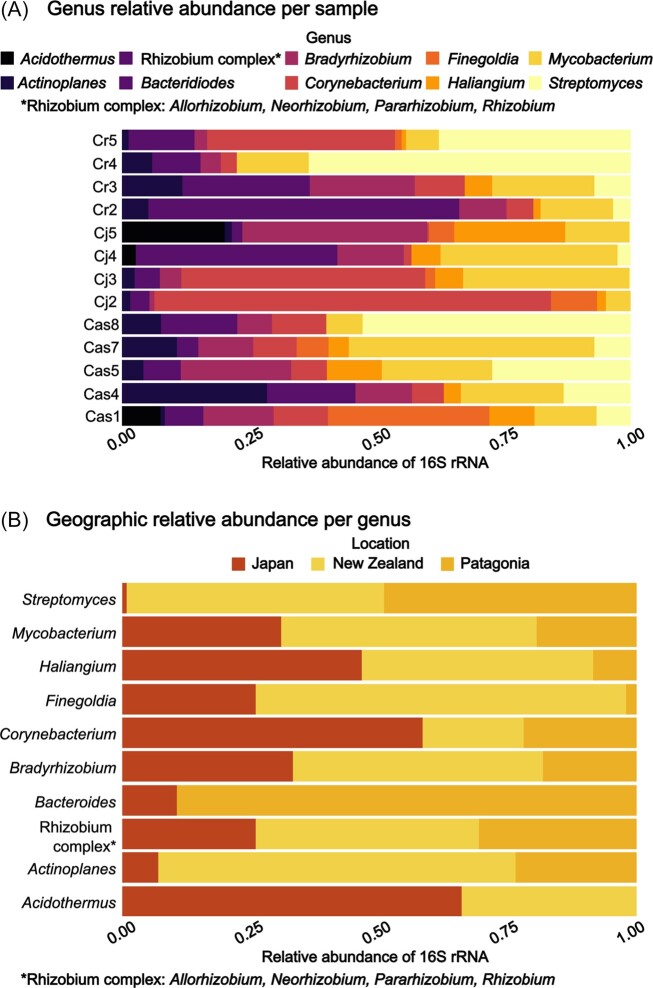
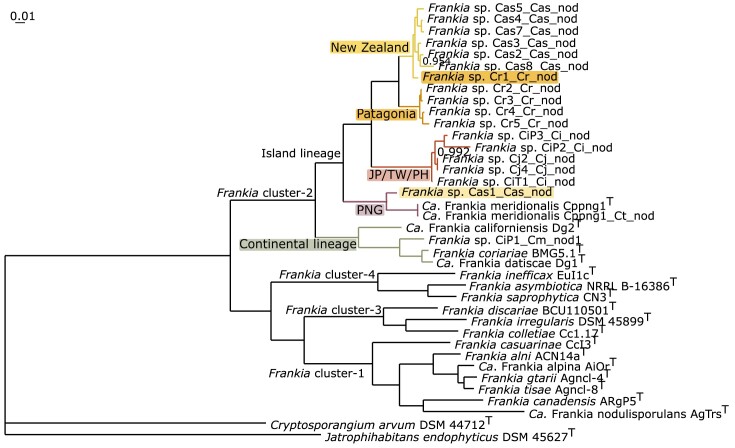
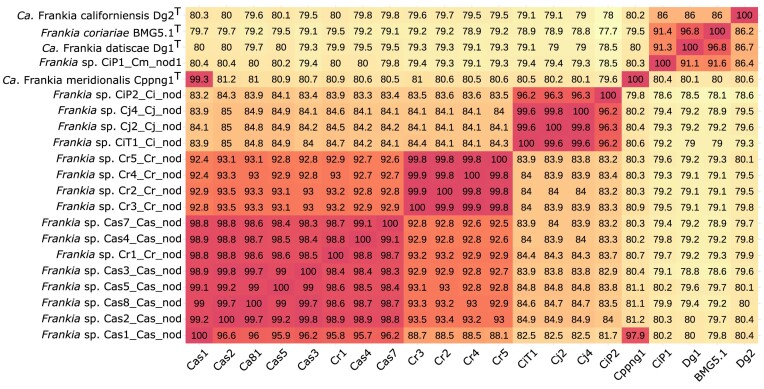
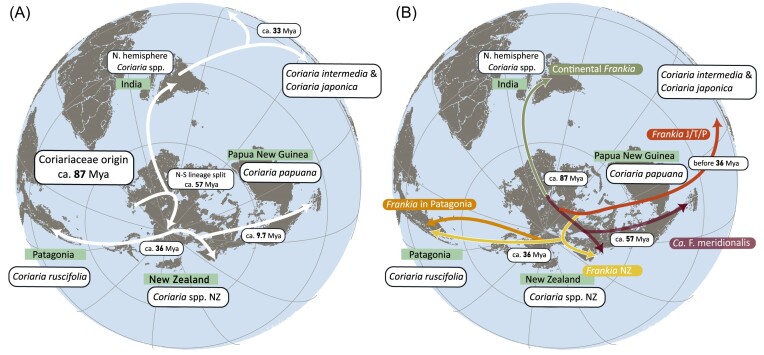
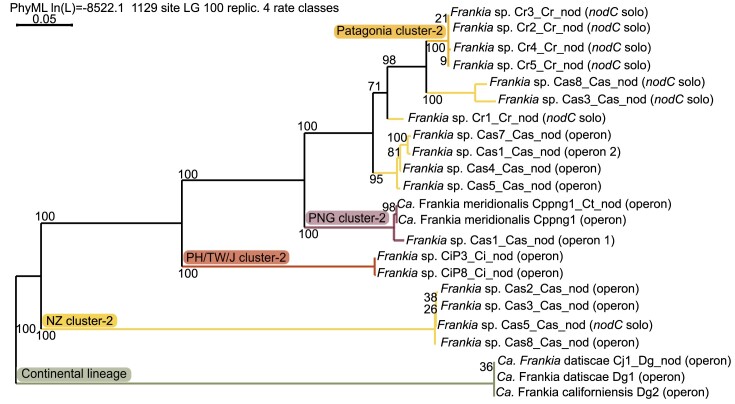
Coriariaceae are a small plant family of 14-17 species and subspecies that currently have a global but disjunct distribution. All species can form root nodules in symbiosis with diazotrophic Frankia cluster-2 strains, which form the earliest divergent symbiotic clade within this bacterial genus. Studies on Frankia cluster-2 mostly have focused on strains occurring in the northern hemisphere. Except for one strain from Papua New Guinea, namely Candidatus Frankia meridionalis Cppng1, no complete genome of Frankia associated with Coriaria occurring in the southern hemisphere has been published thus far, yet the majority of the Coriariaceae species occur here. We present field sampling data of novel Frankia cluster-2 strains, representing two novel species, which are associated with Coriaria arborea and Coriaria sarmentosa in New Zealand, and with Coriaria ruscifolia in Patagonia (Argentina), in addition to identifying Ca. F. meridionalis present in New Zealand. The novel Frankia species were found to be closely related to both Ca. F. meridionalis, and a Frankia species occurring in the Philippines, Taiwan, and Japan. Our data suggest that the different Frankia cluster-2 species diverged early after becoming symbiotic circa 100 million years ago.
马桑科是一个小型植物科,有14 - 17个物种和亚种,目前分布于全球但呈间断分布。所有物种都能与固氮的弗兰克氏菌属2型菌株共生形成根瘤,该菌株是该细菌属内最早分化的共生进化枝。对弗兰克氏菌属2型的研究大多集中在北半球的菌株。除了来自巴布亚新几内亚的一个菌株,即暂定南方弗兰克氏菌Cppng1外,迄今为止尚未发表过与南半球马桑属植物相关的弗兰克氏菌的完整基因组,然而马桑科的大多数物种都分布在南半球。我们展示了新的弗兰克氏菌属2型菌株的野外采样数据,这些菌株代表两个新物种,它们分别与新西兰的乔木马桑和多花马桑以及巴塔哥尼亚(阿根廷)的圆叶马桑相关,此外还鉴定出了新西兰存在的暂定南方弗兰克氏菌。发现这些新的弗兰克氏菌物种与暂定南方弗兰克氏菌以及一种存在于菲律宾、台湾和日本的弗兰克氏菌物种都密切相关。我们的数据表明,不同的弗兰克氏菌属2型物种在大约1亿年前形成共生关系后不久就分化了。