Parpa Koulla, Katanic Borko, Michaelides Marcos
Faculty of Sports and Exercise Science, UCLan University of Cyprus, Avenue 12-14, Larnaca 7080, Cyprus.
Montenegrin Sports Academy, 81000 Podgorica, Montenegro.
Sports (Basel). 2024 Mar 20;12(3):84. doi: 10.3390/sports12030084.
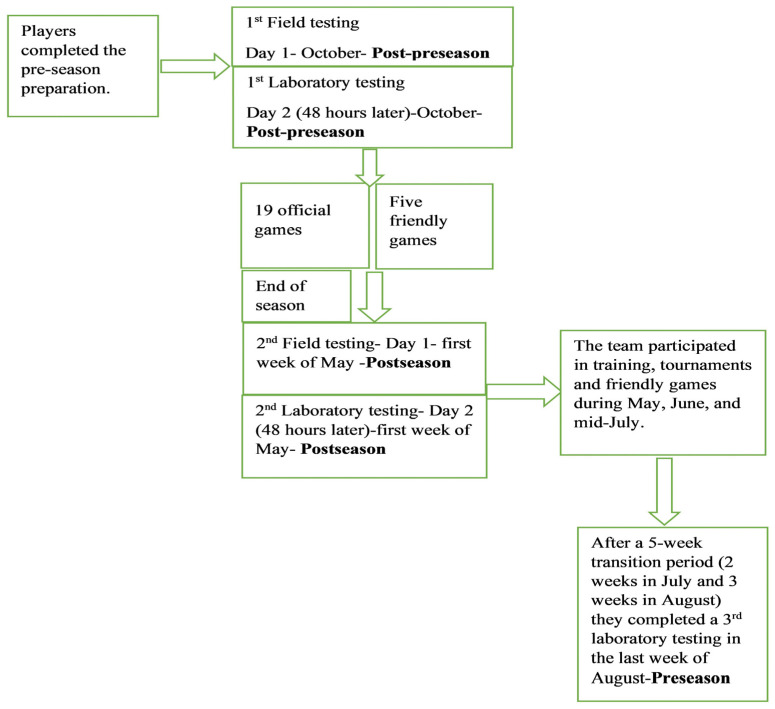
This study examined seasonal variation and the effect of the transition period on physical fitness parameters in female youth soccer players. Twenty-four players (13-17 years old) were assessed through field and laboratory testing. They completed laboratory testing three times: (1) at the beginning of the season (post-preseason), (2) at the end of the regular season (postseason), and (3) following the transition period (preseason). Field testing was conducted post-preseason and postseason. Results indicated that weight and body fat significantly increased from post-preseason to postseason and following the transition period. A paired samples T-test revealed that the players performed significantly better in the vertical jump and 30 m sprint test (all < 0.01) postseason compared to post-preseason. Also, it was indicated that torque production for the right quadriceps, left quadriceps, and right hamstring (all < 0.01) was significantly reduced after the transition period by 10%, 11.8%, and 10.5%, respectively. Cardiorespiratory measurements demonstrated that performance on an incremental cardiopulmonary treadmill test, maximal oxygen consumption, velocity at the first ventilatory threshold, velocity at the second ventilatory threshold, and velocity at maximal oxygen consumption (all < 0.01) were significantly reduced postseason and following the transition period. Based on the results, coaches and trainers should primarily focus on maintaining the aerobic capacity of the players during the season, as it has been indicated to be reduced from the beginning to the end of the competitive period (VO2max reduced by 3.3%). In addition, they should focus on maintaining lower body strength and aerobic capacity during the transition period.
本研究调查了青年女子足球运动员的体能参数的季节性变化以及过渡期的影响。通过现场和实验室测试对24名运动员(13 - 17岁)进行了评估。他们进行了三次实验室测试:(1)赛季开始时(季前赛后),(2)常规赛结束时(赛季后),以及(3)过渡期后(季前赛)。现场测试在季前赛后和赛季后进行。结果表明,从季前赛后到赛季后以及过渡期后,体重和体脂显著增加。配对样本T检验显示,与季前赛后相比,运动员在赛季后垂直跳跃和30米短跑测试中的表现显著更好(均P < 0.01)。此外,结果表明,过渡期后右股四头肌、左股四头肌和右腘绳肌的扭矩产生(均P < 0.01)分别显著降低了10%、11.8%和10.5%。心肺测量结果表明,在递增式心肺跑步机测试中的表现、最大耗氧量、第一通气阈值时的速度、第二通气阈值时的速度以及最大耗氧量时的速度(均P < 0.01)在赛季后和过渡期后均显著降低。基于这些结果,教练和训练师应主要关注在赛季期间保持运动员的有氧能力,因为已有研究表明在竞争期从开始到结束有氧能力会下降(最大耗氧量下降3.3%)。此外,他们应在过渡期关注保持下肢力量和有氧能力。