Potsdam Institute for Climate Impact Research (PIK), Member of the Leibniz Association, Potsdam, Germany.
Faculty of Organic Agricultural Sciences, University of Kassel, Witzenhausen, Germany.
Sci Adv. 2024 Mar 29;10(13):eadj3832. doi: 10.1126/sciadv.adj3832. Epub 2024 Mar 27.
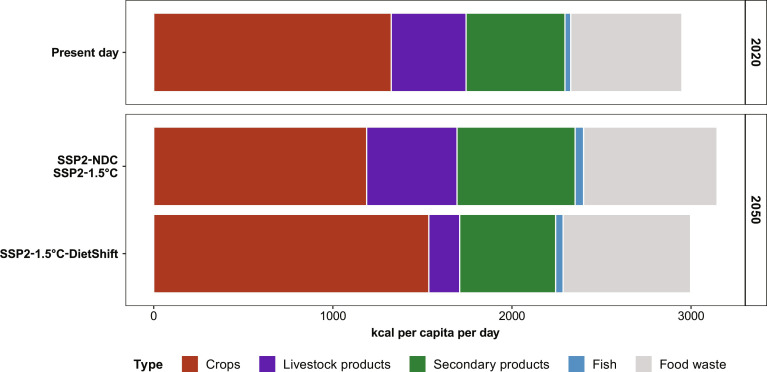
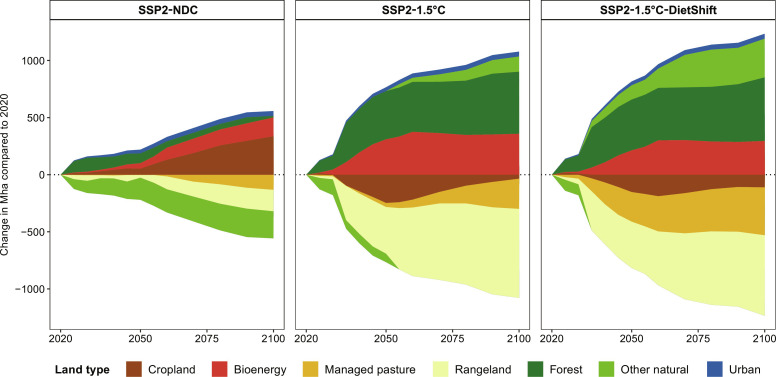
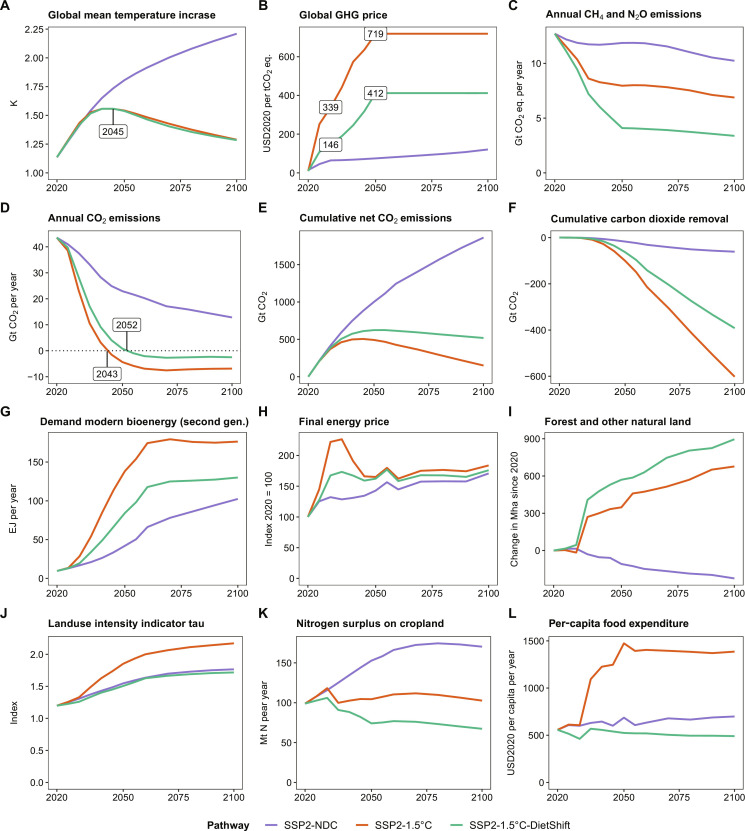
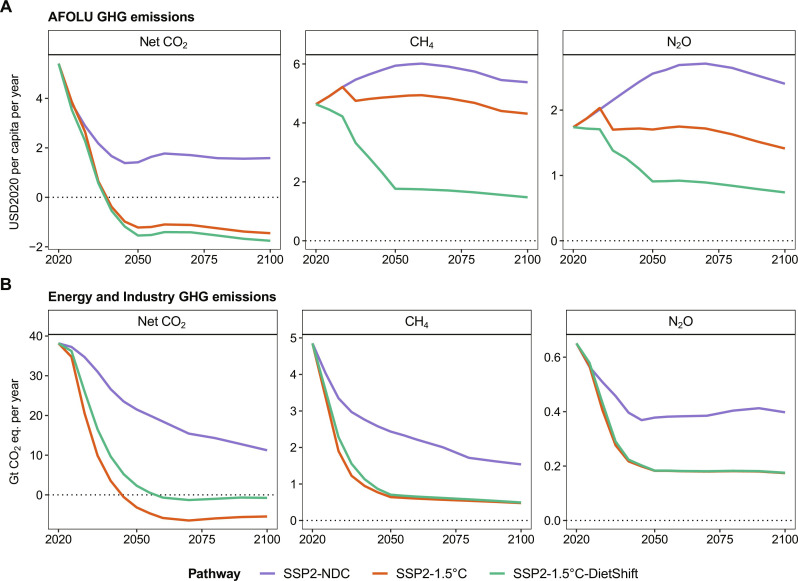
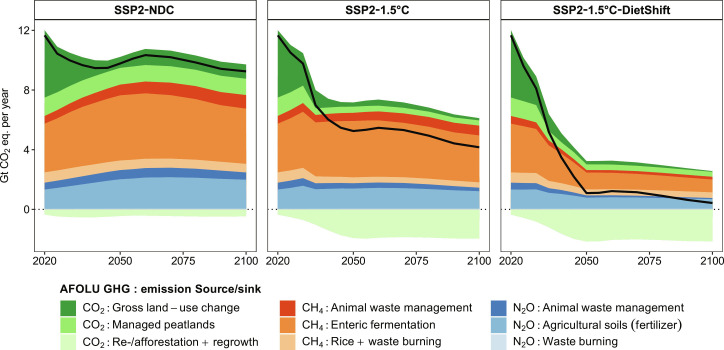
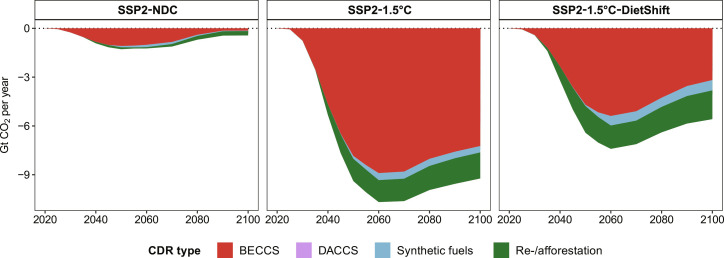
A transition to healthy diets such as the EAT-Lancet Planetary Health Diet could considerably reduce greenhouse gas (GHG) emissions. However, the specific contributions of dietary shifts for the feasibility of 1.5°C pathways remain unclear. Here, we use the open-source integrated assessment modeling (IAM) framework REMIND-MAgPIE to compare 1.5°C pathways with and without dietary shifts. We find that a flexitarian diet increases the feasibility of the Paris Agreement climate goals in different ways: The reduction of GHG emissions related to dietary shifts, especially methane from ruminant enteric fermentation, increases the 1.5°C compatible carbon budget. Therefore, dietary shifts allow to achieve the same climate outcome with less carbon dioxide removal (CDR) and less stringent CO emission reductions in the energy system, which reduces pressure on GHG prices, energy prices, and food expenditures.
向健康饮食过渡,例如采用 EAT-柳叶刀行星健康饮食,可大幅减少温室气体(GHG)排放。然而,饮食变化对 1.5°C 路径的可行性的具体贡献仍不清楚。在这里,我们使用开源综合评估模型(IAM)框架 REMIND-MAgPIE 来比较有和没有饮食变化的 1.5°C 路径。我们发现,杂食性饮食以不同方式提高了《巴黎协定》气候目标的可行性:与饮食变化相关的 GHG 排放减少,特别是反刍动物肠道发酵产生的甲烷,增加了 1.5°C 相容的碳预算。因此,饮食变化使得在能源系统中以更少的二氧化碳去除(CDR)和更宽松的 CO 减排就能实现相同的气候目标,从而降低 GHG 价格、能源价格和食品支出的压力。