The Alliance of Bioversity International and CIAT-Multifunctional Landscapes, Cali, Colombia.
The Alliance of Bioversity International and CIAT-Sustainable Finance, Cali, Colombia.
Sci Rep. 2022 Sep 5;12(1):15064. doi: 10.1038/s41598-022-18601-1.
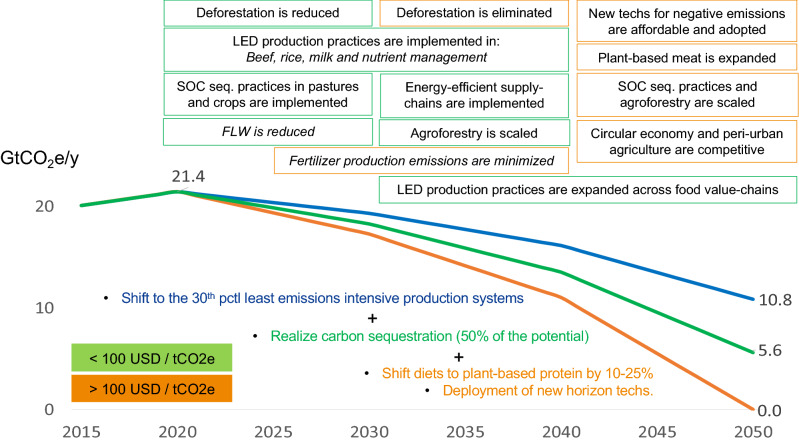
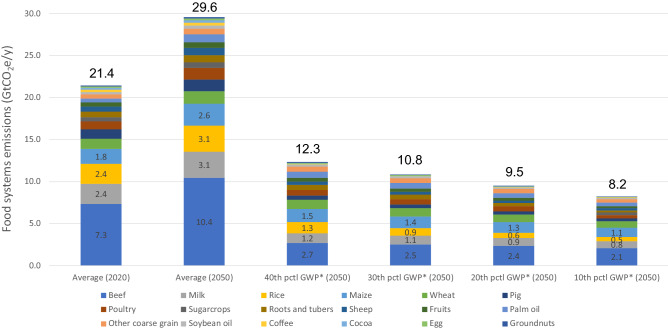
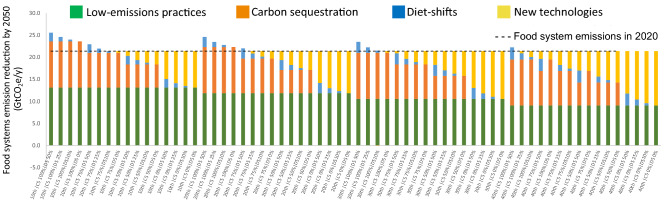
Food systems (FSs) emit ~ 20 GtCOe/y (~ 35% of global greenhouse gas emissions). This level tends to raise given the expected increases in food demands, which may threaten global climate targets. Through a rapid assessment, evaluating 60+ scenarios based on existing low-emission and carbon sequestration practices, we estimate that intensifying FSs could reduce its emissions from 21.4 to - 2.0 GtCOe/y and address increasing food demands without relying on carbon offsets (e.g., related to afforestation and reforestation programs). However, given historical trends and regional contexts, a more diverse portfolio of practices, including diet shifts and new-horizon technologies, will be needed to increase the feasibility of achieving net-zero FSs. One likely pathway consists of implementing practices that shift food production to the 30th-percentile of least emission-intensive FSs (~ 45% emissions reduction), sequester carbon at 50% of its potential (~ 5 GtCOe/y) and adopt diet shifts and new-horizon technologies (~ 6 GtCOe/y). For a successful transition to happen, the global FSs would, in the next decade (2020s), need to implement cost-effective mitigation practices and technologies, supported by improvements in countries' governance and technical assistance, innovative financial mechanisms and research focused on making affordable technologies in the following two decades (2030-2050). This work provides options and a vision to guide global FSs to achieving net-zero by 2050.
食物系统(FSs)排放约 20 亿吨二氧化碳当量/年(占全球温室气体排放的 35%)。考虑到预期的粮食需求增加,这一水平可能会威胁到全球气候目标。通过快速评估,我们评估了 60 多个基于现有低排放和碳固存实践的情景,估计加强 FSs 可以将其排放量从 21.4 减少到-2.0 亿吨二氧化碳当量/年,并在不依赖碳抵消(例如与造林和再造林计划相关的抵消)的情况下应对不断增长的粮食需求。然而,鉴于历史趋势和区域背景,需要更广泛的实践组合,包括饮食转变和新视野技术,以提高实现净零 FSs 的可行性。一条可能的途径是实施将粮食生产转移到排放强度最低的 FSs 的第 30 百分位的做法(减排约 45%),在其潜力的 50%(约 5 亿吨二氧化碳当量/年)封存碳,并采用饮食转变和新视野技术(减排约 6 亿吨二氧化碳当量/年)。为了成功实现向净零 FSs 的过渡,全球 FSs 在未来十年(2020 年代)需要实施具有成本效益的缓解实践和技术,同时得到各国治理和技术援助的改善、创新的金融机制和专注于在未来二十年(2030-2050 年)实现负担得起的技术的研究的支持。这项工作提供了选择和愿景,以指导全球 FSs 到 2050 年实现净零排放。