Department of Endocrinology, Yulin First People's Hospital, Sixth Affiliated Hospital of Guangxi Medical University, No.495, Education Middle Road, Yulin, 537000, Guangxi Zhuang Autonomous Region, China.
BMC Cardiovasc Disord. 2024 Mar 27;24(1):186. doi: 10.1186/s12872-024-03853-8.
The cardiometabolic index (CMI) is a new metric derived from the triglyceride-glucose index and body mass index and is considered a potential marker for cardiovascular risk assessment. This study aimed to examine the correlation between the CMI and the presence and severity of arteriosclerosis in patients with type 2 diabetes mellitus (T2DM).
This study involved 2243 patients with T2DM. The CMI was derived by dividing the triglyceride level (mmol/L) by the high-density lipoprotein level (mmol/L) and then multiplying the quotient by the waist-to-height ratio. Multivariate logistic regression was used to analyze the correlations between the CMI and BMI blood biomarkers, blood pressure, and brachial-ankle pulse wave velocity (baPWV).
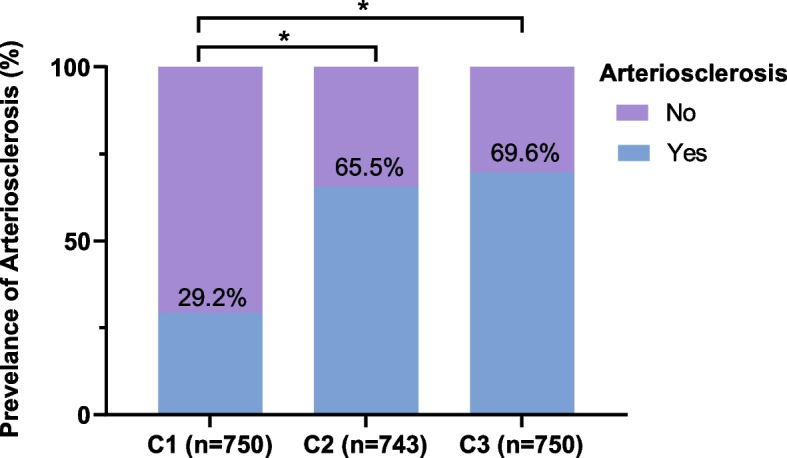
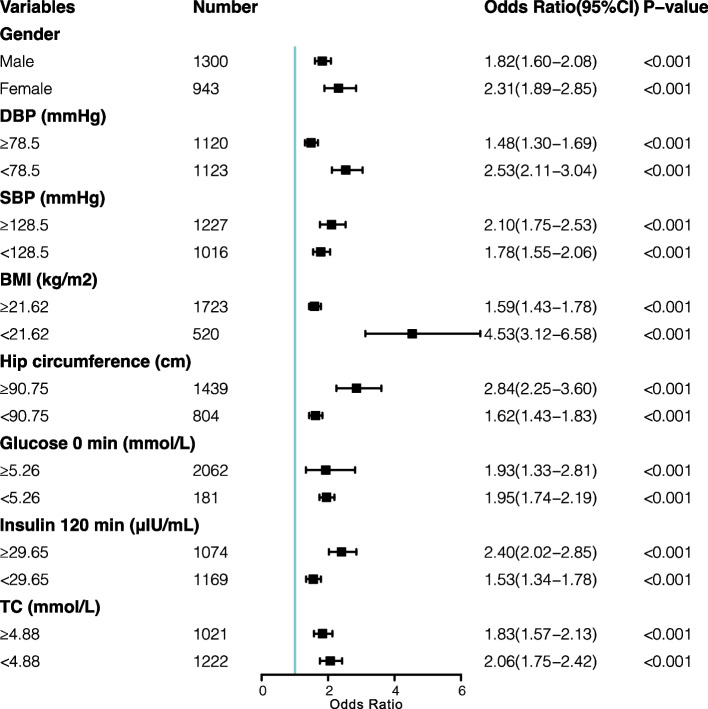
Patients were categorized into three groups based on their CMI: Group C1 (CMI < 0.775; n = 750), Group C2 (CMI: 0.775-1.355; n = 743), and Group C3 (CMI > 1.355; n = 750). Increased BMI, fasting glucose, insulin (at 120 min), total cholesterol (TC), and baPWV values were observed in Groups C2 and C3, with statistically significant trends (all trends P < 0.05). The CMI was positively correlated with systolic blood pressure (r = 0.74, P < 0.001). Multivariate analysis revealed that an increased CMI contributed to a greater risk for arteriosclerosis (OR = 1.87, 95%CI: 1.66-2.10, P < 0.001). Compared to the C1 group, the C2 group and C3 group had a greater risk of developing arteriosclerosis, with ORs of 4.55 (95%CI: 3.57-5.81, P<0.001) and 5.56 (95%CI: 4.32-7.17, P<0.001), respectively. The association was notably stronger in patients with a BMI below 21.62 kg/m² than in those with a BMI of 21.62 kg/m² or higher (OR = 4.53 vs. OR = 1.59).
These findings suggest that the CMI is a relevant and independent marker of arteriosclerosis in patients with T2DM and may be useful in the risk stratification and management of these patients.
代谢心血管风险指数(CMI)是一种新的指标,由甘油三酯-葡萄糖指数和体重指数衍生而来,被认为是心血管风险评估的潜在标志物。本研究旨在探讨代谢心血管风险指数与 2 型糖尿病(T2DM)患者动脉粥样硬化的发生和严重程度之间的相关性。
本研究纳入了 2243 例 T2DM 患者。CMI 通过将甘油三酯水平(mmol/L)除以高密度脂蛋白水平(mmol/L),然后将商乘以腰高比来计算。采用多变量逻辑回归分析 CMI 与 BMI 相关的生物标志物、血压和肱踝脉搏波速度(baPWV)之间的相关性。
根据 CMI 将患者分为三组:C1 组(CMI<0.775;n=750)、C2 组(CMI:0.775-1.355;n=743)和 C3 组(CMI>1.355;n=750)。C2 组和 C3 组的 BMI、空腹血糖、胰岛素(120 分钟)、总胆固醇(TC)和 baPWV 值升高,且呈统计学显著趋势(所有趋势 P<0.05)。CMI 与收缩压呈正相关(r=0.74,P<0.001)。多变量分析显示,CMI 升高与动脉粥样硬化风险增加相关(OR=1.87,95%CI:1.66-2.10,P<0.001)。与 C1 组相比,C2 组和 C3 组发生动脉粥样硬化的风险更高,OR 分别为 4.55(95%CI:3.57-5.81,P<0.001)和 5.56(95%CI:4.32-7.17,P<0.001)。在 BMI<21.62kg/m²的患者中,这种相关性明显强于 BMI≥21.62kg/m²的患者(OR=4.53 与 OR=1.59)。
这些发现表明,CMI 是 T2DM 患者动脉粥样硬化的一个相关且独立的标志物,可能有助于对这些患者进行风险分层和管理。