Salceda Rocío
Instituto de Fisiología Celular, Departamento de Neurodesarrollo y Fisiología, Universidad Nacional Autónoma de México, C.P. 04510, Mexico City 70-253, Mexico.
Antioxidants (Basel). 2024 Mar 18;13(3):362. doi: 10.3390/antiox13030362.
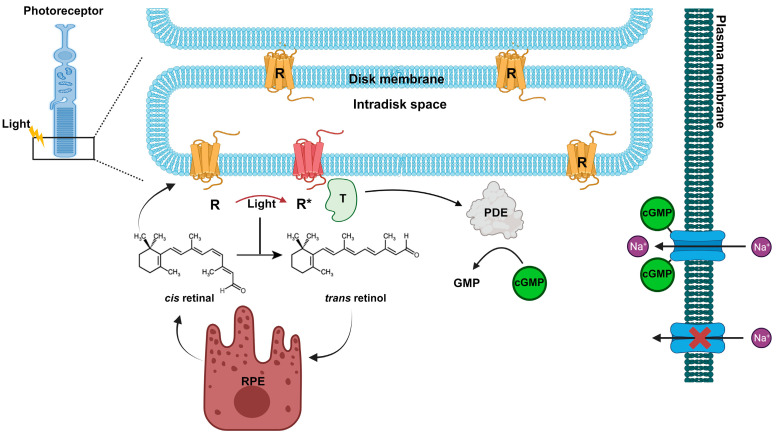
Visible light refers to the frequencies within the electromagnetic spectrum that humans can see, encompassing radiation with wavelengths falling between 380 nm to 760 nm. The energy of a single photon increases with its frequency. In the retina, photoreceptor cells contain light-sensitive pigments that absorb light and convert it into electrical stimuli through a process known as phototransduction. However, since the absorption spectrum of photoreceptors closely aligns with blue light (ranging from 400 to 500 nm), exposure to high light intensities or continuous illumination can result in oxidative stress within these cells, leading to a loss of their functionality. Apart from photoreceptor cells, the retina also houses photosensitive ganglion cells, known as intrinsically photosensitive retinal ganglion cells (ipRGCs). These cells relay information to the suprachiasmatic nucleus in the brain, playing a crucial role in modulating melatonin secretion, which in turn helps in synchronizing the body's circadian rhythms and responses to seasonal changes. Both, ipRGCs and skin possess a peak sensitivity to blue wavelengths, rendering them particularly susceptible to the effects of excessive blue light exposure. This study delves into the consequences of excessive illumination and/or prolonged exposure to blue light on retinal function and explores its implications for human health.
可见光指的是人类能够看到的电磁频谱内的频率范围,涵盖波长在380纳米至760纳米之间的辐射。单个光子的能量随其频率增加而增加。在视网膜中,光感受器细胞含有对光敏感的色素,这些色素吸收光并通过一个称为光转导的过程将其转化为电刺激。然而,由于光感受器的吸收光谱与蓝光(400至500纳米)紧密匹配,暴露于高强度光或持续光照会导致这些细胞内的氧化应激,从而导致其功能丧失。除了光感受器细胞外,视网膜中还存在光敏神经节细胞,即内在光敏性视网膜神经节细胞(ipRGCs)。这些细胞将信息传递至大脑中的视交叉上核,在调节褪黑素分泌方面发挥关键作用,进而有助于使身体的昼夜节律与对季节变化的反应同步。ipRGCs和皮肤对蓝光波长均具有峰值敏感性,这使得它们特别容易受到过度蓝光暴露的影响。本研究深入探讨了过度光照和/或长时间暴露于蓝光对视网膜功能的影响,并探究其对人类健康的意义。