Zhang Qingyou, Cai Yunzhang, Zhang Luping, Lu Mei, Yang Luyun, Wang Dekai, Jia Qiaojun
College of Life Sciences and Medicine, Zhejiang Sci-Tech University, Hangzhou, Zhejiang, China.
Key Laboratory of Plant Secondary Metabolism and Regulation of Zhejiang Province, Hangzhou, Zhejiang, China.
Front Microbiol. 2024 Mar 15;15:1347204. doi: 10.3389/fmicb.2024.1347204. eCollection 2024.
With the increasing demand for health products derived from Polygonati rhizoma (PR), people begin to artificially plant Hua () in the middle and lower reaches of the Yangtze River. To promote cultivation and increase farmers' income, efforts are needed to understand the ways to obtain high-quality PR under artificial cultivation conditions.
Rhizomes of artificial planting and rhizosphere soils were collected across five regions in Zhejiang Province, China. Subsequently, the contents of the main active ingredients of and soil properties were analyzed, and both rhizosphere and endophytic bacteria of were detected by 16S rDNA sequencing. The relationship between the active ingredients and soil properties, and the dominant bacteria were investigated by correlation analysis.
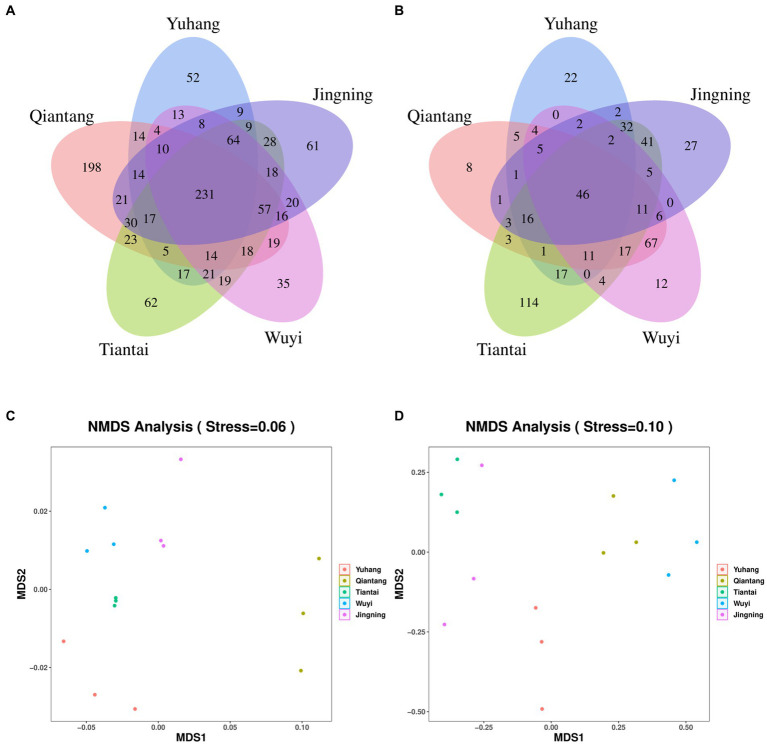
The content of active ingredients of from the five regions varied significantly, especially polysaccharides and saponins. High-throughput sequencing demonstrated that Proteobacteria was the dominant bacterial phylum in all samples, and was the main endophytic bacterial genus in rhizome. In addition, the bacterial diversity and richness of rhizosphere soil samples were higher than those of rhizome samples. Soil physicochemical properties and enzyme activities were significantly different across regions, leading to notable variations in the community structures of rhizosphere and endophytic bacteria. Redundancy analysis (RDA) displayed that pH and urease (UE) were the major factors altering shifting rhizosphere bacteria community structure. Moreover, the composition and diversity of rhizome endophytic bacteria were principally affected by both soil physicochemical properties and soil enzyme activities. Soil properties and bacteria from rhizosphere soil and rhizome had a considerable impact on certain active ingredients in under artificial cultivation conditions after Pearson correlation analysis. Polysaccharides were significantly correlated with nutrient-rich soil and endophytic bacteria, such as , , , and . However, flavonoids were associated with nutrient-poor soil. Saponins were positively correlated with OM and available phosphorous (AP) and were significantly negatively affected by rhizosphere bacterial communities.
The study demonstrated that bacterial microorganisms were involved in the accumulation of active ingredients of together with soil physicochemical properties and enzyme activities, which provided a theoretical basis for the scientific and effective artificial cultivation of high-quality .
随着对黄精衍生保健品需求的增加,人们开始在长江中下游地区人工种植黄精。为了促进其种植并增加农民收入,需要努力了解在人工栽培条件下获得高品质黄精的方法。
在中国浙江省的五个地区采集人工种植黄精的根茎和根际土壤。随后,分析黄精主要活性成分的含量和土壤性质,并通过16S rDNA测序检测黄精的根际和内生细菌。通过相关性分析研究活性成分与土壤性质以及优势细菌之间的关系。
五个地区黄精活性成分的含量差异显著,尤其是多糖和皂苷。高通量测序表明,变形菌门是所有样本中的优势细菌门,芽孢杆菌属是根茎中的主要内生细菌属。此外,根际土壤样本的细菌多样性和丰富度高于根茎样本。不同地区的土壤理化性质和酶活性存在显著差异,导致根际和内生细菌的群落结构出现明显变化。冗余分析(RDA)显示,pH值和脲酶(UE)是改变根际细菌群落结构的主要因素。此外,根茎内生细菌的组成和多样性主要受土壤理化性质和土壤酶活性的影响。经过Pearson相关性分析,在人工栽培条件下,土壤性质以及根际土壤和根茎中的细菌对黄精中的某些活性成分有相当大的影响。多糖与富营养土壤和内生细菌(如芽孢杆菌属、假单胞菌属、伯克氏菌属和贪铜菌属)显著相关。然而,黄酮类化合物与贫营养土壤有关。皂苷与有机质和有效磷(AP)呈正相关,并受到根际细菌群落的显著负面影响。
该研究表明,细菌微生物与土壤理化性质和酶活性共同参与了黄精活性成分的积累,这为科学有效地人工种植高品质黄精提供了理论依据。