Institute of Environmental and Occupational Health Sciences, National Taiwan University College of Public Health, No. 17 Xuzhou Road, Zhongzheng Dist., Taipei, Taiwan.
Scand J Work Environ Health. 2024 Jul 1;50(5):380-388. doi: 10.5271/sjweh.4159. Epub 2024 Apr 3.
We aimed to evaluate the association between long working hours, night work, and estimated glomerular filtration rate (eGFR) among young healthcare workers.
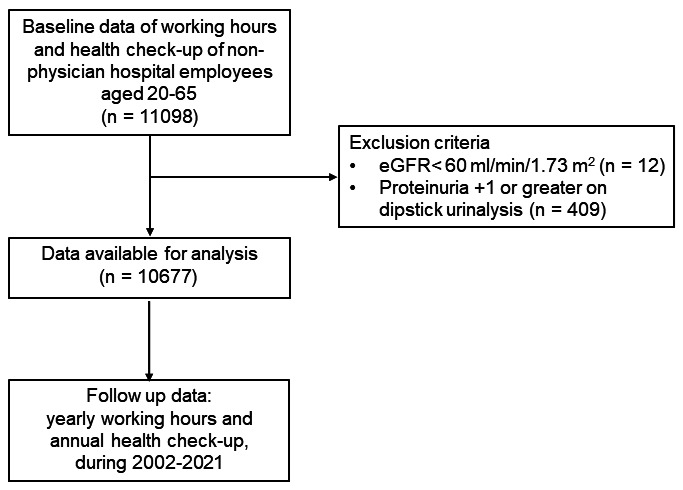
We conducted a retrospective cohort study among healthcare workers in a tertiary medical center in Taiwan from 2002 to 2021. Other than physicians, all hospital employees aged 20-65 years with documented yearly working hours and an annual blood test including creatinine were eligible. We excluded participants with eGFR <60 ml/min/1.73 m and proteinuria at enrollment to focus on early renal impairment. Total working hours, night working hours, and eGFR in each year were collected. We assessed the relationship of total working hours and night and non-night working hours with eGFR using the generalized linear mixed model, adjusting for demographic, comorbidities, and laboratory profiles.
The study included 10 677 participants with a mean age of 27.2 (standard deviation 7.1) years. The mean follow-up duration was 6.2 years. For every 10-hour increase in total weekly working hours, the eGFR decreased by 0.86 [95% confidence interval (CI) 0.61-1.11] ml/min/1.73 m. For every 10-hour increase in weekly night working hours, the eGFR decreased by 0.25 (95% CI 0.07-0.42) ml/min/1.73 m. In stratified analysis, the negative associations between total working hours and eGFR remained in the subgroups of individuals aged <40 years and those without hypertension or diabetes, with a P-value for interaction of <0.05.
Longer working hours and night work were associated with lower eGFR among healthcare workers.
评估长工时、夜班与年轻医护人员估算肾小球滤过率(eGFR)之间的关系。
我们对台湾一家三级医疗中心的医护人员进行了一项回顾性队列研究。该研究纳入了 2002 年至 2021 年间年龄在 20-65 岁之间、每年工作时间有记录且每年有包括肌酐在内的血液检查结果的除医生外的所有医院员工。我们排除了 eGFR<60 ml/min/1.73 m 和入组时蛋白尿的参与者,以关注早期肾功能损害。收集了每年的总工作时间、夜班工作时间和 eGFR。我们使用广义线性混合模型评估了总工作时间和夜班及非夜班工作时间与 eGFR 的关系,调整了人口统计学、合并症和实验室特征。
该研究纳入了 10677 名参与者,平均年龄为 27.2(标准差为 7.1)岁,平均随访时间为 6.2 年。每周总工作时间每增加 10 小时,eGFR 降低 0.86(95%可信区间 0.61-1.11)ml/min/1.73 m。每周夜班工作时间每增加 10 小时,eGFR 降低 0.25(95%可信区间 0.07-0.42)ml/min/1.73 m。在分层分析中,在年龄<40 岁和无高血压或糖尿病的亚组中,总工作时间与 eGFR 之间的负相关关系仍然存在,交互 P 值<0.05。
工作时间较长和夜班与医护人员的 eGFR 降低有关。