Nuffield Department of Orthopaedics, Rheumatology and Musculoskeletal Sciences, University of Oxford, Oxford, United Kingdom.
Michael G. DeGroote School of Medicine, McMaster University, Hamilton, Ontario, Canada.
PLoS One. 2024 Apr 16;19(4):e0301922. doi: 10.1371/journal.pone.0301922. eCollection 2024.
Use CFIR guidance to create comprehensive, evidence-based, feasible, and acceptable gender-affirming care PROM implementation strategies.
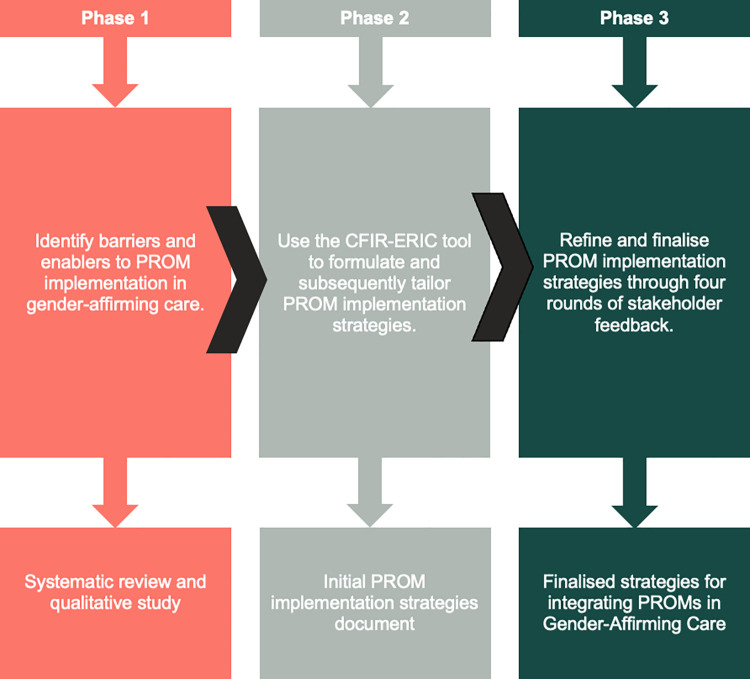
DESIGN, SETTING, PARTICIPANTS: A 3-Phase participatory process was followed to design feasible and acceptable strategies for integrating PROMs in gender-affirming care. In Phase 1, barriers and enablers to PROM implementation for gender-affirming care were identified from a previous systematic review and our prior qualitative study. We used the CFIR-ERIC tool to match previously identified barriers and enablers with expert-endorsed implementation strategies. In Phase 2, implementation strategy outputs from CFIR-ERIC were organised according to cumulative percentage value. In Phase 3, gender-affirming care PROM implementation strategies underwent iterative refinement based on rounds of stakeholder feedback with seven patient and public partners and a gender-affirming healthcare professional.
The systematic review and qualitative study identified barriers and enablers to PROM implementation spanning all five CFIR domains, and 30 CFIR constructs. The top healthcare professional-relevant strategies to PROM implementation from the CFIR-ERIC output include: identifying and preparing implementation champions, collecting feedback on PROM implementation, and capturing and sharing local knowledge between clinics on implementation. Top patient-relevant strategies include: having educational material on PROMs, ensuring adaptability of PROMs, and collaborating with key local organisations who may be able to support patients.
This study developed evidence-based, feasible, and acceptable strategies for integrating PROMs in gender-affirming care, representing evidence from a systematic review of 286 international articles, a qualitative study of 24 gender-affirming care patients and healthcare professionals, and iteration from 7 patient and public partners and a gender-affirming healthcare professional. The finalised strategies include patient- and healthcare professional-relevant strategies for implementing PROMs in gender-affirming care. Clinicians and researchers can select and tailor implementation strategies best applying to their gender-affirming care setting.
利用 CFIR 指导原则制定全面、基于证据、可行且可接受的性别肯定护理 PROM 实施策略。
设计、设置、参与者:遵循三阶段参与式过程设计将 PROM 纳入性别肯定护理的可行且可接受策略。在第 1 阶段,从先前的系统评价和我们先前的定性研究中确定了 PROM 实施用于性别肯定护理的障碍和促进因素。我们使用 CFIR-ERIC 工具将先前确定的障碍和促进因素与专家认可的实施策略相匹配。在第 2 阶段,根据 CFIR-ERIC 的实施策略输出按累计百分比值进行组织。在第 3 阶段,根据与七位患者和公众合作伙伴以及一位性别肯定医疗保健专业人员进行的几轮利益相关者反馈,对性别肯定护理 PROM 实施策略进行了迭代完善。
系统评价和定性研究确定了跨越所有五个 CFIR 领域和 30 个 CFIR 结构的 PROM 实施障碍和促进因素。CFIR-ERIC 输出中与医疗保健专业人员相关的实施 PROM 的顶级策略包括:确定和准备实施冠军、收集 PROM 实施反馈、以及在诊所之间捕获和共享有关实施的本地知识。与患者相关的顶级策略包括:提供有关 PROM 的教育材料、确保 PROM 的适应性、以及与可能能够支持患者的关键本地组织合作。
本研究制定了将 PROM 纳入性别肯定护理的基于证据、可行且可接受的策略,代表了对 286 篇国际文章的系统评价、24 名性别肯定护理患者和医疗保健专业人员的定性研究以及 7 名患者和公众合作伙伴以及一名性别肯定医疗保健专业人员的迭代的证据。最终确定的策略包括患者和医疗保健专业人员在性别肯定护理中实施 PROM 的相关策略。临床医生和研究人员可以选择和调整最适合其性别肯定护理环境的实施策略。