Li Yuan, Wu Xinyu, Liu Min, Deng Ke, Tullini Annamaria, Zhang Xiao, Shi Junyu, Lai Hongchang, Tonetti Maurizio S
Department of Oral and Maxillofacial Implantology, Shanghai PerioImplant Innovation Center, Shanghai Ninth People's Hospital, Shanghai Jiao Tong University School of Medicine, Shanghai, China.
College of Stomatology, Shanghai Jiao Tong University, Shanghai, China.
J Clin Periodontol. 2024 Dec;51(12):1632-1643. doi: 10.1111/jcpe.13987. Epub 2024 Apr 17.
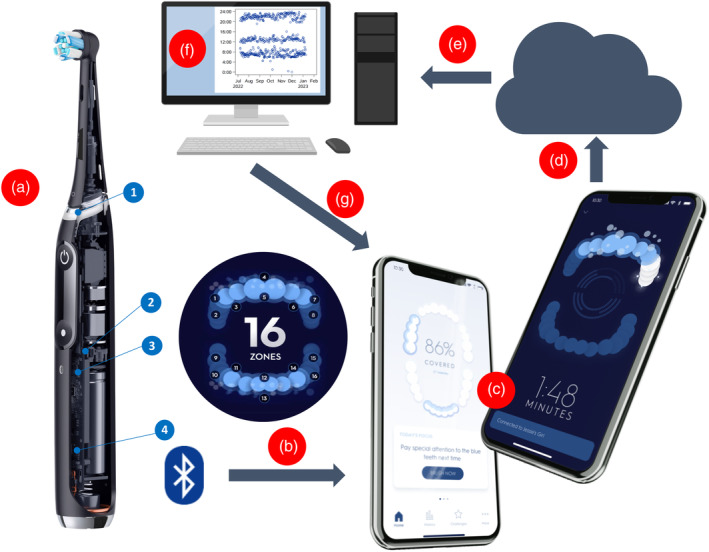
Treatment of periodontitis, a chronic inflammatory disease driven by biofilm dysbiosis, remains challenging due to patients' poor performance and adherence to the necessary oral hygiene procedures. Novel, artificial intelligence-enabled multimodal-sensing toothbrushes (AI-MST) can guide patients' oral hygiene practices in real-time and transmit valuable data to clinicians, thus enabling effective remote monitoring and guidance. The aim of this trial was to assess the effect of such a system as an adjunct to clinical practice guideline-conform treatment.
This was a single-centre, double-blind, standard-of-care controlled, randomized, parallel-group, superiority trial. Male and female adults with generalized Stage II/III periodontitis were recruited at the Shanghai Ninth People's Hospital, China. Subjects received a standard-of-care oral hygiene regimen or a technology-enabled, theory-based digital intervention consisting of an AI-MST and targeted doctor's guidance by remote micromessaging. Additionally, both groups received guideline-conform periodontal treatment. The primary outcome was the resolution of inflamed periodontal pockets (≥4 mm with bleeding on probing) at 6 months. The intention-to-treat (ITT) analysis included all subjects who received the allocated treatment and at least one follow-up.
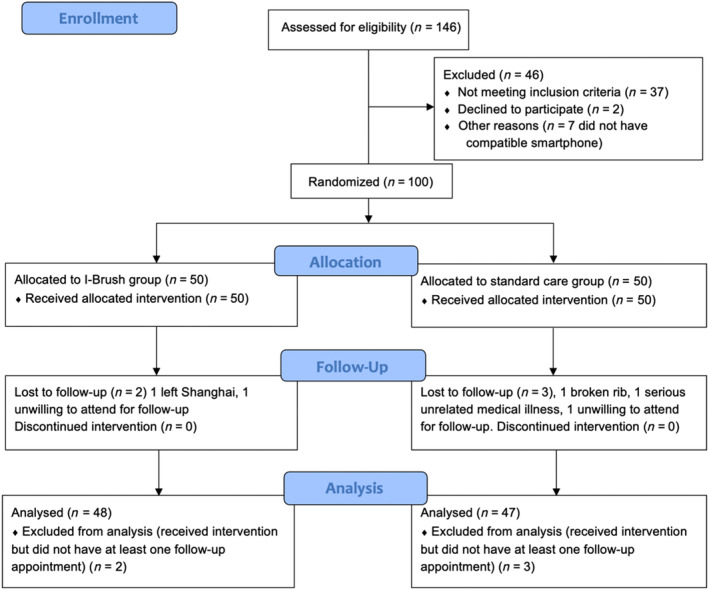
One hundred patients were randomized and treated (50 tests/controls) between 1 February and 30 November 2022. Forty-eight tests (19 females) and 47 controls (16 females) were analysed in the ITT population. At 6 months, the proportion of inflamed periodontal pockets decreased from 80.7% (95% confidence interval [CI] 76.5-84.8) to 52.3% (47.7-57.0) in the control group, and from 81.4% (77.1-85.6) to 44.4% (39.9-48.9) in the test group. The inter-group difference was 7.9% (1.6-14.6, p < .05). Test subjects achieved better levels of oral hygiene (p < .001). No significant adverse events were observed.
The tested digital health intervention significantly improved the outcome of periodontal therapy by enhancing the adherence and performance of self-performed oral hygiene. The model breaks the traditional model of oral health care and has the potential to improve efficiency and reduce costs (NCT05137392).
牙周炎是一种由生物膜生态失调驱动的慢性炎症性疾病,由于患者在必要的口腔卫生程序方面表现不佳且依从性差,其治疗仍然具有挑战性。新型的、具备人工智能的多模式传感牙刷(AI-MST)可以实时指导患者的口腔卫生习惯,并将有价值的数据传输给临床医生,从而实现有效的远程监测和指导。本试验的目的是评估这样一种系统作为临床实践指南相符治疗辅助手段的效果。
这是一项单中心、双盲、标准治疗对照、随机、平行组、优效性试验。在中国上海第九人民医院招募患有广泛性II/III期牙周炎的成年男女。受试者接受标准的口腔卫生方案或基于技术、理论的数字干预,该干预包括一支AI-MST以及通过远程微信息进行的针对性医生指导。此外,两组均接受符合指南的牙周治疗。主要结局是6个月时炎症性牙周袋(探诊出血且深度≥4毫米)的消退情况。意向性分析(ITT)包括所有接受分配治疗并至少进行一次随访的受试者。
2022年2月1日至11月30日期间,100名患者被随机分组并接受治疗(50例试验组/对照组)。在ITT人群中分析了48例试验组(19名女性)和47例对照组(16名女性)。6个月时,对照组中炎症性牙周袋的比例从80.7%(95%置信区间[CI]76.5 - 84.8)降至52.3%(47.7 - 57.0),试验组从81.4%(77.1 - 85.6)降至44.4%(39.9 - 48.9)。组间差异为7.9%(1.6 - 14.6,p < 0.05)。试验组受试者的口腔卫生水平更高(p < 0.001)。未观察到显著不良事件。
所测试的数字健康干预通过提高自我口腔卫生的依从性和表现,显著改善了牙周治疗的效果。该模式打破了传统口腔保健模式,具有提高效率和降低成本的潜力(NCT05137392)。